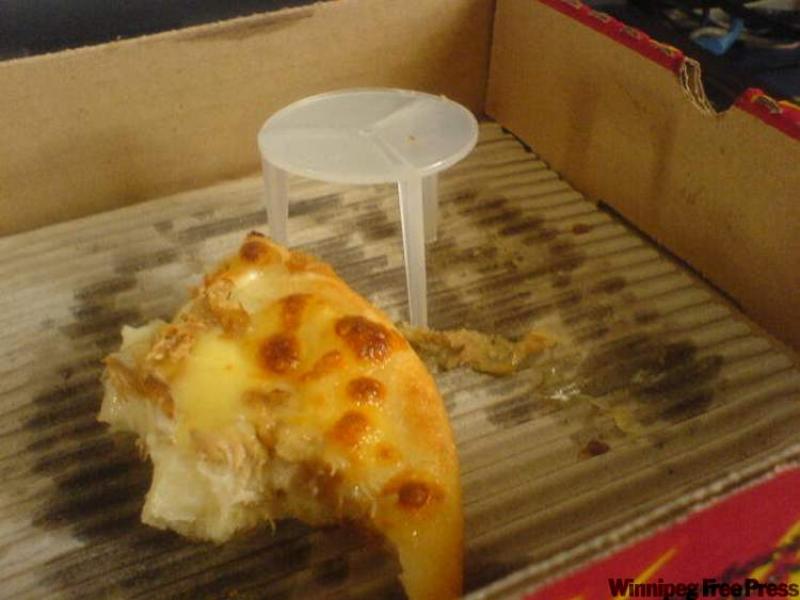
QUESTION: Being a bachlorette, I have several pizza restaurants on speed dial and when the pizza arrives it often has a little plastic white table looking item in the centre of the pizza. Do you have any ideas as to how I can reuse these little pieces of plastic instead of throwing them out?
ANSWER: I know exactly what you are talking about. Reuse them to keep plastic wrap off a frosted cake or similar food item if you're bringing it somewhere for a party and don't want to transport a reusable food storage tub. Or use them for flower arranging, when using florist's oasis (oasis is the green foamy stuff they use). Stick it to the bottom of your container and it will stop the oasis from slipping. Florists often sell these items for this use.
Many people assume pizza boxes are recyclable because they are made from corrugated cardboard. However, what makes parts of them non-recyclable is what comes inside them, specifically, the grease and cheese from pizza. Food is one of the worst contaminants in the paper recycling process. Grease from pizza boxes causes oil to form at the top of the slurry, and paper fibres cannot separate from oils during the pulping process. Essentially, this contaminant causes the entire batch to be ruined. The easiest remedy for this problem is to cut or tear out the soiled portions of your pizza boxes and garbage them.
QUESTION: I have a dehumidifier in my basement that needs emptying every day during summer months. I'm wondering if this water is good for anything such as watering plants.
ANSWER: Dehumidifier water should not be used as drinking water because it is classified as grey water that may contain traces of lead and other dangerous elements. However, there are a few interesting uses for dehumidifier water. Yes, you can use it to water the plants in your home and garden. Do not use this water on plants grown for consumption because of the risk of harmful contaminants. You can also use dehumidifier water to save on your water bill by pouring the water into your toilet tank until it is full after each flush.
QUESTION: Love your column in the Winnipeg Free Press and your book series. I was recently married and now live in a small home in the east end of Winnipeg. It is my goal to recycle but I am not clear on what is considered recyclable. Can you provide me with a list of items that may be recycled?
-- Newly Wed and Clueless
ANSWER: Congratulations and good for you that you are taking steps to reduce your ecological footprint. The following is a list of what can be recycled: Newspapers, aluminium food and drink containers, glass food and beverage containers, steel food and beverage containers, PET (#1 plastic) bottle, telephone books, magazines and catalogues, boxboard, juice boxes, gable top beverage containers, HDPE (#2 plastic) containers, #4, #5 and #7 plastics (Gee, can they make this number system more complicated please?). For more information about recycling in Manitoba contact: greenmanitoba.ca
QUESTION: Please tell me whether or not I can recycle food containers such as Kraft Dinner boxes and empty waffle boxes. They do have a recycling symbol on them which says 'Made from 100 per cent recyclable material'. Does that mean they were recycled previously or does that mean they can be recycled?
-- Thomas (Foxwarren, Man.)
ANSWER: If cardboard has a recycling symbol on it; add it to your blue box. Most cardboard can be recycled several times before the fibres become too weak to manufacture into a new product. Therefore, it is a good idea to recycle all of the cardboard items in your home that carry a recycling logo.
A good rule of thumb is to recycle according to the list above. Plastic grocery bags cannot be recycled but they can be reused over and over again. If you have an abundance of plastic bags in your home, donate them to a second-hand store instead of throwing them into the garbage.
QUESTION: One of your previous columns suggests switching to white vinegar to reduce static cling. I am not having much luck with dryer balls. I have two very hairy dogs; try as I might to clean off the hair from clothes before they go in the washing machine, some ends up in the dryer. Fabric softener sheets still seem to work the best to get hair off the items, and onto the filter, but I would like to try an alternative. So, my question is, how do you put the vinegar in the dryer, or is it added to the wash rinse? I look forward to hearing from you. I enjoy your column very much and have received many useful tips.
-- Candice (Thompson, Man.)
ANSWER: Add a half cup ofbwhite vinegar to your wash load (not the dryer). Your clothes will not smell of vinegar and you will save yourself a pile of money as vinegar is cheap. Fabric softener sheets and liquid fabric softener do a wonderful job in clogging up the hoses in your washing machine. Vinegar, on the other hand, works to clean out your washing machine hoses and leaves everything fresh and static free. But don't get your hopes too high. Let's face it, as long as you have pets you will be in a constant fur battle. But another great tip is to lightly sponge your clothes with water before putting them into the washing machine. This helps to remove some of the fur. If you are desperate, purchase clothes that match the colour of your dog. This will make pet hair much less obvious. Lastly, be sure to empty your lint trap after each use.
Fabulous Thanksgiving Tips:
-- Loosen the skin of a turkey without damaging the skin. Poke the end of a small spoon between the breast meat and skin, starting at the open cavity of the turkey. Move the spoon over the breast to separate the skin from the meat; take care not to rip the skin. Do this on both sides of the breastbone. Place a spoonful of herbs, butter and spices under the skin, and press it out to distribute it evenly over the breast.
-- Cornucopias are a traditional Thanksgiving decoration and make a great centrepiece. Fill them with small fruits, nuts and berries and have the contents spill decoratively onto the table.
-- When stuffing your turkey, mix ingredients just before stuffing it; stuff loosely. Additional time is required for the turkey and stuffing to reach a safe minimum internal temperature. For safety and doneness, the internal temperature should be checked with a food thermometer. The temperature of the turkey and the centre of the stuffing must reach a safe minimum internal temperature of 165 �F. Check the temperature in the innermost part of the thigh and wing and the thickest part of the breast. Let the turkey stand for 20 minutes before removing stuffing and carving.
I enjoy your questions and tips. Keep them coming.
Reena Nerbas is the author of the national bestselling Household Solutions series. Her website is www.householdsolutions.org. You can contact her at Box 429, Blumenort, Man., ROA 0C0.