"Holy cow! I think it’s a monarch," Barbara Downs says as an orange-and-black butterfly flicks across her mature garden in the Georgetown neighbourhood of Washington, D.C. "We have lots of swallowtails, but I think it’s a monarch."
The excitement of this experienced gardener is clear. Little by little, for nine years, she has been adding native plants to be ecologically responsible and to attract birds and butterflies that have lost much of their habitat through pesticide use.
Downs is not alone in her effort to plant more natives. "People used to say, ‘What’s a native?’" says Kirsten Johnson, president of the Maryland Native Plant Society. Founded in 1992, its membership has increased dramatically since then as gardeners of all stripes have championed plants native to their regions.
"We used to be happy if eight people showed up for our field trips," Johnson says. "In the last five years, we’ve had to limit the numbers on our 50 trips. They often fill up within 24 hours."
Now, she says, most gardeners not only know what a native is, but they also know that deer, development and invasive species are the three major threats to them.
Downs, an artist and community volunteer, is a case in point. In 1988, when she moved to her current townhouse, she asked a former neighbour and landscape architect, the late Jim van Sweden, to design her front and back gardens.
"I was impressed that his gardens needed no pesticides," she says. His Washington-based firm, Oehme, van Sweden & Associates, pioneered the forward-thinking New American Garden style, which champions four seasons of garden interest. The firm eschews lawns in favour of swaths of perennials and grasses. When Downs’ gardens were installed in 1992, the New American Garden look was at the cutting edge of design.
Originally, the gardens received plenty of sun and included several natives, including leatherleaf viburnum, bottlebrush grass and oakleaf hydrangea bushes. The beds in front remain sunny, and Downs has replaced a Chinese witch hazel with a native witch hazel that shows persimmon-edged leaves before they drop. To this mature, streetside area, she has added the deciduous shrub summersweet: fragrant in bloom, attractive to butterflies and golden in its fall foliage.
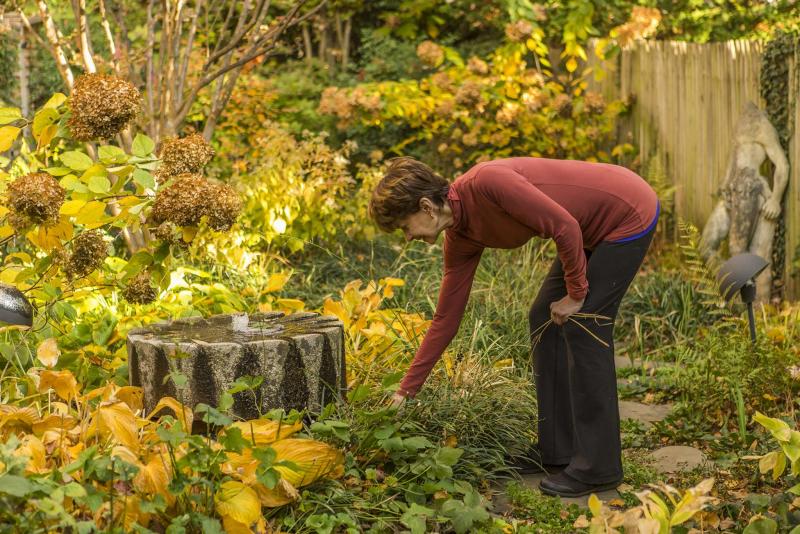
In the long, 1,600-square-foot garden behind her den, two neighbouring trees gradually turned the area shady. Downs used the changing condition to introduce native plants and trees. "They make everything so much more interesting," she says. With them, she has gained a new plant palette, and those plants have added texture to her layered and painterly garden.
"Native plants increase the food chain and the web of life," Johnson explains. "People love to see the butterflies (they attract), and birds feed on their caterpillars."
For a decade, Downs has used Sheila Brady, vice-president of Oehme, van Sweden & Associates, as her landscape architect. Brady was the lead designer of the Native Plant Garden at the New York Botanical Garden, which opened in 2013. Brady says she and Downs are passionate about including natives, "and we understand that by doing so, we simultaneously support wildlife and biodiversity. We wanted to select the right plant that fits contextually, ecologically and esthetically."
Shade-tolerant natives now punctuate a long, curvilinear stone path, whose year-round focal points include classical sculpture and a bubbling, millstone-shaped pink-granite fountain. These undulating borders include American ginger, foamflower, coral bells and various ferns, as well as marginal shield fern and Christmas fern, both evergreen for winter interest in this city garden.
"I’m trying to replace the Liriope with Iris cristata (dwarf crested iris) as an edging plant," Downs says, "also Carex plantaginea (seersucker sedge), both great textural plants."
Another tree event is bringing further opportunity. The neighbours’ towering Southern magnolia recently came down, so sun-loving natives are a new option for Downs. Topping her list are the Virginia bluebells she admires at the nearby Volta Park, where she and her Georgetown Garden Club have been involved and which sports natives such as inkberry, bloodroot, coneflower and false indigo.
When contemplating future natives for Downs, Brady says, "As we add plants over the years, we will be careful to maintain the sense of mystery in the garden — when you look out the window or wander along the steppingstone path, it’s not clear what’s beyond the fountain; boundaries are blurred."
— Washington Post