Since about the third week in June, I have been receiving a number of calls and email messages from property owners who are complaining about aphids in their mature green ash trees and, to a much lesser extent, Manchurian ash trees as well. What's going on?
Aphids can attack just about every plant we have on the Prairies, but I haven't heard so many complaints about the mess they are making of green ash leaves before this summer. Green ash has been singled out this year. I had to see the effects of their feeding first-hand. Virtually the entire tree is engulfed with the feeding frenzy of thousands of aphids. Once aphid numbers are high and they have begun to distort and curl leaves, it is often hard to control them, because the curled leaves shelter aphids from treatment or natural enemies. The leaf curl is caused by the loss of sap near the edges of the leaves. The leaf grows more slowly at the edge while the inner area of the leaf continues to grow at the normal rate. This causes leaf distortion. Many aphid species in our area prefer the undersides of leaves; be sure to turn leaves over to check them.
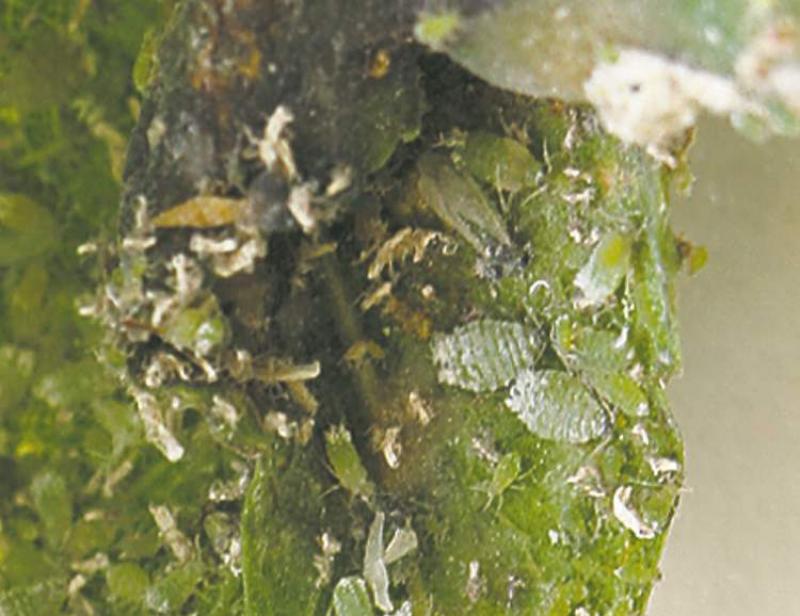
When aphids moult, they cast off their skins, which look like small white flakes or particles. The leaf image shows many plump, healthy green aphids, along with the irregular white skins on a green ash leaflet.
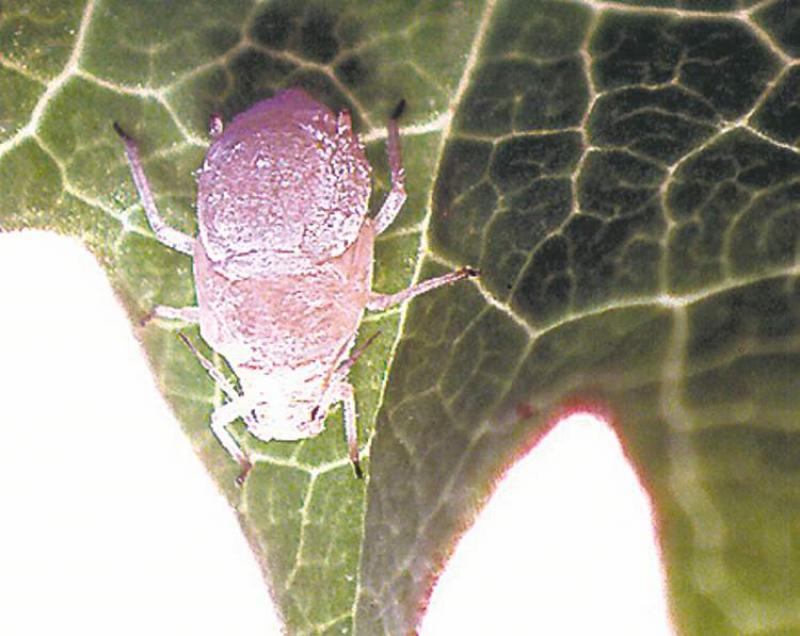
Most aphids have a pair of tube-like structures called cornicles projecting backwards out of the hind end of their bodies. These are shown on the large image of a typical aphid. The presence of cornicles distinguishes aphids from all other insects. These structures are used to exude honeydew and wax. These are waste excretions from their bodies.
Many species of aphids cause the greatest damage when night temperatures are cool and day temperatures are much warmer. In southern Manitoba, that describes the earlier part of our late May and early June season.
There is a well-known relationship between ants and aphids. An increase in aphids is followed by an increase in ants. Ants "look after" aphids and feed on the honeydew aphids excrete. If you see ants crawling up aphid-infested trees or woody plants, place a Tanglefoot sticky band around the trunk to prevent ants from getting up. Ants also protect the aphids from natural enemies.
I believe the natural enemies of aphids, such as ladybugs, parasitic wasps and lacewing insects, are being destroyed by pesticides such as malathion. Avoid spraying chemical pesticides to control aphids, as you will kill many favourable insects that feed on aphids. I suspect heavy use of these pesticides in certain situations has allowed aphid populations to grow almost out of control.
At the first sign of aphids, hose down your shrubs with water. A Bug Blaster sold by Lee Valley Tools works well in removing aphids from the undersides of leaves. Leaves, twigs and branches of infested trees can be washed down carefully with a pressure washer using water only.
Overwintering aphid eggs can be controlled in April only by spraying dormant oil to smother the breathing pores in aphid eggs. If you would like more information on aphids, please contact the writer.
Michael Allen, MScF, RPF, is a consulting urban forester and certified arborist. He owns Viburnum Tree Experts, a Manitoba company that provides objective assessments of the condition and the care required for trees and shrubs on home and business landscapes. He can be reached at 204-831-6503 or viburnumtrees@shaw.ca. His website is www.treeexperts.mb.ca