Photos by Marc LaBossiere / Free Press
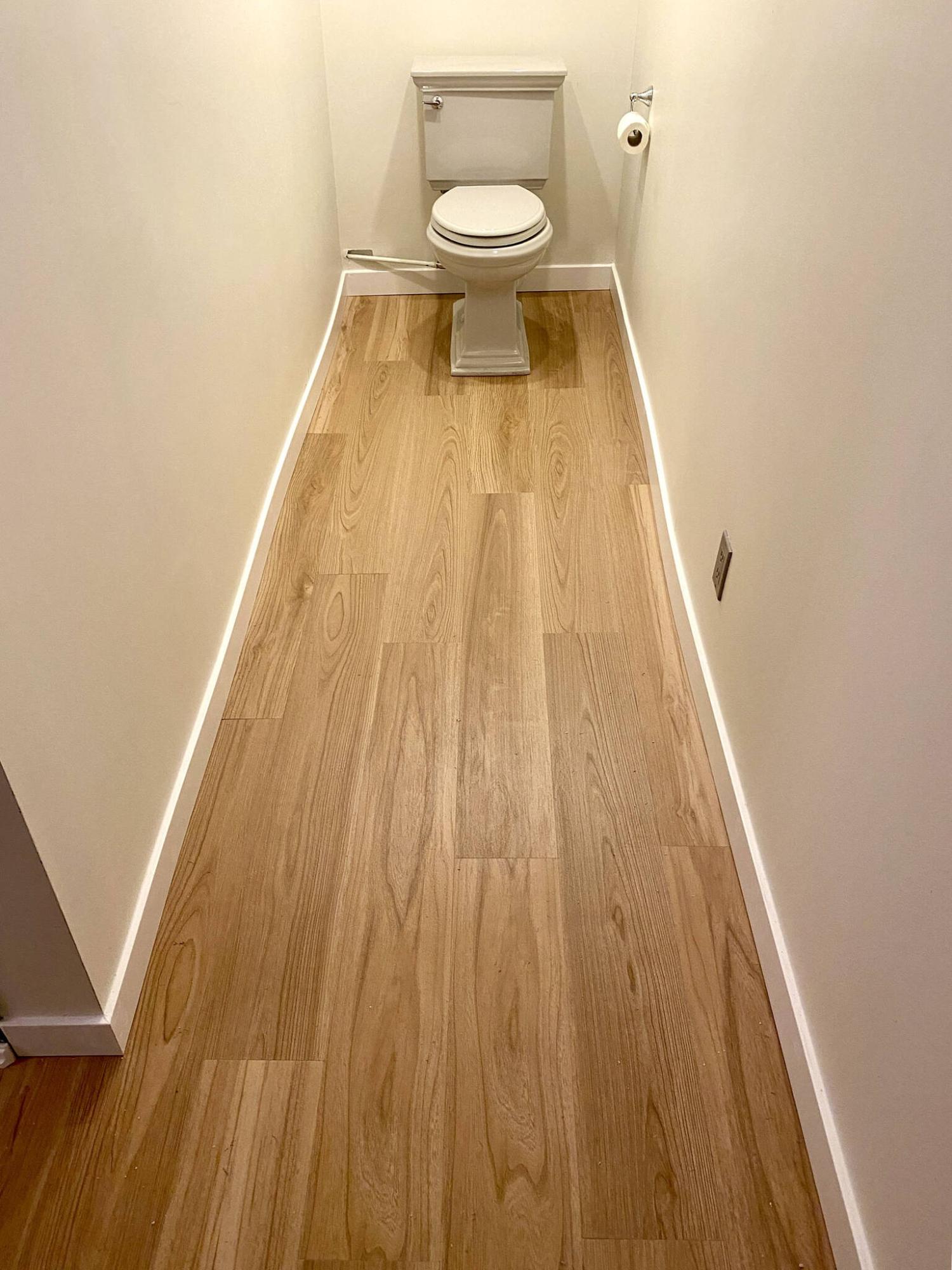
A long, narrow stretch toward the toilet feels like walking down a bowling lane.
Marc LaBossiere / Free Press
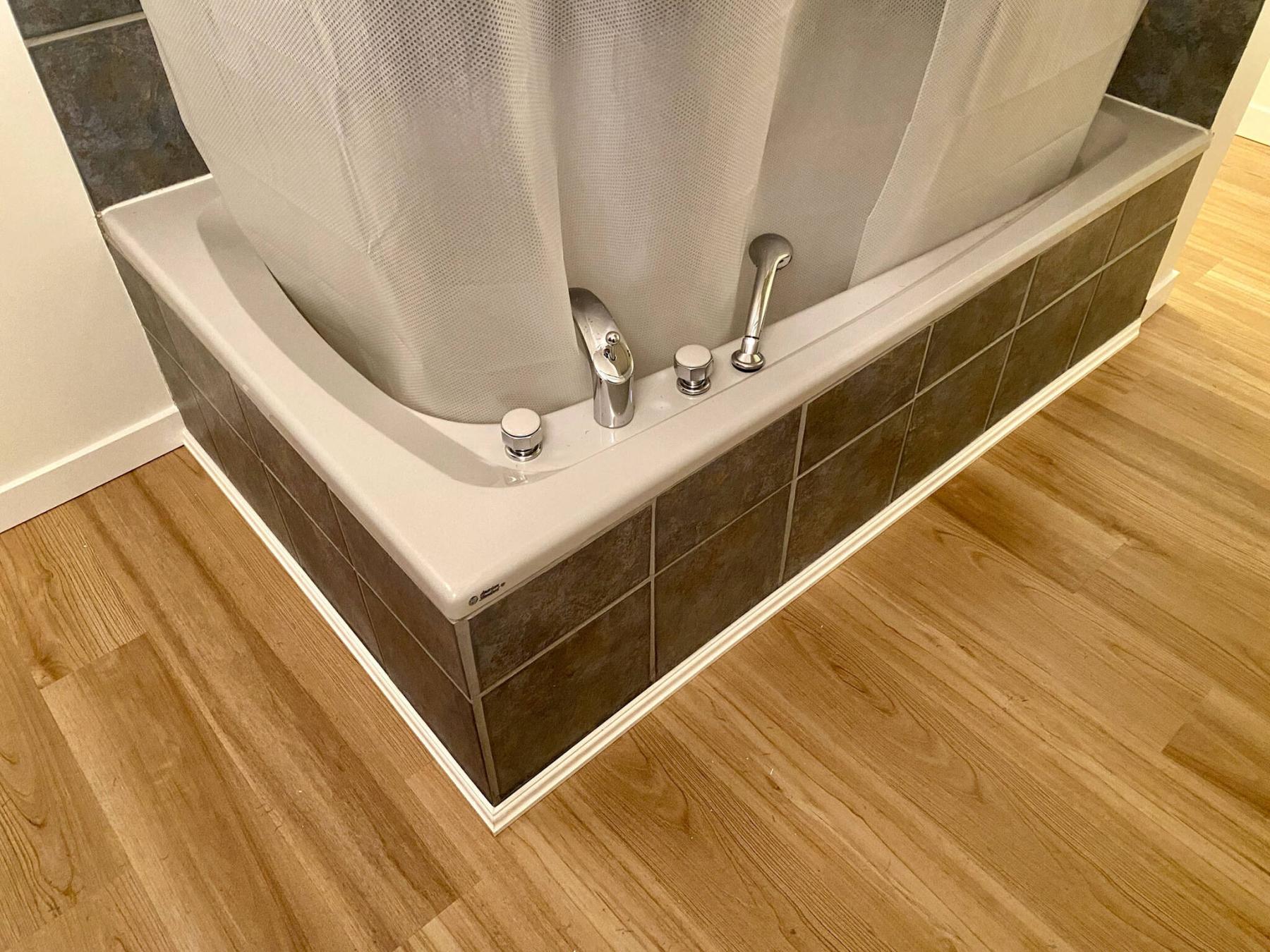
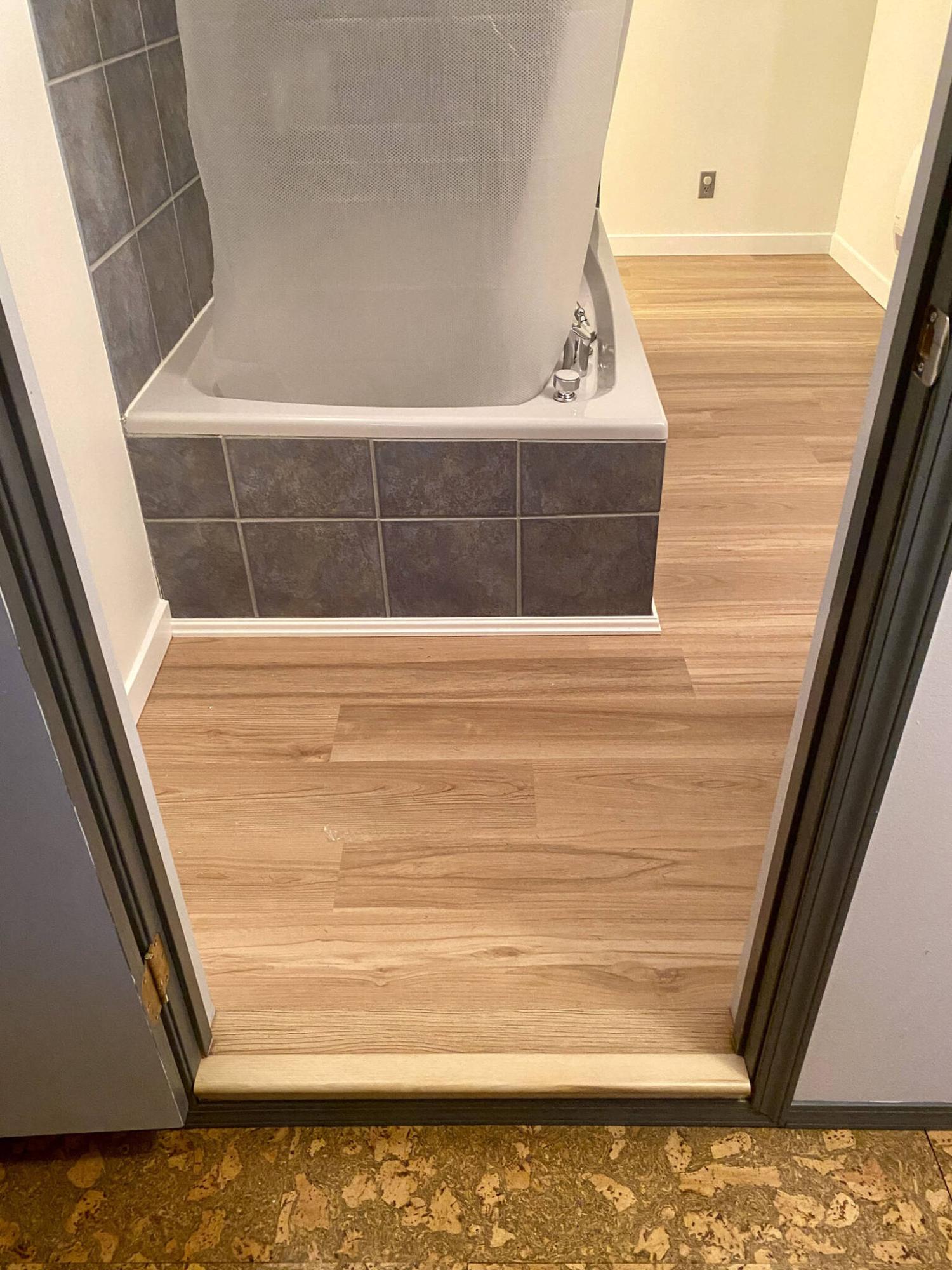
The tub was fitted with new trim along the perimeter to match the upgraded baseboards following the vinyl-plank installation.
Marc LaBossiere / Free Press
A framed platform serves as the main floor area for the entire basement bathroom, redone in vinyl planking.
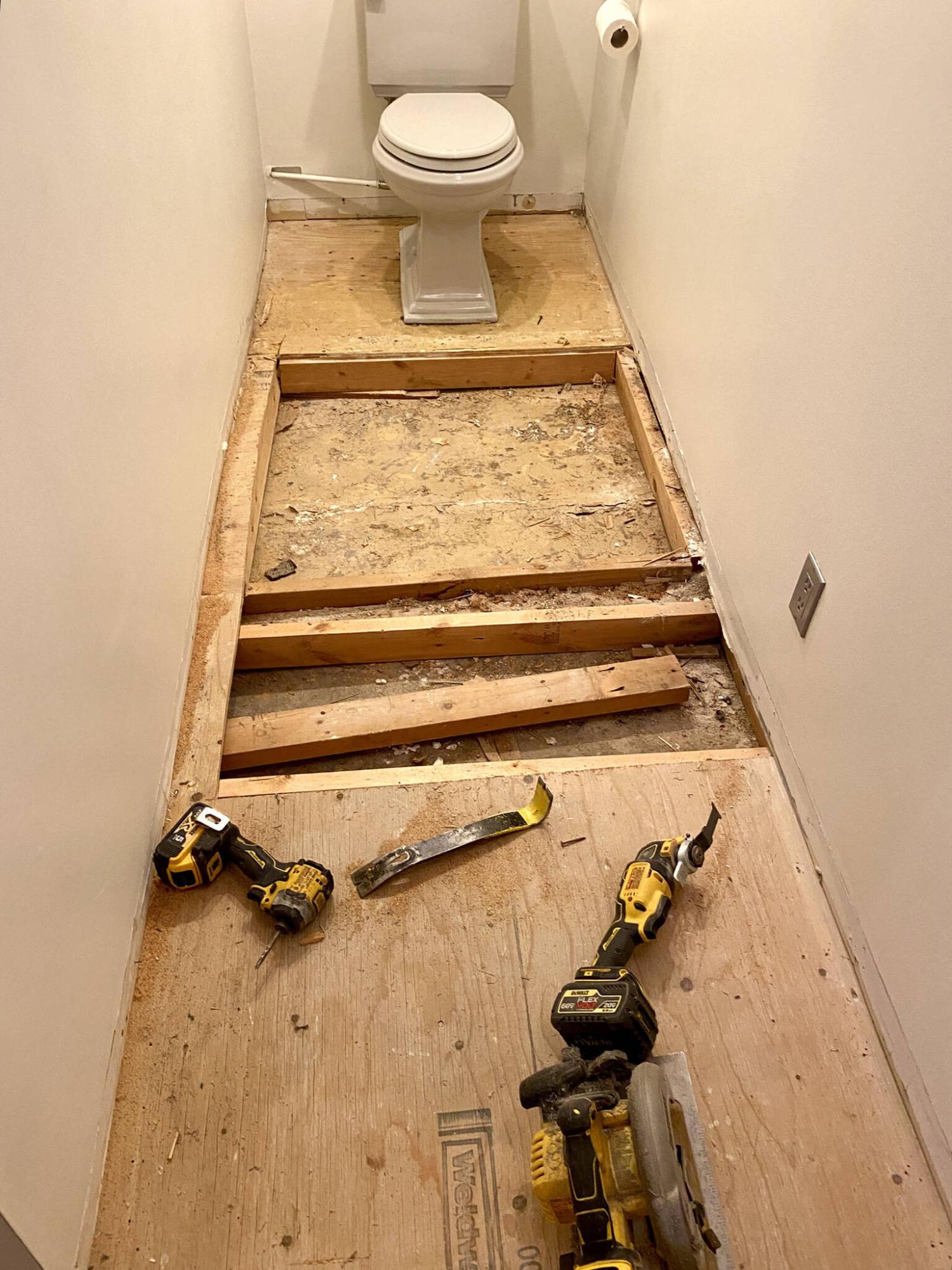
To eliminate a bulge along the platform base, old joists were replaced with new, notched to meet the uneven concrete below.
I’m not often surprised anymore by what I’ll encounter when asked to update a basement bathroom. However, a recent flooring upgrade did catch me off-guard slightly.
Basement bathrooms present hurdles because their layouts are usually predetermined by the rough plumbing set within the concrete floor at the time the house was originally built. And short of spending a fortune to rearrange the sub-concrete services, adapting an upgrade to the existing layout quickly minimizes options.
This particular bathroom had been upgraded prior to the current homeowners’ purchase of the house. And although it remained functional, there were a few aspects leaving much to be desired, primarily the carpeted flooring. Although I understand the intention to keep a basement bathroom floor warm to the feet, wall-to-wall carpet does not belong in a bathroom, for what seem to me obvious reasons. No matter, the carpet was now coming out and new vinyl-plank flooring was to be installed.
Beyond the carpet, the bathroom floor in its entirety had been built up, with a sort of platform throughout for one reason or another. I suspect this could have also been to buffer the coldness of the concrete below from the space above, or maybe there were a few water leaks along the floor that are concealed by the framework. The homeowners decided to keep the platform and simply re-sheathe it with vinyl once the carpet and underlayment were removed.
The bathroom layout itself was also one of the strangest I had ever encountered. Upon entry, an over-sized tub and shower utilized the available space quite well, with a decently sized vanity on the right side, adjacent to the wall. That’s when the layout takes a nasty turn (literally). At the end of what could be considered a hallway (that also allows doorway access to the utility room), a 90-degree turn to the left eventually leads to the toilet, which at first glance appears much like an oddly-shaped pin at the end of a short bowling alley. Nonetheless, the bathroom is fully functional despite the odd layout.
Once the carpet and underlayment were discarded, a substantial bulge along the platform midway from the left turn toward the toilet was now quite visible, having been cleverly concealed by the old carpet.
Unfortunately, the vinyl plank would not adapt well to this area, as it was well beyond the plank-elevation-discrepancy tolerance.
As such, it was necessary to rip out the top plywood along the base framing of that area to investigate the cause of the bulge, which I suspected was likely due to a small area of concrete floor heaving upwards. Once the plywood was lifted, there was indeed a crack in the concrete floor below that I suppose over time allowed moisture in, slowly lifting the edges of the concrete.
Short of removing this section of concrete and pouring new (which would increase costs), a cheaper solution was suggested to the homeowners, as they had indicated they wanted to focus solely on the flooring upgrade at the moment.
The quick approach was rather simple. By removing the “joists” along the area where the concrete had heaved, new joists would be inserted that were notched along the underside to sit atop the concrete, “absorbing” the heave and allowing the topside plywood to remain level.
After carefully adjusting every joist to cater to the elevation idiosyncrasies at every joist location, the entire structure was secured unto itself (as a floating platform), and the plywood was reattached.
With the entire platform now relatively level throughout, the vinyl plank flooring was installed using traditional methods. A nosing was introduced at the step-up entry, and new baseboards were installed throughout.
Although access to the toilet still feels much like walking down a bowling lane toward porcelain pins, at least one can now do so on a level floor — without negotiating bathroom carpet.
RenoBoss.Inc@outlook.com