There's a certain ritual that takes place among gardeners each year when May comes around. It starts with the race to greenhouses to select new annual introductions and favourite varieties before they disappear from shelves.
Spring's fluctuating temperatures can test an annual's survival. Once summer's baking heat and drought takes hold, the next ritual begins: watering daily, sometimes twice-daily, to ensure annuals' short-term survival. By season's end when we pull them out of the ground, the whole endeavour can represent a significant investment.
For some gardeners this annual ritual isn't a habit they plan to quit, although an increasing number of gardeners and homeowners are discovering the joy and ease of growing succulents and cacti.
This growing trend has as much to do with a desire for minimal input and a more contemporary statement as it does with a fascination for the oddball shapes and textures that succulents offer to both the outdoor and indoor landscape. While non-hardy varieties will also need protection from low spring temperatures, succulents and cacti require minimal watering when warmer temperatures arrive.
In response to the increased demand for these sun-worshipping plants, greenhouse operations both large and small are expanding their displays to include more and more exotic varieties.
Krystee Van Den Bosch of the Shelmerdine Garden Centre says the love affair with succulents is now also embracing cacti, including older plants with imposing size such as Cereus peruvianus, a sculptural cactus with branching arms. One impressive, prickly 10-year old specimen at Shelmerdine retails for approximately $275 and appeals to customers, says Van Den Bosch, because its lifespan is 25 years or more.
In addition to their longevity, low water needs and even a forgiving nature during periods of owner neglect, varieties with tactile, visual textures exude character such as the formidable barrel cactus with heavy spines, Eve's needlecrest with undulating green fans and the fiery sticks of pencil cactus. Their ability to move easily from the outdoors in the summertime to the indoors for the winter months makes these plants even more attractive.
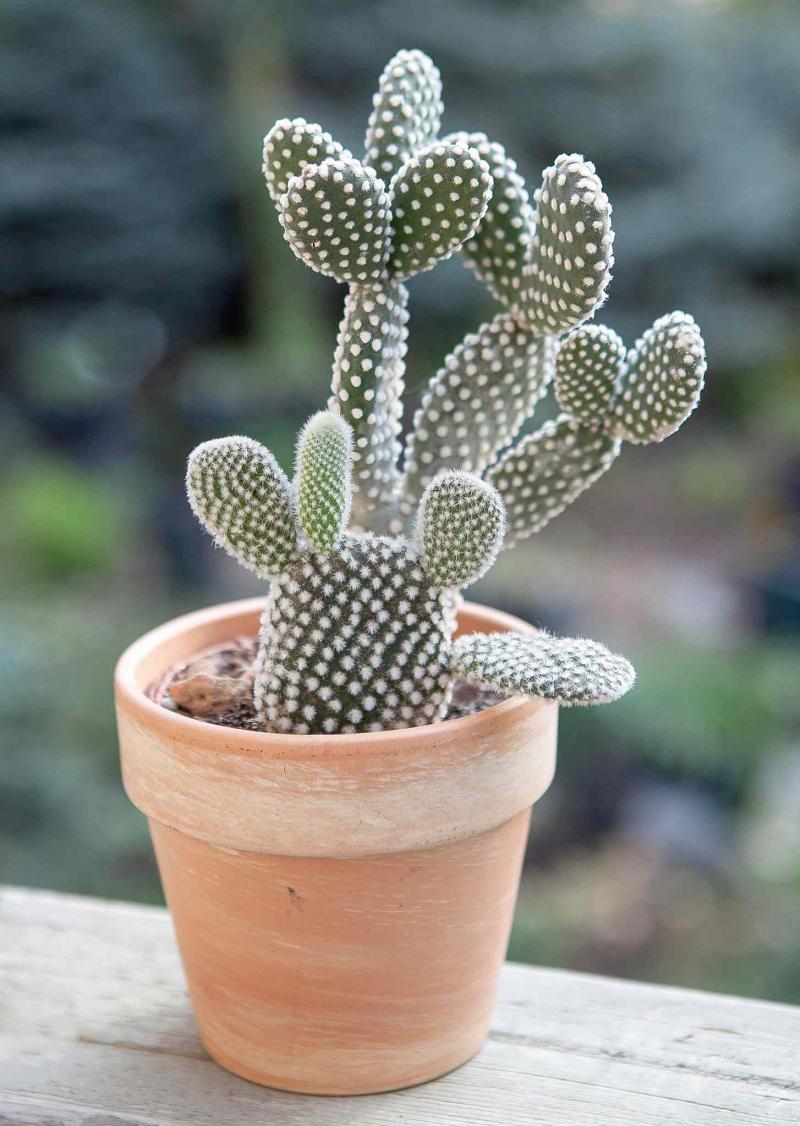
Of course, you can start out very small, too. The Opuntia microdasys cactus also known as Bunny Ears or Polka-Dot cactus can be purchased as small as 15 to 20 cm and grows slowly.
Agave, classified as a succulent, has an undisputed architectural elegance and is finding its way into more garden containers.
Take for example the beautiful symmetry of the rosettes of Blue Glow agave, which has blue-green leaves with crimson red margins edged in yellow, each with tiny soft spines. The tips of the distinctively tapered outward-facing leaves bear pointy spines that could draw blood if you aren't careful. Agave is beautiful planted alone in a low-profile bowl or tall, contemporary concrete planter or combines well with a mix that includes, for example, frilly echeveria, burro's tail, sempervivum (hens and chicks), or powdery blue chalksticks.
Johannes Olwages, conservatory horticulturist at the International Peace Garden, says people often have a personal connection with succulents and cacti and see them almost as objects they can arrange into interesting scenarios.
"Succulents and cacti are so structurally sound with an aura of permanence," Olwages says. "They retain their size and features for a very long time as opposed to leafy plants that grow rapidly and go through various phases. You can create something like a sculpture and have it remain intact for quite some time."
Olwages says cactophiliacs come from far and wide to visit the collection since the conservatory was completed in March 2014 when an extra 650 square metres of display area was added to the existing 278 square metres.
Many visitors have private collections at home and much of their passion has to do with the relatively low maintenance and resilience of cactus. Young children are tempted to squeeze the fleshy leaves of succulents and shudder with excitement at the sight of full-size thorny specimens.
How should a prickly or spiny cactus be repotted into another container when you first bring it home from the garden centre?
Van Den Bosch recommends wearing puncture-resistant gloves, the type you might use with roses. She suggests slicing the pot down one side with a utility knife while using forceps to hold the cactus, then shaking off the pot to remove the plant. Since most cacti prefer their roots somewhat pot-bound, Van Den Bosch says it is important to repot them into containers that are only one size or 2.5 cm larger in diameter.
Olwages immediately works the nursery soil off newly purchased plants as sometimes nursery soil is intended more for the short-term needs of the plant.
He mixes his own medium which consists of a well-draining potting mix containing peat moss, aged pine bark and perlite, adding approximately 30 per cent of a baked clay product called lightweight, which is inert and porous so it provides lots of air space and little crevices where roots can find moisture. Olwages says the roots of cacti like to look for water, not sit in it.
Another option is to purchase a store-bought peat-based mix such as Pro-Mix Cactus Mix, which is specially formulated to provide good porosity and fast water-draining qualities. Olwages says it is helpful to use the same medium for all of your dry-loving plants.
"If all your plants dry out at different rates," says Olwages, "it's easier to under- or over-water them even if they are all cacti and all in the same size container."
How often should you water? Olwages suggests a regular watering schedule of about once every seven to 10 days. When active growth slows in fall and winter and the plant is brought indoors, a light splash of water about once a month during dormancy will prevent all the roots from dying back. Olwages says if left completely dry, most cacti would survive but may rot if water is applied early on in the growing season as the lack of new root growth would not allow moisture to be taken up.
Carlos Ferreira is a Winnipeg resident and a talented container gardener. He lives in an old house with access to only a tiny space in which to garden, essentially an area that is less than a meter wide opposite a south-facing brick wall. A nearby door that has seen better times provides an interesting backdrop for Ferreira to create his eclectic, imaginative designs using a variety of succulents.
Ferreira says succulents are a natural choice for the arid conditions experienced during the height of our summers and believes that one of the reasons succulents are gaining in popularity is because they lend themselves to growing in small spaces. They don't invade other people's spaces, says Ferreira who likes to create self-contained tableaux or zen gardens.
"A zen garden is more than an arrangement," Ferreira says. "It's a scenario or tableau with different shapes, almost like drawing a picture with plants and incorporating other elements such as small stones, bits of glass, wood or metal."
This year Ferreira's backyard design concept is a terracotta ladder using a broomstick. Tilted terra cotta pots on opposite sides of the broomstick drip with succulents, which he has combined with geraniums and kangaroo paws (Anigozanthos).
For succulent or cacti container designs using the typical thriller, filler and spiller concept, Ferreira recommends sansevieria. With an erect height between 61 and 123 cm, sansevieria has stiffly pointed, deep green sword-shaped leaves with horizontal stripes and is best suited to a part shade location outdoors.
What about perennial succulents? In addition to sempervivum (hens and chicks) Shelmerdine's Jess Stacey says stonecrop varieties such as Autumn Joy have value not only for their fall colour but also as a source of late-season nectar for honeybees. A less common variety, Purple Emperor stonecrop has dark purple-black succulent foliage with showy heads of star-like pinkish-purple blooms.
Hardy, low-growing varieties such as Angelina sedum have tiny, brilliant yellow, needle-like foliage that is outstanding in containers. This spring I am trying Blue Spruce sedum.
Olwages says the ease of taking cuttings is another reason succulents are a good investment. Succulents and cacti make fewer demands on our time so they're compatible with busy lifestyles. They help to lower the cost of watering, too.
colleenizacharias@gmail.com
Notices:
Today: Fiesta Day Plant Sale, 10 a.m. to 2 p.m., hosted by the West Kildonan Horticultural Society. Partridge Avenue and Andrews Street. Includes bake sale and silent auction.
On Sunday, June 14, the Can-West Iris Society will host its eighth annual Iris Flower Show. 1 p.m. to 4 p.m. at the Bourkevale Community Centre, 100 Ferry Road. For more information email Barbara-Jean Jackson at jacksonb@mts.net.