Accessorizing a room has got to be one of the trickiest processes when redecorating your home. Too much and it's cluttered; too little and it's barren.
If the items are too eclectic, the room can be visually confusing and if everything matches then it feels like a Stepford Wives kind of space. The right outcome requires a delicate balance between necessity, budget, style preference and placement.
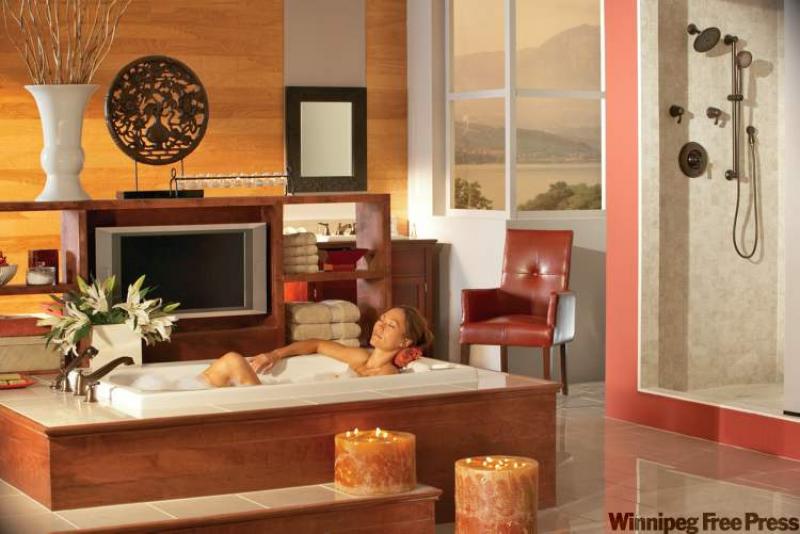
I chose this lovely Moen bathroom photograph today because it has a good mix of interesting accessories that can be interchanged in other rooms in the home. If, for example, you removed the soaker tub and shower and put in a sectional sofa facing the television unit, the room could easily be a family room or den, save for the towels.
The lesson here is you don't need to use items that only 'belong' in certain rooms. Keep your mind open to possibilities.
If we break this room down into the four categories mentioned above, the process of accessorizing your home might be an easier task than first thought. The basic concepts below can be applied to any room in the home.
Necessity
In our feature photograph, the necessary items are the towels and bar soap but could be anything from jewelry on a bedroom dresser to magazines on the coffee table in the family room. Items you want access to on a regular basis are what I consider the necessities. These items are not always something you desire as part of the décor but you need them handy to make life easier.
For items you want out of sight, choose decorative storage containers that co-ordinate with the room in question. If you can use these items as accessories (like the lovely towels in our feature photograph) then use them to your advantage. Those magazines in the family room, for instance, could be hung on a decorative magazine ladder for easy access and as a unique display.
Budget-saving ideas
Turning everyday items into accessories is a clever way to keep the budget in line.
Display your dishes, pots and pans in the kitchen. Hanging pot racks will save cupboard space and will make you look like a real chef. Items like large, ceramic serving platters you only use a few times a year can be hung on the wall or placed on a shelf for use as an accessory in the kitchen. Food stuffs like dried pasta, hanging garlic braids, spices, fresh fruits and veggies can make great accessories when displayed in appropriate containers.
In the bathroom, bar soaps, bath beads and crystals can be displayed in decorative containers instead of hidden away in a closet. Items like cotton balls and swabs can be stored in apothecary jars and placed on open shelving. Towels and face cloths can be stacked into neat piles on open shelves or in decorative baskets or bins. Purchase linens with colours that compliment the space.
Personal style
You should love what you display and display what you love. Choose items that elicit positive emotional responses -- great art, personal treasures, family heirlooms, photographs and so on. Keep within your general colour scheme as seen in our feature bathroom. The leather chair's peachy-brown colour is dotted throughout the room. A similar colour (the colours don't have to match exactly) is found on the wall around the shower stall and in the square soap dish, bowl and square wicker basket. This colour is also found in one accent towel, which is just enough not to be overdone. The other towels are in a neutral sand colour.
Stick to a central theme if you're overwhelmed by the choices. This bathroom is quite Zen and bodes accessories that work within that theme, for example.
Placement
Try to mix things up with regard to size, shape and form. Our feature room boasts a large, wooden scrollwork plate, which has lots of texture and movement juxtaposed with a soft white vase with wavy lines and no detail. The two opposites really attract. The addition of dried twigs in the plain vase adds dramatic height and a natural element.
To balance the vignette, a third accessory is added. (Three items is always a good number to use when placing items for display.) A long, low-profile tea-light holder is placed at the base and slightly to the right of the two larger pieces to create visual interest. These three items really have nothing in common but work well together when placed correctly.
Try to choose a few large-scale items rather than a smattering of small items to keep things simple and stylish. The inclusion of some square items (soap dish, decorative bowl) rather than the expected round counterparts is a nice touch detail.
What is interesting about most of the accessories in this room is they are not what you would consider 'bathroom' accessories but they all work in this room. There are no hard and fast rules for display. You just have to play around with the placement of accessories until you end up with an eye-catching arrangement. The more you practise the better you'll get at it.
If what you're doing is just not coming together, study lots of décor photographs online or in magazines and deconstruct the photos as we've done here. Once you get your eye trained to find scale, form and colour palettes, the rest will be a cakewalk.
connieoliver@shaw.ca