Today I want to revisit some common decorating problems many of you out there may have to deal with at one time or another. From awkward narrow spaces to cavernous wide open plans, we'll look at simple ways to combat some common decorating dilemmas.
Creating a focal point
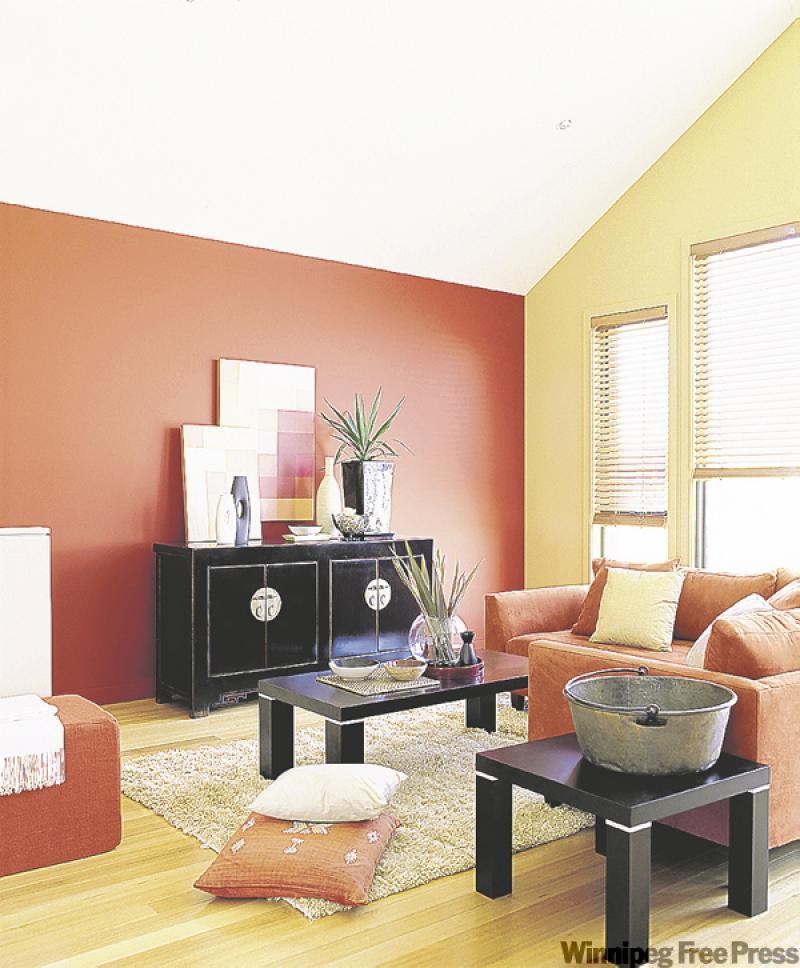
There is a very distinct focal point in our feature living room photo. A strong punch of colour behind a sleek, black cabinet grabs your eye right away. Topping off the vignette is a collection of artwork place asymmetrically, which provides even more visual punch. While many would assume the window wall should be the focus, that's not necessarily the case. You can choose to create a more fitting focal point if the 'obvious' one doesn't work for you. In this living room, a focal point was created where there was none to begin with. The wall behind the cabinet is just a plain, flat, boring wall. By adding a punch of colour and an interesting feature, a focal point was born. To ground the focal point, you'll notice the furniture is placed in a conversational grouping around the central feature. Whether the feature is a fireplace, picture window or, in this case, a simple vignette, placing the furniture accordingly enhances the overall appeal of the feature wall.
In a bedroom, a splash of rich colour behind the head of the bed will help transform a plain wall into a feature wall. An oversized headboard or large painting placed against the strong colour will further enhance the focal point. Height can help you create drama as well. If, for example, in our feature living room the black cabinet was topped with a simple display of family photographs and maybe a small painting hung on the wall above, it would not carry near as much punch as it does with the large painting that gives the setting height. So, in a bedroom, you might hang netting at the head of the bed and have it flow down on each side to create a dramatic canopy, just as one example.
Open concept space
Our Dulux living room deals with another common decorating dilemma in that it is an open concept space with a vaulted ceiling. This is a common floor plan in many homes and can be tricky when it comes to painting the walls. It's sometimes hard to know where to end a specific paint colour because the spaces often run together with no real distinct separation points. Colour blocking is a great solution to this problem. Using various strengths of one colour throughout the space will provide visual interest but will keep the space flowing. If you want to create more definition within the space, you can use two co-ordinating colours, as was done in our feature living room.
Furniture placement issues
In some instances, you might come across difficulty placing furniture in rooms that are oddly shaped or that have lots of windows and doorways that impede your efforts. Rooms with several large windows, bow windows, doorways and odd angles are lovely but difficult when it comes to arranging furniture. There isn't a one-size-fits-all answer to this issue because of the variables but there are some helpful solutions that may fit your situation.
In a room bordered with lots of doors and windows, leaving little wall space for furniture placement, consider floating the arrangement in the centre of the room, if possible. A centre conversational furniture grouping can be eye-catching and will leave the perimeter of the room obstacle-free, so you can enjoy gazing out those windows. This idea can work in a bedroom as well as a sitting room. A bed placed in the centre of the room, perhaps on an angle, can be quite stunning.
In open concept spaces, like the living room featured in our photo, you may only have one unobstructed wall to work with. Instead of placing the sofa along this wall, you can float the furniture more in the centre of the room as was done here. The windows remain unobstructed and the furniture placement is cozy and comfortable.
In some situations, you may have to change out one or more pieces of furniture to accommodate an awkward room. Instead of the traditional sofa, loveseat and large chair, modular furniture may be the answer.
Narrow spaces
Narrow spaces are not all that common, but when you have to deal with this problem it can be frustrating. Depending upon the situation, you can do a number of things to enhance what could be an problematic space. If, for instance, you're dealing with a narrow hallway that has little natural light and feels like a bowling alley, you could enhance the space by adding mirrors to the space to reflect light. To combat the tunnel look, you could create a vignette at the end of the hallway, which will bring the end of the narrow space closer visually. Remove any items that might make the space feel even more confined. Furniture, window treatments or decorative shelving that juts into the space will only be in the way. Keep the window treatments and wall art flush against the walls and hang the art in a gallery style to add interest to the area. Breaking up the floor space with two or three round area rugs or a long area rug with a wavy design will keep the floor from having that bowling alley look. If you are able to add lighting to the space, choose recessed lighting that will not protrude into the narrow space.
I hope these hints will help you in your quest for a beautiful space.
Connieoliver@shaw.ca