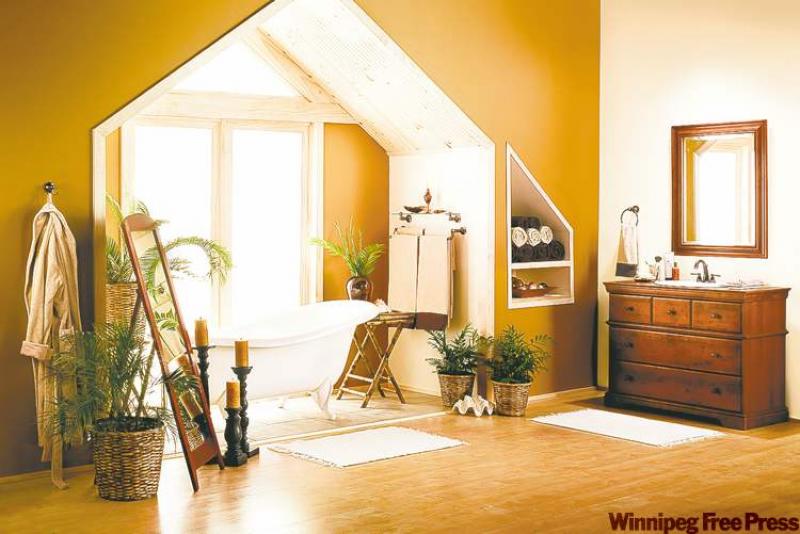
Today's featured room is glorious. The unusual shape of the dormer lends itself to so many decorating possibilities. In this instance, it was used to house a beautiful soaker tub.
The setting is decadent but woodsy, unique but homey. The stylish vanity with mirror and freestanding tub are attractive and the brushed bronze double towel bar and robe hooks offer an Old World flavour to the space.
The addition of several leafy house plants provides a tropical feel and also softens the tub area, which could look cavernous if left unadorned. The wicker and bamboo accents provide a casual flavour that works well with the wood flooring.
There are so many great features in this room that I'd like to break them down into sections and look at what was done in this particular room and what other ways a space like this can be beautifully utilized.
Colour
The dark tan wall colour is warm and makes the feature wall really pop. This colour works well with the various wood tones in the room. If a lighter shade of this colour were used instead, the light-coloured wood in the dormer and the light flooring would look washed out. This feature area needed a strong wall colour to make it work. The light-toned wood in the dormer area helps reflect daylight and keeps it bright and cheerful during the day. (No doubt the trio of large floor candles would offer a warm glow during the evening.)
For a more romantic and cosy look, one could paint all of the wood in the dormer area in the same rich tan colour, which would make the white tub really pop visually. Using light-coloured accessories and linens would be an asset in this scenario as well.
The space behind the wall
The creation and use of the built-in cubby is a great feature of this room. The shape of the nook is interesting and it offers additional open storage. Painting it white makes it stand out as a feature.
If you have a similar space in your home, you may consider creating additional storage if there is room behind the wall. You could utilize this space to install a built-in dresser, bookshelves, a closet or even a sound system, depending upon the hidden space available and what the room is being used for.
The vignette to the left of the tub defines the dressing area in our feature bathroom. While there is no actual wall dividing this dressing area from the rest of the room, it's very clear what the space is intended to be. This visual separation was achieved by placing the free-standing floor mirror to the left of the dormer area and flanking it with a house plant and three floor candles. Hanging the robe on the wall just behind the vignette completes the look.
You can define areas of a room in various ways. You may need to achieve this goal in situations where two children are sharing a bedroom, or you want to have an office space or hobby area in a bedroom or corner of a living room.
One option is to use decorative, free-standing room dividers, which come in a variety of styles. Purchase them or make your own out of louvre doors hinged together accordion-style and painted to your taste. Tall houseplants are another item that can help define a specific area of a room. You can also curtain off areas with decorative fabric panels. The use of area rugs can help define a space as well.
The way to bring it all together is to follow these basic rules: first, place the main item of the vignette in a workable area. For example, in our feature room, the dressing area's main item is the mirror. In your case it may be the office desk or hobby table.
Second, you want to use items that will visually separate this area from the rest of the room. As mentioned above, the house plants and candles were used in our feature room for this purpose. If you are creating a home office in the bedroom, for instance, you may want to use a two-panel room divider on one side of the desk and a few tall floor plants on the other side, and define the whole area further with an area rug.
Scrutinizing the elements of a great room is always a fun and enlightening endeavour. There is a method to the overall madness that is decorating. Sometimes you just have to dissect it before you can put it to use in your own home.
connieoliver@shaw.ca