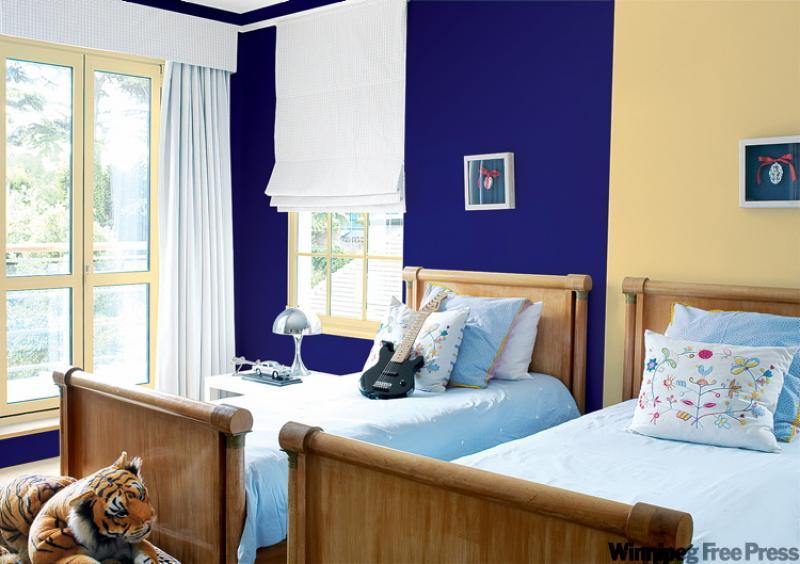
I grew up in a family of nine children so I know all about having to share a bedroom with siblings. At times there was rivalry for spatial rights which ended up in more than a few sibling squabbles.
With the tight economy and high housing prices many families have to double up occupancy and make the best of the room that they have. This is not necessarily a bad thing. Childhood development experts agree that sharing a room offers early-life lessons in learning to co-operate. Kids learn, as well, from having a say in how the room is decorated. Helping to choose the paint colour, for instance, is a wonderful way for a youngster to gain self-confidence and feel empowered.
"Think back to your own childhood and the impact colour had in helping to define your world," said Sharon Grech, Benjamin Moore colour expert and mother of two. "You probably had a favourite-coloured shirt, or at least a favourite crayon colour. And, certainly you chose the lollipop or candy by colour, not by flavour. So, allowing a child to choose his or her own room colour is an experience that helps foster individuality while nurturing creative expression."
Visually defining each child's area of the bedroom may assuage their concerns that one child is getting more out of the deal than the other. Isn't that what sibling rivalry is all about? One child feels that the other is getting special treatment or more than their fair share. Equalizing the bedroom space through clever design might help alleviate these fears.
As you can see in our feature photograph, courtesy of Benjamin Moore, the division of space is defined by contrasting colours. Not only is this a fun, sporty look, it gives each child a space that is definitely their own. To make this impact even stronger you could let each child choose the colour for their portion of the room. That way they have a say in what their space will look like which gives them a sense of personal identity.
In the case of twins, who may share a room for many years but want to attain their individual identity, a duo-zone colour scheme, like the one pictured here, may help define and strengthen each child's sense of self.
After the paint pair has been established, you can strengthen the visual division of space and personal identity through bedding and accessories. Purchasing bedding and accessories that will co-ordinate with each colour and will establish each child's personal taste will complete the transformation. You may choose to use a dual-colour bed set in co-ordinating colours that allows each kid to choose which look they'd like on any given day. One side may be a two-tone strip, while the other side has a solid colour, for example. With a simple flip of the quilt a change in the look is simply achieved.
With the accessories you may find that one child is partial to sports paraphernalia while his brother may prefer reading and video games. Purchasing a bedside lamp and throw rug in each genre, for instance, will give each child a sense of his own space.
Safety
According to Sharon Grech of Benjamin Moore, when shopping for paint the No. 1 question you ask should be, "Is this genuinely zero-VOC paint?" She also recommends that you also make sure to find out whether there are VOCs in the colourant -- the tint that's mixed in to give you your colour choice.
"Ideally, you should be shopping for paint with minimal or zero Volatile Organic Compounds (VOCs), like Benjamin Moore's Natura zero-VOC premium paint," she said.
"What so many consumers are unaware of is that the base paint may be zero-VOC, but the colourant has VOCs, and so they mistakenly think they're walking out of the store with a zero-VOC paint. You just really have to be cautious, curious and conscious about what you're purchasing."
With its colourants free of VOCs, Benjamin Moore Natura paint is available in all of the 1,800-plus colours that the company offers, plus it can be custom-matched.
Where to start
If you don't know which way to go with colour and your children change their minds every other day on what they want in their shared space, you might find middle ground in the bedding. Considering your children's tastes, choose one or two bedding patterns for the kids to choose from and use the preferred choice as a jumping-off point for the colour scheme. The colour palettes in any printed fabric will always work well together so you don't have to worry about clashing.
If you don't want a clearly defined "yours and mine" paint treatment as shown in our photograph, you can incorporate each child's preferred colour through a striped paint treatment or geometric patterns using each paint colour. Use the leftover paint to create artwork by painting a design on a simple stretch canvas.
You might even allow each child to create their own work of art to hang over their bed. This idea will definitely give each child a sense of individuality while maintaining an overall co-ordinated decor.
Plan ahead
As the children grow you'll need to update their room every three to four years. Keep this in mind when planning for more permanent changes like flooring. Choose something that will work into the future as tastes change.
connieoliver@shaw.ca