Dear Leanne: We are selecting cabinets for our kitchen and have decided on white with a simple profile. We have planned to include a dentil moulding around the top of all the cabinetry so the design is more traditional than modern. I have selected oiled bronze handles to give it an old-world look.
We have the option of adding glass door fronts to some of the cabinets and I am a little nervous about making this commitment. I like the look in magazines, but I don't know how practical it is. If we added this look, how many do you recommend and where should they go?
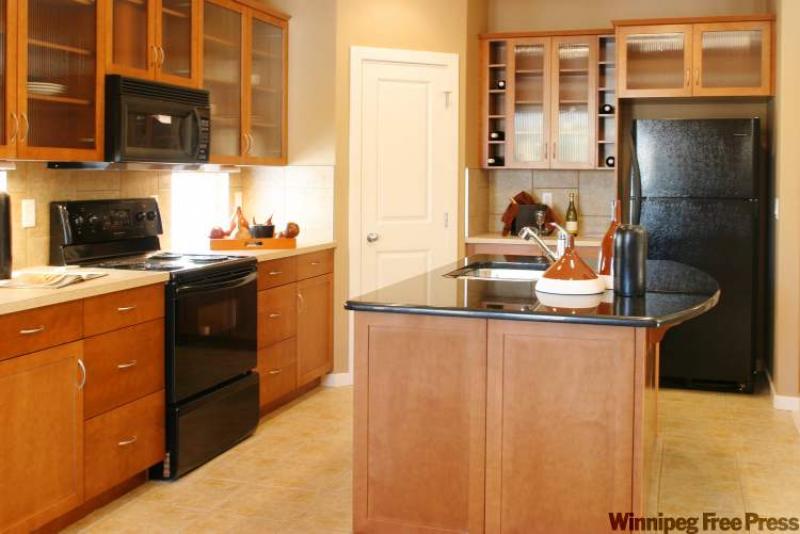
A: Glass doors on cabinets are a wonderful look, but there are a few things to consider. These door fronts are generally used in kitchens as a feature or showcase. That means you are going to proudly display what you have behind the door. Glass doors are frequently photographed displaying beautiful glasses or display plates.
If you have the space available for displays and you intend to keep the cupboard neat and tidy for all to see, then glass doors can be a spectacular addition to a kitchen. If this is the option you select, take the time to install recessed lighting inside the cabinets. This will offer a stunning showcase as well as provide an indirect lighting source for your kitchen.
The number of glass doors really depends on the kitchen plan as well as the number of cabinets you can devote to viewing. Two well-placed full glass door panels may be sufficient for a visual impact. If you are drawn to the glass look but uncomfortable with losing storage, consider obscure glass. This gives you the lighter look without the visual impact of what is behind the door.
In this situation, I would not recommend the recessed light as it will lose its effect and show shadows rather than offering a highlight feature. Placement of these doors should be presented to highlight a feature in a kitchen, encasing a beautiful window or artistic fan-hood or perhaps an angled corner unit.
Recently, I saw an advertisement for Southampton by Wood-Mode (wood-mode.com), which displayed cabinets with the only the top third offering a glass insert. This provided the feature of a lit showcase, while allowing the lower cabinet to remain functional. There are many options available; perhaps your cabinet maker can be creative to meet your design needs as well as alleviate your functionality concerns.
Dear Leanne: I am attempting to go greener this year. In my plans to clean my windows this spring, I am looking for chemical-free products, but at the same time I want to get the job done. I have heard people say to use vinegar and newspaper, but then I have also heard people say that only leaves streaks. I don't love doing my windows, so I would rather not have to do them over if it didn't work the first time. Do you have any suggestions?
A: The practice of using vinegar and newsprint was popular from the 1940s to 1960s. After reading, newsprint was relegated to tasks such as lining birdcages and wrapping fish bones and coffee grounds. Someone, no doubt, used the leftover newsprint to clean up a mess or two and likely attempted to wipe the window.
Lo and behold, it proved excellent at leaving windows sparkling clean. It wasn't long before marketing companies got in on the scene.
In an attempt to capture the attention of the busy housewife, ready-made formulas hit the market. Packaged in spray bottles, fresh scents and pines replaced the vinegar aroma associated with spring cleaning.
After years of cleaning windows with these chemicals, we're seeing a movement to return to the simpler, greener methods. Unfortunately, when people try to use vinegar and water, the results are less than sparkling, with streaks everywhere. Good intentions are soon ditched and cleaning practices revert to the commercial spray products.
Vinegar and water can cut through most organic products, but the combination has difficulty with waxy films left over from grime and years of using new chemical products. The film requires a bit more than a weak acid diluted in water.
A simple addition of mild dish soap fixes this dilemma. Soap acts as an emulsifier that breaks down the waxy film and allows the vinegar to do its job. A popular recipe is 500 mL of very warm water with 50 mL of vinegar and 2.5 mL of dish soap.
Newsprint has the capability of absorbing dirt and oil. While it spreads the soap and vinegar mixture, it absorbs the grimy film. The surface of newsprint is absorbent without leaving lint, which can occur with paper or cloth towelling. If you are not a fan of the vinegar aroma, lemon juice can be used as a substitute.
Although it is good to have the water warm, a hot window makes the cleaning solution dry too quickly for it to be effective, leaving streaks. Wait for a cloudy day for best results.
Q: Dear Leanne: When I hear it said that less is more, I'm unsure of what less is. I am decorating a new home and tend to add more as I shop and find things I like in the stores. How do you know when to stop and when to keep going, when it comes to decorating?
A: This is an excellent question -- and a common one. First, you need to understand that the architectural style of your space will dictate the decor that best complements it.
For example, an open-concept home with soaring ceilings and minimal walls will be well-suited to a strong but clean, contemporary look. A home designed in a traditional period will welcome a layered environment.
In all cases, the idea is to achieve a balance of completeness. Less is more does not refer to an empty, incomplete feeling. In fact, it is essential that less still be stunning.
Generally, homeowners tend to err on the side of over-accessorizing, which loses the design style. The key here is balance.
First, imagine your room in its unadorned state and identify its focal point. If there isn't a naturally occurring focus, then you will need to create one.
A spectacular window, a fireplace, detailed mouldings, soaring cabinetry or a spectacular kitchen island are examples of architectural features that command attention. Decor should enhance these elements, not compete with them.
Contemporary designs tend to be classified, erroneously, as the only spaces appropriate for minimalistic design. This is not correct.
To understand the minimalistic approach, you need to appreciate that, by being selective, you can achieve greater overall impact -- and this is true for all styles.
Think of the little black dress. A single strand of pearls complements the look perfectly. Each item by itself is not strong, yet, by combining these two simple elements, you have a balanced statement.
Adding a gold belt and gold bangles would not add to this look; it would detract from it. This is an example of too much. There is no longer a natural focal point, nor is an overall balance achieved.
Think of that when you're tempted to add to your space. In a contemporary kitchen, with smooth, gleaming surfaces, flowing counters and seamless cupboards, the eye needs to have a place to stop and rest. This can be on a light fixture, or a stunning piece of art.
It's necessary to incorporate elements that enhance the room's personality without confusing the visual statement it makes. A large stainless steel bowl filled with green apples adds colour and decor while blending with the room's style.
Adding terracotta pots, porcelain roosters, or wicker baskets will not make this space feel balanced. They would be better suited to a traditional or country-style kitchen; however, this look can get carried away.
To avoid compulsive purchases that can overwhelm your home, keep to a plan. Take a critical look at each room from every view possible. Confine layering to strategic locations.
Place one basket on the floor with neatly folded blankets and throws rather than tossing various patterns over chairs.
Simplify a bookcase by removing books from each shelf to provide breathing space, replacing them with elements such as a glass orb or vase. Bookcases are frequently culprits of too much going on, which is distracting to a room.
Once you have placed items in your home, take a few away and see if your space still feels complete without them. Remember the black dress. You may love the other accessories, but they may simply be too much for the space.
Leanne Brownoff is an Edmonton interior design consultant who welcomes your questions at www.leannebrownoff.com. Answers will be featured in her column as high volumes prevent individual email responses.
-- Canwest News Service