Be honest: A visit to a garden that has an abundance of vigorously growing clematis is all it takes to fill you with garden envy.
How is it that you can be so successful at growing almost every other variety of plant but fail each time you try to grow clematis? It doesn't help to be told that it is supposedly easy to grow this versatile climbing plant that can boast an abundance of blooms.
What is the secret? There are three basic requirements for growing clematis so it will flourish in your garden: adequate support for climbing, never losing sight of the importance of keeping the roots cool and moist but not wet, and selecting a location that allows for enough sunlight throughout the day to reach the leaves and stems of the plant.
Insist that you did all of that but still couldn't realize your ambition? Clematis is an amazingly diverse genus that offers choice of flower colours, heights and bloom times that range from early-season to late flowering. The steps you take to establish your clematis at the time of planting are most important.
Similar to peonies, clematis must be planted at the proper depth. Plant the crown 5 cm below the soil surface. It helps to soak the clematis before planting.
Although clematis has proven its tolerance of our clay soil, the ideal is a well-drained loamy soil. Prepare the plant hole by roughing up the sides of the hole so that the roots can more easily penetrate. Add a layer of well rotted manure or compost mixed with peat moss. Backfill with the soil that has been dug out, scooping out the heavier bits of gumbo.
The clematis does dictate one requirement that cannot be ignored: its roots must be kept cool. This can be accomplished by shading the soil surface with a layer of pebbles or mulch or try under planting. Water well at the time of planting and maintain adequate moisture while establishing your new clematis.
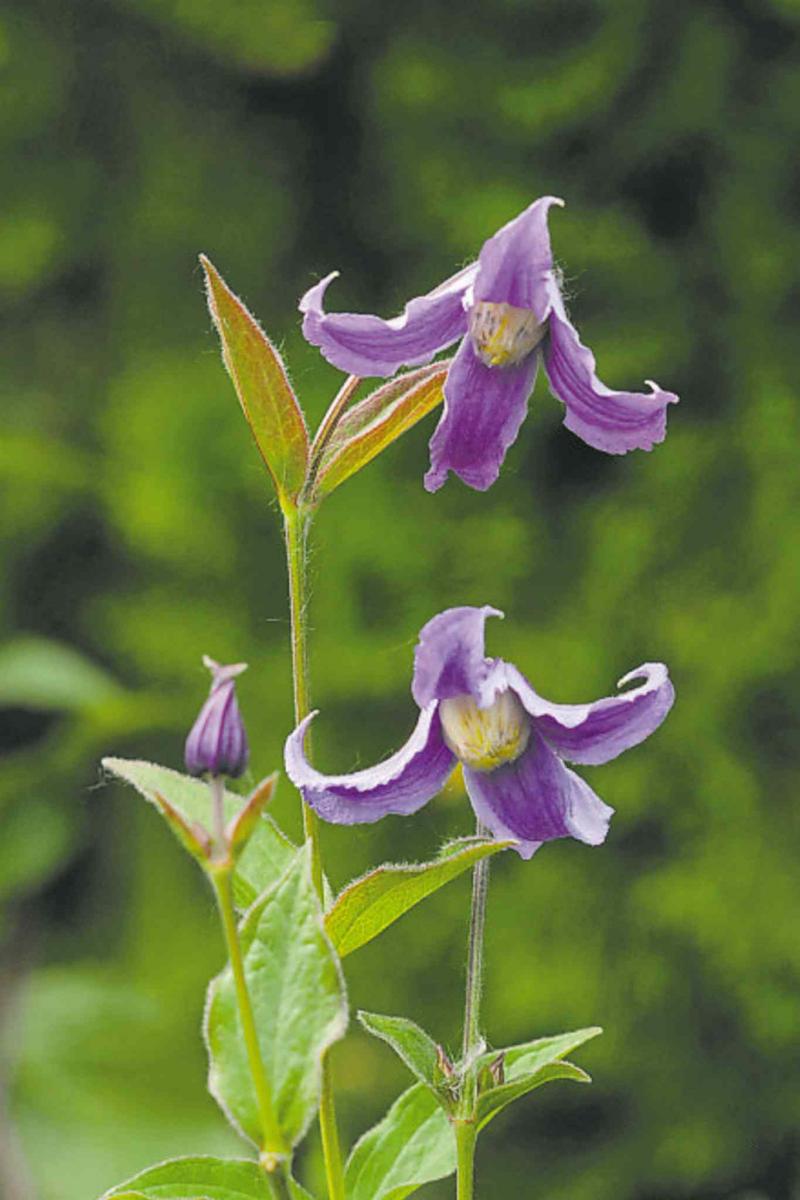
When deciding how to support your clematis, consider plant habit which varies depending on the species. Clematis integrifolia, for example, grows as an upright clump, about 60 to 90 cm.
In the case of the climbing species with twining stems, the leafstalks act as tendrils that cling to any number of imaginative support systems. The most common cultivars of climbing clematis include alpina, macropetala, and tangutica.
George and Eileen Bowden's River Heights garden reflects their love of sclematis, instilled from their childhood growing up in England. Favouring the small flowered varieties that bloom in early season, George Bowden emphasizes that many of these are easier to grow and have a greater chance of survival relative to the large flowered hybrids.
"The early flowering macropetala and alpina species are particularly vigorous," said the Bowden's, adding that both will self-seed and respond well to layering. Their garden includes integrifolia, tangutica and orientalis types that grow very well planted against the stone and brick walls of their residence.
Hardy, long-lived varieties are rampant with blooms in pink, white, yellow and blue that scramble across every wall. "It's almost too much sometimes," said George, who must occasionally trim back the robust vines. Another drawback is although the clematis blooms in May on new growth produced the previous season, eventually there is a mass of old wood.
The Bowden's wait for the bloom period to end then cut the wood back sharply. This task must be completed by the end of July in order to allow time for the new growth that will set up next year's blooms.
One of the showier beauties in the Bowden's garden is clematis serratifolia kugotia or golden tiara clematis. An award-winning variety from the tangutica group, it features nodding bell-shaped blooms that are golden yellow with dark purple-black stamens. It blooms on the current year's growth and tolerates partial sun. A vigorous grower, it will reach a height of 3 to 4 metres and flowers in early to late summer followed by attractive, silky seed heads.
Of course, the spectacle of large flowered cultivars is highly desirable as well. Early flowering species such as alpina and macropetala can be combined with early to mid-season large flowered cultivars as well as those that flower from midsummer to autumn for an unsurpassed sumptuous display.
If your garden space will only hold so much, think outside of the ubiquitous wall-mounted trellis.
With a distinctly artistic flare that pays respectful homage to the folk art style, Ron Mielitz, a local gardener, utilizes 4 -by-4 posts as support systems for his and wife Sandi's collection of more than 50 clematis vines. Each of the nine white-painted posts, towering well above the perennial beds throughout their property, is topped with a hand-carved creation. A spike inserted into the post stabilizes them in the ground.
Some of the creations have a personal significance. A carved cock, for example, is patterned after what one might see in Quebec on a lot of the churches or in the antiques markets. Although the original might be mostly made of tin, Ron Mielitz works from wood, using an axe to create the intriguing shapes, then carves with chisels, files and a rasp for the final design. The hand painted finish is allowed to weather.
His vision is to create an interesting garden, one with structural elements that reflect his background in sculpture. By combining multiple varieties of clematis around a single post together with a lush landscape that emphasizes repetition in colour and form, the overall effect is mesmerizing.
Maintaining a reserve of clematis combinations that are heeled in for the winter and used as replacements in the event that a variety dies, Mielitz experiments with both hardy and exotic types.
Brimming with health and no sign of fungal infection, Mielitz' clematis benefits from its pole-type of support that promotes good air circulation. The shaded soil surface limits any root stress.
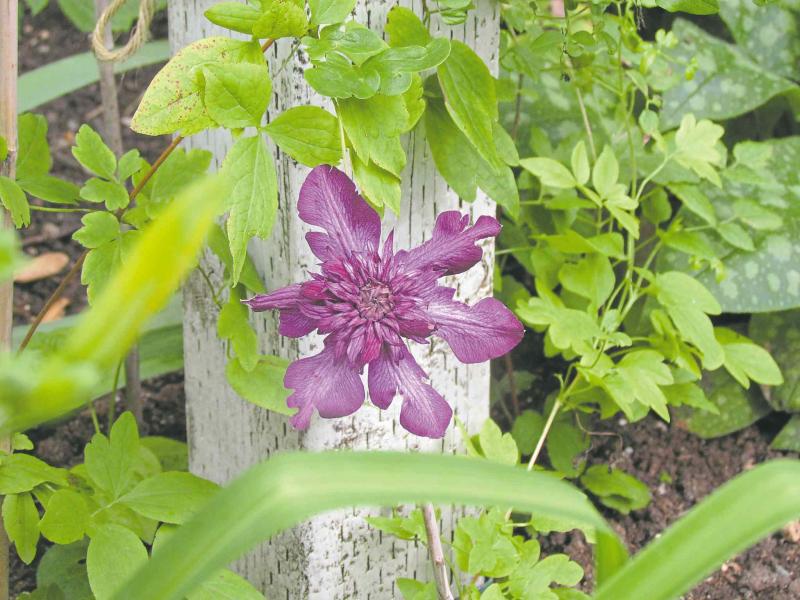
Multi-blue, Vyvyan Pennell, niobe, asao, viticella venosa violacea - these are some of his favourites. Mielitz recommends patience in growing clematis. Some of the more exotic varieties such as Florida var. sieboldii can take until July before making an appearance.
Jens Wrogemann, a south Winnipeg gardener, has some unique and creative suggestions for vastly increasing the number of clematis that can be cultivated in a garden, no matter its size.
With a vast and leafy landscape punctuated by freely flowering and free-standing clematis vines, Wrogemann uses a single 3-metre length of rebar, ridged to support climbing varieties, ably demonstrating the ways in which clematis can be situated almost anywhere in a garden.
Appearing as floriferous sentries that provide contrast against a heavily treed backdrop, Wrogemann also partners his clematis with trees and shrubs serving as host plants.
The branched structure of a volunteer willow or columnar tree such as Purple Spire lends perfect support to Lady Betty Balfour. The lacy leaves of a cedar plant adds another interesting dimension of texture.
"What I do is plant them at the same time so that the clematis will grow to the same height," described Wrogemann. Because he selects narrow columnar forms to act as a natural trellis, the plant still gets the amount of light that it needs. Also, the depth of the supporting plant lends support to the clematis against the wind which, in the case of a wall or fence-mounted vine, can do considerable damage.
"If you combine a mid-season cultivar with a spring-blooming lilac," said Wrogemann, "then you don't compete with the lilac blooms."
In one example, the prolific blooms of red cardinal clematis intertwine with the less floriferous but stunning pale mauve blooms of Ramona. Wrogemann makes the argument as well that growing clematis on a columnar tree or shrub that isn't at its best anymore helps to camouflage its faults. Plus it is double the fun.
Favourites include Durandii, a groundcover type with indigo blue blooms. Growing in Wrogemann's front yard, it contrasts beautifully with a nearby barberry with brilliant chartreuse foliage. Also in the front yard is Alionushka, with deep mauve-pink bell-shaped flowers that nod in the breeze.
For dramatic colour, Wrogemann grows John Howells with profuse brilliant scarlet flowers.
Whether you grow your clematis on a trellis or partner it with multiple varieties on a pole, rebar or shrubby companion, the rewards will be beautiful.