One of the greatest pleasures in spring as we walk through the garden, taking care to avoid compacting soggy-wet soil with our boots or the premature use of garden tools, is seeing the first shoots of perennials emerging. But there is always the nagging concern some of our favourites won't return.
Perennials can succumb for a variety of reasons. It might be due to a harsh winter, lack of proper siting, or in direct relation to a plant's natural lifespan. Then again, all that may be needed is patience for the late-bloomers that wait sometimes until almost mid-June before appearing.
Regardless, many gardeners will be in the market this spring for new additions to their perennial borders either to fill in space or for the sheer enjoyment of planting something different.
While the trend continues toward tight, compact plants, the structure provided by varying heights in the middle and back of the border is a key element in any garden design.
What makes vertical interest so important? The use of too many short or dwarf plants can cause a small garden to look even smaller or result in a garden design that lacks definition.
In a recent interview, Owen Vanstone, co-owner of Vanstone Nurseries, a family-owned wholesale nursery in Carman, shared his suggestions for middle-of-the-border perennial selections beginning with an interesting recommendation: bearded iris.
Bearded iris remains a very important group of garden perennials and Vanstone is offering a new collection. "Generally, iris varieties tend to be really early and very low-growing," said Vanstone. The new collection ranges from 75 cm to 90 cm tall, with blooms appearing in May.
Vanstone's favourites include Spartan with outsized dark-as-night wine-red blooms and Devil's Lake whose gigantic, prolific blooms are navy blue.
If you currently grow some of the smaller varieties of iris in your garden, then including some of these later-blooming tall bearded varieties will extend their flowering period. The sword-shaped leaves add texture and vertical interest throughout the growing season.
The use of Asclepias, or milkweed, in the garden, helps to attract butterflies that lay their eggs on the underside of the leaves. It is also an attractive, hardy perennial for the mid-border.
"We've sold so many asclepias over the years and it's really on the rise," says Vanstone. Heights range from 60 cm to 100 cm and varieties are available in white, deep pink, orange, and golden yellow.
Ice ballet with white vanilla-scented flowers and Soulmate with deep cherry-pink flowers are two new varieties that both grow to 100 cm or more, forming a tall, upright clump. Vanstone grows them in the trial garden at his nursery and says nothing seems to bother them. The bloom period is from June to August.
Echinacea, says Vanstone, may be a plant we are all too familiar with but there are some positive new developments in the genus. Cheyenne Spirit coneflower is a brilliantly coloured example that is showing a lot more hardiness than has been traditionally found in some of the yellow or orange Echinacea varieties. Vanstone says that with an impressive height of up to 100 cm, the mix of colour includes deep red, orange, purple, scarlet, cream, yellow, and white.
"The form is compact and well branched and it flowers freely right from the first year," adds Vanstone. It takes its time, though, waiting until later in the season before it begins to bloom. Vanstone cautions that Echinacea does not like its feet to stay wet. It needs moisture but shouldn't be soggy going into winter or stay soggy all spring or it will suffer.
Echinacea prefers leaner soil, too. If soil is too rich with compost, echinacea may not harden off as well as it should in time for the winter.
Another later blooming perennial recommended by Vanstone is Blue Fortune anise hyssop.
"It's an easy-to-grow perennial," said Vanstone, "that has the appeal of being a hardy, native prairie plant but also provides an exceptional display of lavender blue colour especially when it is planted as a mass display." The bottlebrush flowers are supported by sturdy stems.
Suited to the middle of the border, hyssop blooms for a long period and is a great colour source in late summer, blooming right up until the first frost. I grow it in my garden and love that it doesn't flop over.
To lend a more natural look to a planting scheme, consider planting mid-size perennials in groups of three and arrange them in a pattern such as a triangle shape rather than planting in a row. In a large garden, the same grouping and pattern can be repeated in another part of the landscape for continuity.
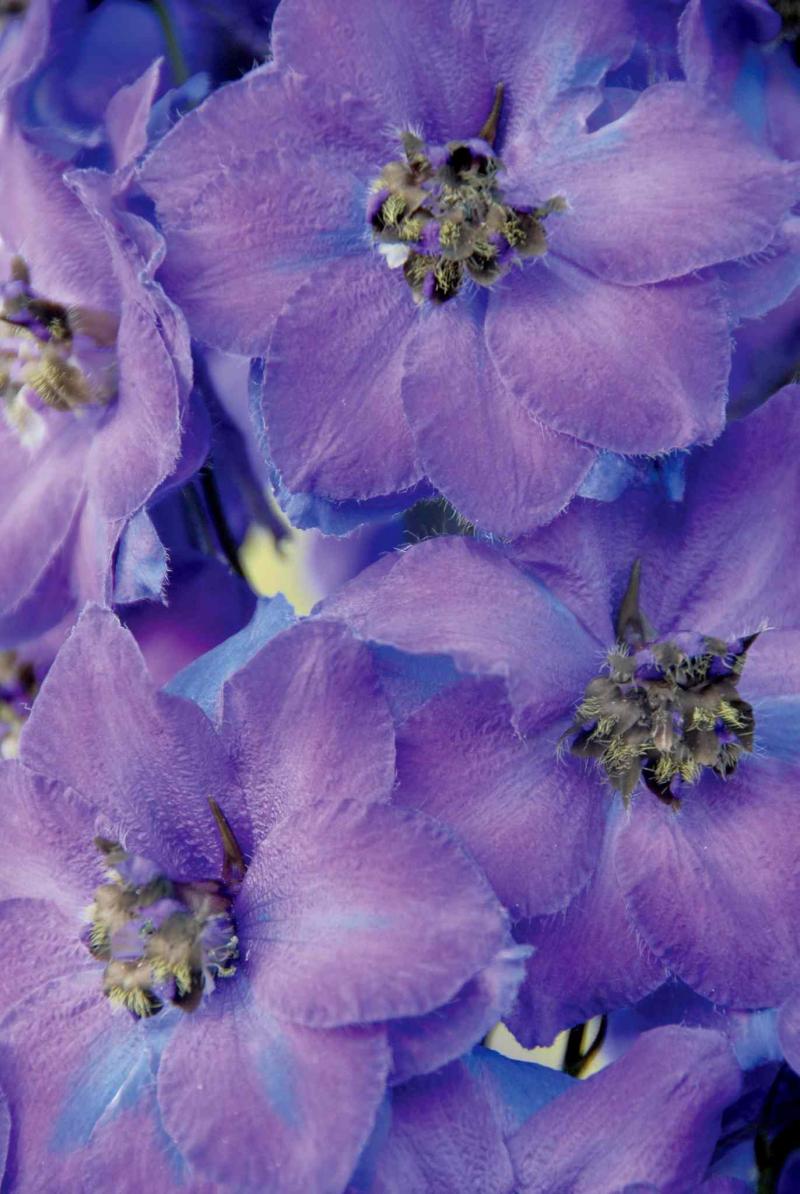
What about the queen of the back border, delphiniums? Locally, delphiniums may be difficult to find due to a significant crop failure this year.
One option may be to purchase them online through a specialty nursery such as Blossom Hill Nursery located just north of Peterborough, Ont. I met owners Joe and Hazel Cook last year when they were in town for the Canadian Peony Society's annual show.
Situated on a 23-acre farm, Blossom Hill (www.blossomhillnursery.com) sells field-grown peonies and delphiniums across Canada and the U.S.
Hazel Cook says Blossom Hill does not grow the familiar Millenium series, which were bred in New Zealand by Terry Dowdeswell. Hybridizers, they grow their own strain of Delphinium elatum and have won the only two bronze medals awarded in Canada by the famed international Delphinium Society in the U.K.
Shy away from delphiniums because of the possibility of wind breakage? While Cook says it's nice to plant where there is a windbreak, their delphiniums (which grow 150 to 180 cm) have strong stems and fare well in high winds when they are tied for support.
Cook places three bamboo sticks to the side of a clump of delphiniums and one to the back, tying garden twine to one stake and wrapping around, then tying twine from bamboo to bamboo, about 30 cm to 60 cm above the ground. "This allows enough support for the delphinium to move in the wind and the rain without breakage," says Cook who cautions that tying each individual stem is a lot of work that can also result in more breakage. Cook also recommends shaking off rain from the plant after a heavy rainfall.
As the plant matures and puts up a lot of stems, sometimes as many as 20, Cook recommends thinning out weaker stems as the plants begin to grow in spring.
"If you have five, seven, or nine strong stems," says Cook, "that's going to give you a much better show. The spikes will be more attractive and stronger."
Since the stem of delphinium is hollow, Cook recommends cutting delphinium close to the ground in the late fall to avoid the risk of the stem filling with moisture which can adversely affect the crown of the plant. Good drainage is essential to delphiniums' longevity and also lessens the potential of slugs and snails.
To improve plant vigour, delphiniums should be divided every three to four years.
Interestingly, Cook is not a fan of mulching delphiniums. These are hardy plants, says Cook, and covering them with mulch causes them to work harder and risks promoting rot.
Less work is a good thing.
John Tinkler, owner of Design Manitoba, has one of the most exceptional examples of a cottage garden in Manitoba. With flowering perennials in relaxed plantings and successive bloom periods, the seemingly casual randomness and colourful display captivates visitors and drive-by gardeners alike who crane their necks out of their car windows.
Punctuated by delphiniums in varying shades of indigo, blue and white, Tinkler appreciates not only their beauty but also their resistance to deer. They self-seed reliably.
Tinkler says that occasionally a few of the plants may be bothered by green worms that eat the flower buds and these he picks off by hand.
Perhaps the peskiest problem is the delphinium worm that likes to eat new shoots in early spring. I monitor my delphiniums and simply pull off the affected leaves.
Delphiniums make a bold statement even when they are planted in singles either in the middle or back of the perennial border.
colleenizacharias@gmail.com