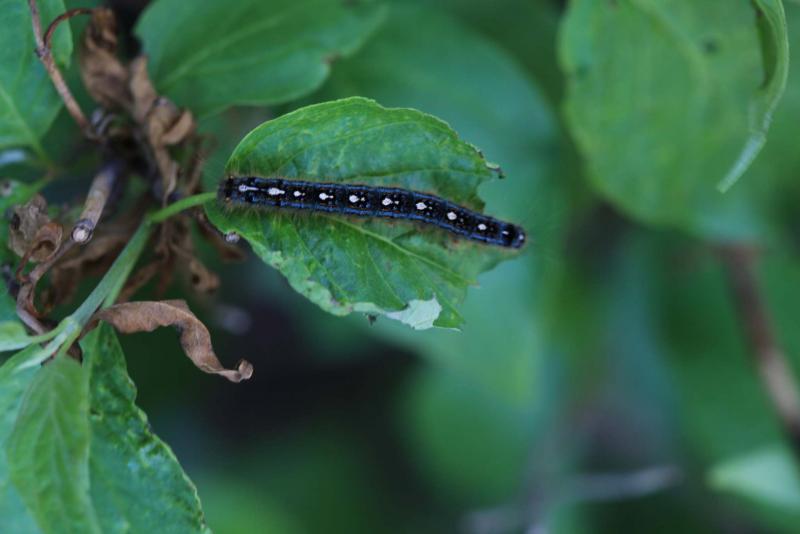
Trees and forests of many areas of southern Manitoba have been attacked and often ravished by the feeding frenzy of forest tent caterpillars.
What do we know about this creature? The adult female moth flies at night and settles on suitable trees usually on the bark of a tree trunk.
Aspen, poplars, maples and crab apple trees seem favoured for locations to lay her eggs, but as the young larvae grow they will move to almost any tree.
There may be up to 300 eggs in each egg mass. She covers this egg mass with a glue-like substance called spumaline. When the eggs hatch, the young caterpillars, called larvae, stay close together for protection and for warmth until they start searching for food.
Each evening, in Manitoba’s climate, the larvae come back together en masse for warmth and protection. They appear like a black patch, usually up to 10 inches long, depending on numbers. Look for these masses in the evening as this is a great time to get rid of them.
These caterpillars do not produce tents. As they grow, they molt and lose their early outer layer, and all subsequent layers with time. Then, they move around the twigs and branches depositing strands of silk which act like pathways for other larvae. They feed and travel more or less together as a group. During the day, older larvae will move much further away in search of food.
As the larvae grow larger, they lose their outer skins. This process is called molting. This happens about four or five times in their lives until they become a pupa — the transformation stage before becoming a moth. Each change is called an "instar," and they grow larger each time this happens. With age, they become more solitary in their feeding.
Looking at the research, it is not known why the larvae populations increase to very dense population sizes cyclically to cause an outbreak many of us are familiar with this year.
Perhaps the rise in population is a result of changes in the local climate especially due to high spring temperatures, and/or reduced feeding pressure from predators (mostly birds).
The forest tent caterpillar populations do move around, especially if they have stripped off most of the local foliage from trees. It is uncommon for the same area to be revisited by large populations of caterpillars in a subsequent year, or very rarely three years in a row.
Severe repeated outbreaks of caterpillar feeding are known to kill trees. I have yet to see whole trees killed by these pests in Manitoba. However, there was an unusual outbreak in northern Ontario that lasted for six consecutive years in the 1990s.
I am sure we all hope that such a calamity does not befall Manitoba’s trees. Usually parasites, severe weather conditions and heavy feeding by predatory birds keeps the populations of these ravenous insects in check.
Just in case, keep your eyes open for any of these dark crawlers next spring.
Michael Allen M.Sc.F., RPF (ret’d) is a consulting urban forester, tree diagnostician and certified arborist. He owns Viburnum Tree Experts. He can be reached at 204-831-6503 or 204-223-7709. His website is www.treeexperts.mb.ca.
viburnumtrees@shaw.ca