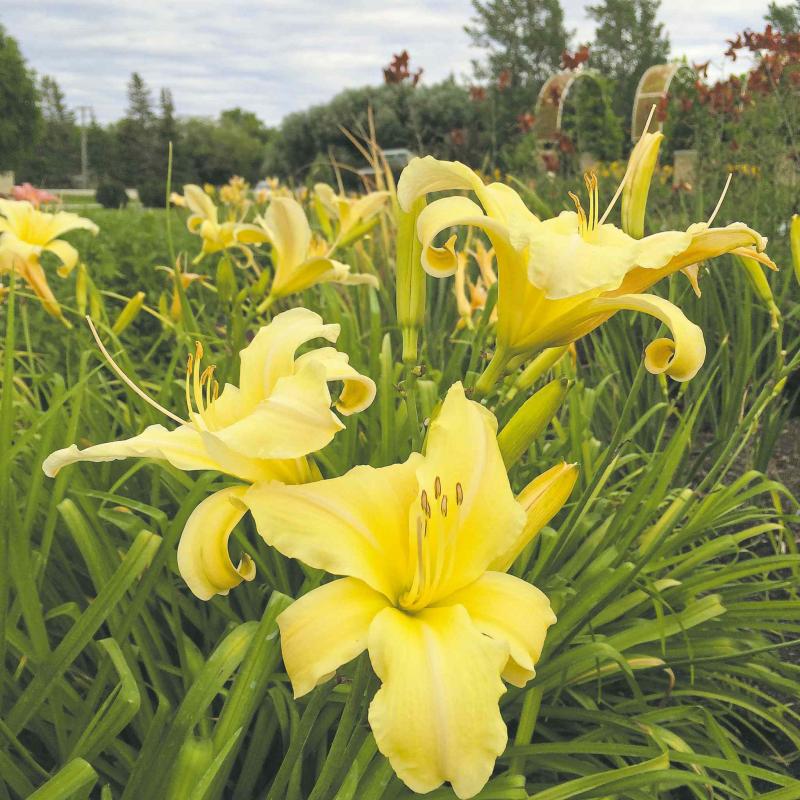
Some gardeners insist they hate Stella de Oro daylily. Too common, too much green foliage, and too yellow.
Like Stanley Kowalski bellowing out "Hey Stella" in the Tennessee Williams' play, 'A Streetcar Named Desire', some see this persistent but common daylily with its perky yellow flowers as no more than a compromise.
If you've turned your nose up at Stella de Oro's trumpet shaped flowers all summer long, you may be showing her some grudging appreciation these cool September days. When many other perennials have taken on a tattered, raggedy look at the end of summer, Stella is just going into her warm up act, blooming right up until early November.
Reliability is never boring. After a growing season of high humidity and wilting temperatures, vigorous and pest resistant daylilies are the least likely plants to show any signs of stress. No offence to Stella, but with more than 75,000 registered daylily cultivars why would you give her any more than a bit part in your garden?
Judy Stamler is an East St. Paul gardener who unabashedly loves daylilies. Last fall she counted more than 450 daylilies in her garden. She has her favourite varieties, such as South Seas, a fragrant coral-tangerine daylily with ruffled edges. Tuscawilla Tigress, a bright orange semi evergreen variety with a gold coloured mid rib and chartreuse throat and Frosted Vintage Ruffles daylily in a soft blend of blushing pink with creamy yellow, are two other favourites. Prolific bloomers, each with more than 200 flowers, Stamler encourages even more blooms by regularly removing spent flowers and stalks, also called scapes.
With heights ranging from 56 cm to 76 cm and bloom sizes up to 18 cm, Stamler's premium daylily collection is a sight to behold. "All daylilies have beauty in their own right," says Stamler who adds that the kaleidoscopes of colours and flower forms almost sing out to her. She is also attracted to the illusion of glitter on the petals, called diamond dust, which sparkles in the sun on some of the varieties.
While many gardeners plan on dividing some of their daylilies this fall, Stamler leaves this chore for spring. Usually if the plant has more than six fans (an individual section of the plant with its own leaves, crown and roots), she digs out the entire plant and washes away all of the soil from around the roots. Using her fingers, she takes time to carefully pry the tubers apart into separate pieces with roots attached ensuring that no damage or injury is caused. It's a hard job, she says, but the results are much better than simply pushing a shovel into the ground and removing a piece.
In the fall Stamler does only a minimal amount of tidying up in her daylily garden to ready it for winter. She removes any remaining flower stalks but does not cut down the foliage. "If we have little or no snow protection when temperatures begin to plunge," says Stamler, "the foliage provides some protection to the plant's root system."
For added protection, Stamler mulches with wood chips to a depth of about 2.5 cm which also reduces water use and improves drainage. Yellowing leaves on daylilies, although part of the annual cycle, can also be a sign of too much or too little moisture. Each spring Stamler feeds her daylilies with bonemeal, magnesium, and calcium, working it in around the roots. Originally she purchased magnesium for her tomato plants but after sprinkling some into the soil around her daylilies, she saw an almost immediate effect in richer, greener leaves.
Stamler is looking forward to the arrival of plant catalogues from the many sources she has purchased from over the years. One source is Dreamy Daylilies, an Ontario daylily farm owned by Giles Boynowski, a former Winnipegger. Boynowski is most excited about Primal Scream, a tangerine daylily with a chartreuse throat, and gold dusting on its narrow, slightly twisted tepals with loosely ruffled edges. At 86 cm tall, this multiple award winning daylily with huge 20 cm blooms will shine at the back of the border. Another two favourites include Countdown to Glory and Strawberry Candy.
Beausejour Daylily Gardens is preparing for its fall plant sale on September 19th. With thousands of plants including 650 daylily cultivars, visitors have an opportunity to choose from a wide range of healthy divisions. Many are from newer varieties but selections also include traditional favourites such as award winning Mary Todd, with ruffled golden-yellow blooms, and Geraldine Dean, an elegant rose coloured daylily with a pale pink midrib and yellow throat. I'm perhaps most captivated by Ming Snow, a delicate understated near-white beauty with hints of soft pink and a glowing yellow throat.
Carol Bender and Mary Veldman are among two of the dedicated volunteers readying the plants for sale. Bender says that with advances in hybridizing, there are more and more blossoms on daylily stems. Although each one blooms for only a day, there are easily 10 blooms on each stem. Bender and Veldman recommend that gardeners look for three or four-way branching. Every bud leaves its own little bud scar so you can count how many flowers a particular stem produced.
Veldman also suggests planting daylilies that bloom early, mid season and late season for a succession of blooms.
Bender says the recipe for healthy daylilies is a simple one -- good drainage and full sun together with good housekeeping practices. Next year, Beausejour Daylily Gardens will see a number of enhancements thanks to a grant from the Canada 150 Fund, recently awarded to the Town of Beausejour.
Have you ever thought about trying your hand at hybridizing? Ernie Brown, a Transcona gardener, became interested in hybridizing his own daylilies out of curiosity as to the different types of combinations he might be able to create. Today his collection of daylilies numbers more than 150, most of which he hybridized or grew from seed.
Brown begins by assessing his daylilies for the characteristics he most favours. He looks for good substance to the petals, how well the bloom and overall plant is formed as well as the colouration of the petals and throat or whether the flower has a faint or barely visible halo between the throat and tips of the flower segments. Once he has selected the parents, he begins the process of cross pollinating while the plants are blooming.
He chooses a calm, still day, usually early morning when blooms are fresh and fully opened. He carefully removes one of the anthers from a selected daylily, the pollen parent, by pinching it off at the base. He gingerly transports the anther with its pollen grains to the receptive flower, rubbing the pollen grains onto the tip of the stigma.
Brown applies a small white label to the back of plants he is crossing and waits for the plant to develop a seed capsule. Once the three-angled seed capsule begins to darken and harden and is almost ready to split, Brown harvests the seed and labels the plant. He germinates the seed in early winter, using a sterile potting medium with a bit of fungicide. Brown says it is important to maintain even moisture and good ventilation.
Once the seeds have germinated, Brown transplants them to 10 cm pots and moves them to a sunny window or beneath grow lights. By spring, Brown moves the seedlings into his sunroom. Once temperatures are above freezing, he begins to harden off the seedlings in a designated, protected area of the garden. Often he transplants them into the garden in the fall.
Brown says patience is required as it can take almost five years for a daylily grown from seed to reach flowering size. He says that daylilies are like people, they don't all grow exactly the same. Waiting to see the results of his hybridizing efforts, though, has been an adventure for the past 15 years, resulting in many unique varieties.
colleenizacharias@gmail.com