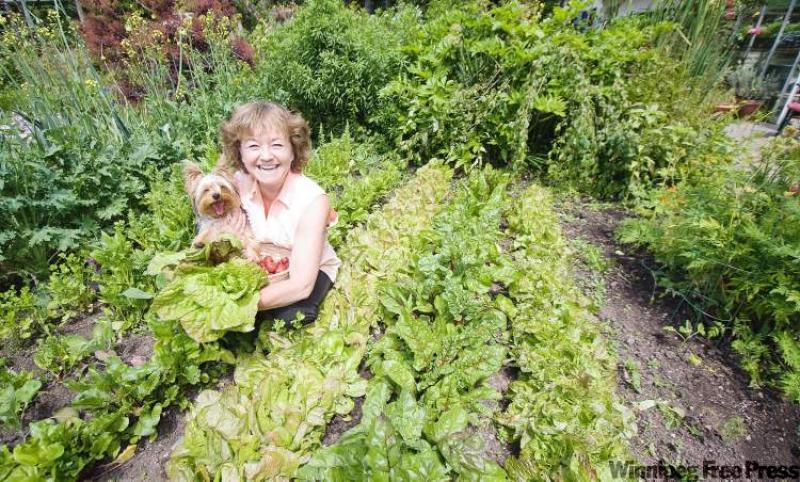
Think for a moment about how you spend your time, Victoria gardener Carolyn Herriot advises.
"Prioritize what's important and give more weight to the things that matter in your life," said the author of The Zero Mile Diet and A Year on the Garden Path. Herriot is betting you'll choose your health, the foundation for everything else you do.
"We're in this health crisis where we are getting sicker and sicker and most of those illnesses are preventable, diet-related problems," she said. "If we pay more attention to what we eat and get out in the garden and reconnect with the Earth and nature and live a more natural lifestyle, we will all be better for it."
None of this is rocket science, she said.
"Spend a bit more time being a human being, rather than a human doing," she quipped. "A lot of people are caught up in this vortex of busy-ness, and it actually just distracts us from the things that really matter."
The solution, she maintains, is right outside your window. Growing food not only ensures you will unplug from the churn of the modern world, it will improve the quality of your diet and give you a little much-needed exercise to boot.
Gardening is also a surprisingly intellectual pursuit, with a rhythm humans are very much evolved to follow.
Gardeners need to pay attention and adapt to the changing climate, said Herriot, whose decades of observant gardening make her aware of the shifts.
This growing season is a case in point.
"People are planting and then thinking their seeds are no good when nothing comes up, but it's all environmental," she said.
This spring has been particularly challenging for food gardeners. Long periods of dark cloud, rain and cold have set most planting dates back at least a month, despite the hot July.
"Twice as much rain, half as much sun," intoned Herriot. "We've seen springs get longer and cooler generally and it's not been heating up until late June, early July."
Even with a greenhouse, Herriot was challenged to grow heat-lovers such as peppers, eggplant and basil.
"I kept them on bottom heat for a long time," she said.
For a seed saver such as Herriot, the shorter growing season means she needs to push her plants to maturity and collect seed during a much-compressed growing season.
"Seeds are wonderful little packages that sense moisture and temperature, and to succeed, we have to do that, too. We have to start thinking like a seed," she said.
Herriot's gardening volumes encourage a leafier mindset. The Zero Mile Diet, her 2010 bestseller, blends sound advice for seed selection, soil preparation and innovative planting techniques with tips on which plants would like to share a bed for mutual benefit and protection as well as instructions for seed saving and recipes for cooking.
"There are hundreds of books about vegetable gardening, but my book is about growing food," she said. "It's about how to feed yourself from the backyard."
People in wealthy countries are drowning in food, but there has never been more distrust of food and the global food system, she said.
"They have lost faith in the calibre of the food that is being provided to them," Herriot said. "You really don't know what you are getting."
Plant the seed yourself and you will know exactly what you are eating.
Hot tip: Weed on a sunny day after a heavy rain or watering. The soft, moist ground will give up the weeds, roots and all. Then leave them on the surface of the soil to dry and die in the sun.
-- Postmedia News
A Year Round Guide to Growing Organic Food
By Carolyn Herriot (Harbour Publishing, $32.95)
Herriot distances herself from typical gardening guides by giving explicit instruction in feeding yourself from the backyard. She outlines steps for soil building, recommends tools and gives extensive natural language instruction for growing dozens of crops. Add sensible garden design plans and recipes for your garden bounty and you have a fairly complete guide to food gardening.
Urban Homesteading: Heirloom Skills for Sustainable Living
By Rachel Kaplan (Seahorse Publishing, $16.95)
Kaplan's manual for farming your yard is part master's thesis, part philosophy text and part manual for living with creatures and plants in a confined space. The book is heavy with tips for space management -- likely your biggest obstacle in the city -- and traditional skills such as canning, animal husbandry and bee-keeping. Kaplan is long on making it work and leaving a light footprint on the earth. If you are pondering a more sustainable lifestyle, Urban Homesteading is a good way to survey the possibilities.
Everyday Eden: 100+ Fun, Green Garden Projects for the Whole Family
By Christina Symons and John Gillespie (Harbour Publishing, $24.95)
As the title implies, Everyday Eden is a family-friendly introduction to the joys of growing and eating food. Projects range from living fences and homemade biodegradable seeding pots to making compound butters, salad dressings and cocktails with your garden herbs. The outdoor projects from landscape designer John Gillespie will certainly give your yard a thoughtful and funky texture.