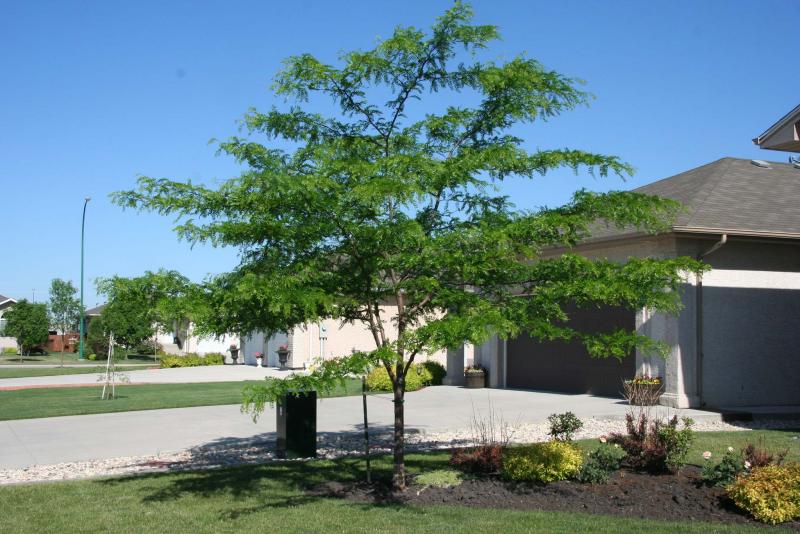
Clients and readers often ask me what type of trees they should purchase. My typical response to this question is, "How much space do you have in your yard?" There is an observation that I am constantly encountering: people typically grow more trees than they can suitably accommodate on their property. Overcrowding of trees leads to many stresses, usually related to the tree’s inability to deal with the overcrowding, susceptibility to pests and diseases, as well as increased numbers of dying branches from reduced sunlight.
A very large, prominent, tree can cause increased growth stresses in nearby smaller trees. The exception to this statement relates to trees growing naturally in a forest environment, where only the best-adapted trees to the forest environment survive.
There is no rule of thumb that relates ideal mature tree size to appropriate lot size. One of the most common tree problems relating to overcrowding is the planting of spruce trees close to each other. I have seen this situation thousands of times. For example, a Colorado spruce will grow up to 20 metres high with a width in excess of eight metres. If you plan to buy one or more trees especially for a new yard, I would advise you to do some research first. Measure the size of your property where the tree or trees will be planted. Keep in mind if you locate the tree near your property line, your neighbour will experience shading or even fence crowding issues. Keep your tree well within your property area. Never plant a tree underneath or directly above buried power and utility services. Manitoba Hydro can mark buried services for you.
No tree is free of problems, especially as it ages. If you have a particular species of tree or trees in mind, look it up online. The trees mentioned here have proved successful as long as they are not planted too close to other trees. All trees need appropriate and frequent maintenance.
Be sure you do not neglect the care of newly planted trees. New trees need frequent watering, especially in the first two to three years of planting. I recommend if you do need to get a new tree, there’s usually a greater variety of trees available in the spring; however, there may also be excellent deals on late summer and fall trees.
This year I have noticed an increase in the number of hackberry trees, whose leaves have been greatly infested with hackberry gall mites. The leaf damage makes the tree very unsightly looking. However, I never have seen these trees die from a heavy gall mite infestation.
Enjoy your new and existing trees. Do not neglect their care.
Michael Allen M.Sc.F., RPF (ret’d) is a consulting urban forester, tree diagnostician and certified arborist. He owns Viburnum Tree Experts. He can be reached at 204-831-6503 or 204-223-7709.
viburnumtrees@shaw.ca