That's right, it's the houses that moved.
All were among 12 slated for demolition to make way for the University of Winnipeg's expansion to Langside Street, but a unique partnership between neighbourhood advocates, the Housing Opportunity Partnership, the U of W and developer Man-Shield Construction came together to move -- not destroy -- the homes.
"The beauty of reusing the homes is that it's cheaper than building new, and you're not dumping useful homes into a landfill to rot," said Don Miedema, housing co-ordinator for the Spence Neighbourhood Association.
"These are classic homes (about 80 to 90 years old) that fit with the character of the neighbourhood. They'll provide excellent, affordable homes for people for many years to come."
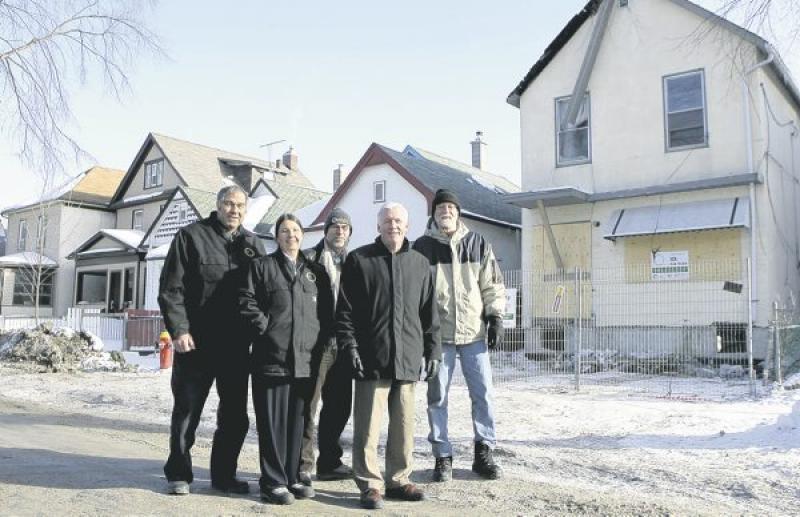
The last of the homes was moved Feb. 7 and placed on its new foundation at 421 Victor St. The others were moved to 203 Maryland St., 580 Furby St. and 598 Balmoral St. over the past four months.
Peter Squire, market analyst for the WinnipegREALTORS Association and board member of Housing Opportunity Partnership, said the homes were slated to go the way of the nearby Winnipeg Roller Rink, but some innovative thinking prevailed.
"Several organizations got together and tossed around the idea of an initiative," he said. "That initiative involved removing houses from one location, preserving them, and then moving them to another location to be re-used. Eventually, we (Housing Opportunity Partnership, Spence Neighbourhood Association, Westminster Housing and the University of Winnipeg's Community Renewal Association) decided to give it a go."
Miedema said it was a chance to bring some good out of a less-than-ideal situation.
"When ManShield bought the roller rink just off Portage Avenue, it was disappointing -- a good chunk of recreational space was lost," he said.
"There were 12 houses in the general area that were going to be demolished. After discussions with the University of Winnipeg and ManShield's Joe Bova, we decided to try and put some of the houses to good use. After examining the houses, we found that four of the 12 were fit to move to other locations in the West End."
"We (HOP) were delighted to be one of the groups asked to save one of the houses and move it to an infill site," Squire said, adding the 421 Victor St. lot had sat empty for a few years. "It took a while to figure things out, but ultimately, we all agreed we could afford to undertake the project. I would be lying, though, if I said we went in without feeling some trepidation. We'd never done it before, and weren't sure what it would cost when the dust finally settled. Fortunately, the University of Winnipeg helped with the move."
Just as he suspected, the process was more involved than first thought.
"As we found out, there are so many things you have to do to prepare a home to be moved," Squire said. "First, we did a complete environmental assessment; it turned out there was asbestos in the home that needed to be removed -- that cost $8,000. We then had to bring the home back to current building code standards (R-20 insulation, as well as a fire-retardant wall on the north side). Of course, we also had to get removal and location permits. The front steps had to be upgraded, four new windows had to be installed, and we removed and demolished the chimney stack (another $1,500)."
At long last, the home was ready for Reimer Building Movers to move -- and then place atop -- the new foundation waiting at its new home on 421 Victor St.
"It was like taking a small parade down Portage Avenue," he said of the move, which took place in the wee hours of Feb. 7. "There was a snowplow, a Manitoba Hydro truck (to take wires down), police and a tow truck in case we had to remove cars (in front of the lot on Victor Street) to make way for the home's placement. Fortunately, everything went well. Very little was disturbed. Once the services are hooked up, it's just a matter of rehabbing the home to make it available to a first-time buyer in the spring. Best of all, the basement is brand-new and fully usable."
Miedema said he's very pleased with how the move went.
"It was a real group effort," he said. "A lot of credit goes to The University of Winnipeg, which not only gave us the houses to move, but covered the cost (which came to about $20,000 per home).
He said that there are more homes to come to different areas through the city's west end.
"We have four more homes booked to go, and we will be up to a total of 30 infill homes by the end of this year, homes that have been added over a four- to five-year period," Miedema said. "I also have to give credit to Homeworks, a federal/provincial program that gave us $160,000 to pursue revitalization projects in the West End."
Squire says while it's encouraging to see the West End's revival continue, there's much more work to be done.
"Of course, it's exciting to see more progress made, but the work never stops. From HOP's perspective, it's our 60th home in the area, so we're extremely pleased to make a home out of a house that likely would have been demolished -- it's great to keep existing homes if at all possible.
"The bottom line is that it's another house available for habitation that will continue to enhance area renewal. Our next project will be an infill at 531 Toronto St. More infill projects are also part of our mandate. Additional thanks go out to Don Miedema, who really quarterbacked the project, Tom Jauch and to the Winnipeg Housing and Homelessness Initiative, who supplemented financing."
Now that the homes have all been moved to their new locations, Miedema says his immediate concern is to replace the recreation space lost when the roller rink was removed.
"I'm anxious to see that space replaced in some form," he says. "We're working to reinstate it with Friends of the Sherbrook Pool. If we can do that in time, we'll really be in business."