Question: I enjoy reading your Free Press columns and I read your recent article about water infiltration in chimneys. It got me to thinking about a situation at our church. Water lies on a sidewalk and up against an exterior wall. Water seeps into the crack between the foundation and sidewalk and down the wall and comes out on a stair landing inside. The stair landing and the depth of the concrete foundation wall are at the same elevation. The crawl space below this area has a dirt floor. This situation occurs when it rains, as water pools in this spot as it comes off the roof.
Can you recommend a good sealing material that church members could install in the crack or is there another, better solution? I suppose removing the concrete and re-pouring with a bit of slope would help, but of course we are looking for an inexpensive solution if possible.
Thanks for your advice.
— Brian Crow
Answer: Solutions for moisture intrusion into basements and crawl spaces often can be traced back to poor water-management issues. Improving grading and running roof rainwater away from the building may do more for stopping the seepage than a good caulking job.
Stopping water from seeping into basements or crawl spaces in our homes is one of the most common concerns among homeowners. This also applies to commercial or industrial buildings, such as your church. The key to this is trying to divert rainwater and snow melt away from the building as quickly and efficiently as possible. Caulking the joint between the sidewalk and the foundation with a good exterior grade sealant may help somewhat, but the water will usually find it way inside if it is allowed to collect near the foundation.
You are correct that removing the concrete from against the foundation may help prevent seepage, but I would be reluctant to replace it and would prefer to see soil and sod used, or other landscaping materials that would allow for future erosion and settlement remediation. If new concrete was poured, it undoubtedly would settle again, leaving you no further ahead. Also, safe entrance for congregants may be compromised if you removed the sidewalk and replaced it with soil only. The more cost-effective approach may be to put full efforts into better water management.
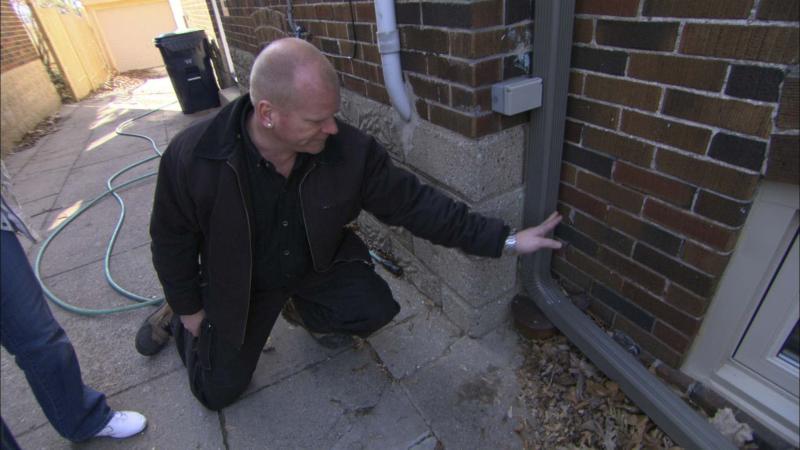
The picture you included with your inquiry shows a roof downspout dumping directly beside the foundation, on to the sidewalk, in the area of leakage. While the stairs beside this area may create a bit of a bowl effect, trapping rainwater, there is currently no effective way of channelling the water further from the building. The solution could be as simple as installation of a proper downspout extension on the elbow, to divert the water two to three metres from the building. There, the grading may be better, or it could be improved to provide a more adequate slope for the water to drain away. That, in combination with sealing the joint between the sidewalk and foundation with a good exterior sealant, available at any home centre, may be enough to minimize the seepage. If the downspout extension is not practical, as it might block the sidewalk, other alternatives are needed.
If a simple downspout extension is not possible, relocation of the downspout may be the next best approach. Without seeing the building and surrounding area, it is difficult to determine if this is practical, but it often is. Moving a downspout to the opposite end of an eavestrough may only require re-sloping the trough, patching the old downspout drop area and installation of a new downspout at the other end. If the downspout is one of several on that side of the building, due to the length of the roof, then diverting more water to the other drains may also helps stop the seepage at the trouble spot. This may require replacement of the eavestrough with a larger capacity unit or re-sloping the existing gutter, but that should still be a moderately priced repair.
The final option may be to install a rainwater-collections system — such as a rain barrel — to prevent excessive pooling in that area. This water could be used to water the grass or flowers around the building, as well. The downside of this is that any rainwater-collection system would have to be removable for the winter and an overflow hose or pipe would have to be installed to prevent the same issue. Those last two concerns may make the rain barrel impractical, so the other alternatives may be better options.
Stopping water from leaking into a basement or crawl space by patching cracks in between a sidewalk and the foundation wall can be somewhat effective, but better water management is also needed. Getting the rainwater away from the building, with a combination of better eavestrough installation and improved grading, may be the key to maintaining a dry foundation.
Ari Marantz is the owner of Trained Eye Home Inspection Ltd. and the past president of the Canadian Association of Home & Property Inspectors — Manitoba (cahpi.mb.ca). Questions can be emailed to the address below. Ari can be reached at 204-291-5358 or check out his website at trainedeye.ca.
trainedeye@iname.com