Will this be the year you decide to have a four-season landscape?
While a blanket of white in the winter months is inevitable, the all-season garden makes it possible to have varying colour schemes with the capacity to both direct and command attention no matter the time of year.
In addition to colours ranging from muted to vibrant, the plant material poking out or standing above the snow line in your garden can provide changes in height, form, structure and texture.
On his travels throughout western Canada as an eco-tour guide and in the landscapes he designs for his clients, prairie author and horticulturalist Lyndon Penner has a passion for plants with native hardiness and especially those exhibiting a distinctive architecture.
Penner's fourth book, Native Plants for the Short Season Yard (Brush Education Inc.) is scheduled to be in bookstores by the end of March and will include recommendations for designing with native plants on the Prairies.
"Even in winter when a garden is in its rest period, it should continue to feel like a garden," says Penner. When homeowners cut down all of their perennials in the fall, leaving only stubs, he says the landscape becomes a big white postage stamp once the snow falls. "Could we please leave some grasses standing or some seed heads to stick out of the snow to show that a garden lives here?"
Known for his love affair with bark, Penner extols its virtues in the landscape to any homeowner who laments their dreary view in winter. Pincherry (Prunus pensylvanica), a selection of the native pincherry, is a small slender tree with four season interest. On bright days, the sun's rays glance off the glossy, bronze-coloured bark and on dull days, the sheen of the bark stands out. Mary Liss is a particularly beautiful variety with an abundance of large fruit to attract birds.
Penner also admires the year-round landscape value provided by the chalk-white bark of the native paper birch (Betula papyrifera). He recommends drawing attention to the bark by adding a string of warm white lights.
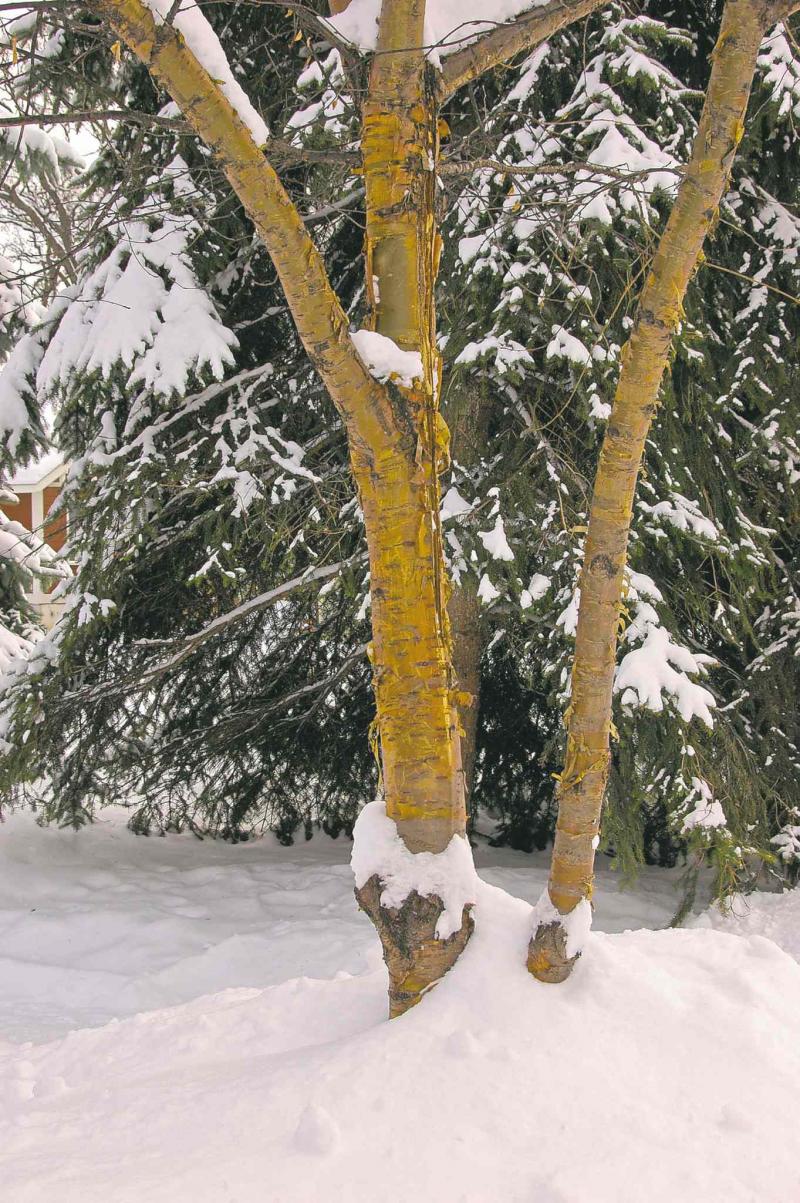
One of the most scintillatingly beautiful examples in Manitoba of bark in all its glory is Goldrush Amur Cherry, a fast growing hybrid cultivar developed at Jeffries Nurseries in Portage la Prairie. Resistant to frost cracking, its flaky, exfoliating bark with uniquely golden-amber colour has the power to transform your winter landscape.
Penner says the beauty of Redosier dogwood, a native species with bright red twigs, is best appreciated against a backdrop of white snow. Recently one of his clients, an artist who lives in Calgary, specified she wanted really rich, vibrant colour for as much of the year as possible. Along her driveway Penner planted a row of Mugo pine and an alternating row of Redosier dogwood. Now the brilliant red colour of the dogwood branches against the bright green colour of the Mugo pine combines with the intriguing seed heads of herbaceous perennials, such as Echinacea and rudbeckia, for a display that is as equally captivating in winter as it is in summer.
While Mugo pine is not native to the Prairies (rather, central Europe), it is hardy to Zone 2 as is Redosier dogwood. As a general rule, when Penner is designing a landscape, he tries to ensure that evergreens make up 25 per cent of plants selected for the landscape so there is something to look at during the winter.
A favourite evergreen is Swiss Stone pine. With long, luxuriantly soft, blue-green needles, this very slow-growing pyramidal evergreen is exceptionally resistant to winter burn. Penner says the use of evergreens and conifers in the landscape adds to the way we perceive winter. Gardening should relieve rather than cause stress, so it is important to execute the basics of maintenance. In order to look their best, evergreens require adequate watering and most would rather not be situated in west-facing corners where they take the brunt of the elements.
Penner also recommends Iseli Fastigiate spruce, a lesser known Picea pungens variety with bright blue needles. He describes it as a more columnar, narrow version of the Colorado Blue spruce. Slow growing, it is only three metres wide at maturity. Intrigued, I contacted Fred Driedger, owner of Evergreen Valley Nursery in Brandon.
Driedger likens the teardrop shape of Iseli Fastigiate to a lightening rod with its very sharp, pointy top. The needles are not as thick or dense as those of a Colorado Spruce, and are somewhat softer. Driedger has seen this variety growing in Brandon and downtown Dauphin.
Developed in Oregon where temperature extremes are rare, Driedger suggests inquiring at your local nursery as to where it was grown. If it was grown on the West Coast and has not been acclimatized to a minimum of two Manitoba winters, there could be the risk of winter damage especially if it is grown in a wide open location. "Nothing prepares a plant for our climate like being first acclimatized," says Driedger.
Driedger also suggests another Picea pungens variety, Montgomery spruce. Alas, it is not easy to find at local garden centres, but don't let that prevent you from asking for it! More widely available is Globe Blue Colorado spruce but you shouldn't be misled, says Driedger, by the mature size quoted in most plant catalogues which describe the plant as growing to only 1.25 metres. That height expectation, says Driedger, is very likely to be exceeded. Now I understand why the two in my backyard, after 20 years, are more than three metres tall.
Tough as old boots, Globe Blue Colorado spruce loves our climate and resists any browning.
This spring expect to see Bylands Blue dwarf spruce, a new introduction that is true to its billing as a dwarf spruce that won't outgrow its allotted space. Jan Pedersen, sales representative for Bylands Nurseries in Manitoba, Northwestern Ontario and Saskatchewan as well as former owner of Shelmerdine Garden Centre, has trialed Bylands Blue in his Winnipeg garden for the past three winters.
A cold hardy short-needled spruce, it boasts long needle retention so is less prone to needle loss on the inside of the tree. Pedersen describes its intense blue colour as summer sky blue.
I like seeing red at any time of the year but especially in winter. Pedersen has piqued my interest with Proven Winners' Little Goblin Holly (Ilex verticilla). A new introduction for spring, Little Goblin is the first ever tetraploid winterberry with extra big and abundant rich-red berries. Picture this compact plant (only 1.2 metres) in your winter garden, its colourful stems perfect for snipping and adding to seasonal displays.
Only minimal pruning to remove any dead or broken branches in early spring is necessary. What will be necessary, however, says Pedersen, is that Little Goblin, a female plant, be provided with a mate or pollinating male plant in order to produce berries. The ideal companion is Mr. Poppins Holly, a compact male winterberry that does not set fruit but serves as a pollinator. For now both plants will be sold in separate containers although Pedersen expects that eventually both will be in one container.
Ilex verticillata has a preference for well-drained, slightly acidic soil. At planting time, adding peat moss to the planting hole and mulching around the base of the plant (but not against the stems) with a layer of pine needles can help to acidify alkaline soil.
Penner says it's great whenever a plant tag states a plant provides winter interest but then it's up to you to figure out where to place it in the landscape. Consider the character of a plant's features and how it might look through the changing seasons ensuring you display plants to their best advantage.
colleenizacharias@gmail.com