Think of Margaret Roach as the gardening friend you've always wanted -- someone with an utterly spectacular garden who is completely willing to share all her secrets with you, especially on how to handle those myriad shady spots in your urban garden.
Her garden talks are full within days, her blog a cornucopia of stories, advice, photographs and a dizzying number of respondents. She is an award-winning garden writer whose book about the life of her garden, A Way to Garden, was named best garden book by the Garden Writers Association of America.
But that was in 1998, when Roach was in her first decade of garden writing, as garden editor at Newsday in Long Island, and then for Martha Stewart Living. She later became editorial director of Martha Stewart Omnimedia and then, in 2008, Roach dropped out to nurture her life in her own 2.3-acre garden in northern New York state.
It matters little that Roach doesn't live down anyone's street. Now, her fans gather online to follow her advice and garden inspiration at www.awaytogarden.com and avidly await her next book, a meditation on dropping out and tuning in, its title, And I Shall Find Some Peace There, taken from a line in William Butler Yeats's evocative poem, The Lake Isle of Innisfree.
In the autumn, Roach is in full gardening mode, preparing the soil in her garden beds to take the plants she is now dividing. Before she begins planting and transplanting, especially in shady areas where it might be cooler but is also more protected from the rain, she makes sure the ground has been well-soaked before digging or planting.
The point of this isn't to make a lot of mud, she says, but to ensure when she takes out a plant for division and transplanting, it doesn't come up with dry, powdery earth around it.
Fall is a time for heaving and thawing, which are very bad for plants, she says.
"In the fall, I wouldn't move things that have rhizomes above the ground, for instance a plant like Heuchera or Coral Bells. Look at the root system and you'll see how they anchor, just above the ground."
Geranium macrorrhizum, or bigroot geranium, is another plant she won't move in the fall.
"I love these plants, but they've got these big roots that lie on top of the soil and only tiny roots below that," Roach said. "Something like that won't stay in the ground if there's a frost."
On the other hand, she will move or just put in a plant like Geranium phaeum "Samobor," a perennial geranium she considers both showy and co-operative.
Basically, Roach advises looking at the structure of plants to decide whether or not to divide and transplant them in the fall.
"Ferns, for instance, the roots are almost at ground level. So I have to decide if it's better to wait until spring and give them a whole season to root in."
If a fern is in a pot, however, like Roach's favourite Japanese Painted Fern, she would plant it now.
But she's very much in favour of dividing those plants that can be transplanted.
"Division is an amazing thing," she says. "When I first gardened, I never touched anything and then I realized I could have 10 of that plant if I was more courageous."
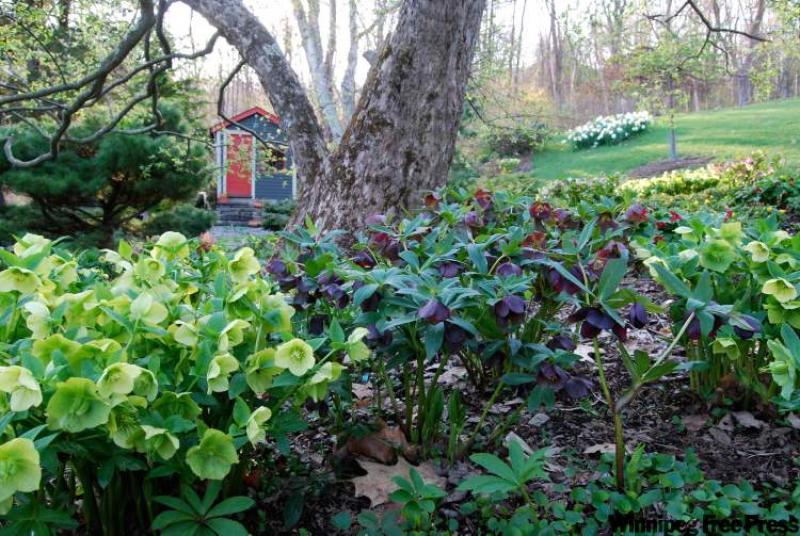
Fall is when she plants hellebores, taking the baby plants from an established plant, or buying new ones.
"If you have a plant that's really doing well, you're going to have babies, so have patience, and then moving them is easy work," she said.
While she wouldn't move a main plant now because of its large roots, she suggests buying some to plant, especially if you can take advantage of plant sales. They do well under deciduous trees, she says.
"That's plenty of light for them and they take very little care other than cutting off their evergreen foliage in the early spring, before the new foliage comes out."
Pulmonarias or Lungworts are great in the shade and can be planted now, she says. She favours Pulmonaria rubra, without the silver splashed or spotted leaves and bluish flowers.
"It has plain green leaves, but starts so early here that it's a cheery colour with its tiny red flowers," she said.
All Pulmonarias are easy, serviceable plants for brightening up shady areas, she said.
"You cut back their foliage after the flowers finish blooming, around the end of April or May, and you'll have nice foliage the rest of the spring and summer."
Another beautiful spring flower that can be planted now is Bleeding Heart, especially the gold-leaf Dicentra "Gold Heart." It's great for brightening up a shady spot, Roach said, though they'll go dormant when the summer gets hot and might leave a hole in the garden. "You may want to think about pairing this with some kind of annual."
A garden or composting centre would be the place to stock up on good composing material like leaf mould to use for these plantings, Roach says.
"You can't expect plants to do well, even though you have the right light conditions," she said. "There's no substitute for compost and good-quality mulch that will break down."
-- Postmedia News