QUESTION: We have a high efficiency furnace, with air intake that terminates on the outside wall under the bedroom floor. The floor is very cold and has produced frost in our closet. I believe it is also affecting the rest of our house’s heating. I would like some help on how this problem can be fixed?
— Jay Bourgeois
Question: I live in a newer house in the north part of the city, built in the late 1990s. A common feature in these houses is to extend the building out over the foundation, in key locations, in order to increase the floor space. The dining room has an alcove to accommodate a hutch, the powder room juts out to allow space for a washer and dryer, and the kitchen was enlarged by pushing it out a couple of feet. My problem is with the area in the kitchen. In the winter the floor in this region has always been noticeably colder than the rest of the floor. A couple of years ago, I put ceramic tile in the kitchen and went with the added expense of having in-floor heating installed. For the most part, the heated floor is really nice, but the area past the foundation is still cold in the winter. It is even more noticeable now with the ceramic tile, even though it is heated. Fortunately, this is not an area that you typically stand in, but I would still like to do something about it.
The void spaces under the floor are accessible from the basement. They are currently filled with pink insulation and sealed over with vapour barrier. I was thinking that if these were opened up to allow the basement air to circulate into that area it would help to keep the floor above warmer. So, is this actually a good idea or are there problems involved that I’m not seeing? After all, if it’s a good idea why didn’t the builders do it in the first place?
— Shaun Tyler
Answer: While these two questions may seem quite different on the surface, the problem of cold floors in areas cantilevered over foundation walls makes them quite similar in nature. Insulating these areas in a more modern fashion should help prevent them from freezing your toes on cold winter days.
One of the most common complaints homeowners have with newer homes is exactly what you both are describing. Cold floors near the outside walls of the home, in areas where the floor joists extend over the foundation walls. These areas often have floor joists cantilevered over the foundation, or a small portion of the floor extending out to allow an alcove or change in direction of the exterior walls. The problem with these areas is that they must have extra insulation installed to prevent heat loss from the home to the exterior, which also blocks heated basement air from warming the underside of the floor surface. Also, polyethylene air/vapour barriers must be installed and wrapped in such a way that they may further restrict warm air from entering these cantilevers. The insulation may prevent heat loss, but without a heated airspace and decent air circulation, the floor area will be colder, sometimes leading to condensation and moisture issues, as you have witnessed.
What must be done to improve this situation is to re-do the insulation in such a manner that it does provide good thermal protection from the outside temperatures, a continuous air/vapour barrier, but still allows some warm air circulation under the subfloor.
The first thing to clear up is that the fresh air intake in the first inquiry has nothing to do with the cold floor or closet. That only draws cold air directly into the furnace for combustion and could only affect the floor if it was located in between the floor joists. So, how do we go about reinstalling the insulation and air/vapour barrier to prevent the cold issues? There may be several ways to go about this, but the simplest may be from the outside of the home.
Removing the sheathing and any stucco, parging or other siding from beneath the floor joists should allow the best access. Once this area is opened up, the existing insulation, likely fibreglass batts as described in the second inquiry, can be removed. The poly air/vapour barrier may or may not have to be cut out with a utility knife, depending on the method chosen for re-insulation. Now that things are opened up, these joist cavities can also be accessed from the basement. The key to the next steps is to remember that the insulation must be installed at or just inside of the building enclosure and the air/vapour barrier remain continuous on the warm side of this insulation.
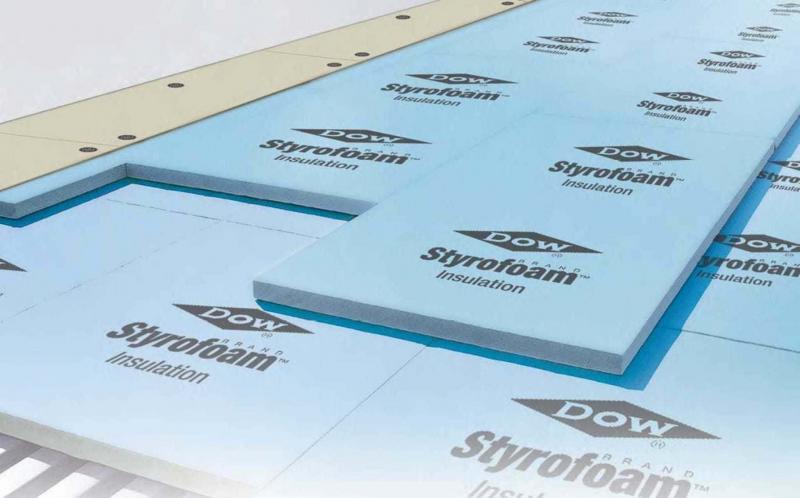
One way this can be successfully completed is by installation of extruded polystyrene foam sheathing on the inside of the rim joist and underside of the floor joists. If this insulation is installed in sufficient thickness and sealed at joints and seams, it should provide an adequate air/vapour barrier. Alternatively, blown-in high density foam can be installed on the inside of these same areas after new sheathing is installed under the joists. The best method may be to incorporate both of these materials, so that the maximum insulation value can be achieved, with the largest open airspace, for the least amount of expense and work. Once the insulation is completed, there should be several centimetres of open space inside the insulation for warm air circulation from the basement, to ensure the floor sheathing is not freezing cold.
Insulating cold cantilevered floor areas with antiquated fibreglass batts and polyethylene sheathing in a modern home will be the cause of the cold floors in both of your homes. Improving the insulation methods, by using higher density foam insulation, should ensure proper thermal protection while providing space for warm air circulation below the floor sheathing, ensuring a warmer floor.
Ari Marantz is the owner of Trained Eye Home Inspection Ltd. and the past president of the Canadian Association of Home & Property Inspectors — Manitoba (cahpi.mb.ca). Questions can be emailed to the address below. Ari can be reached at 204-291-5358 or check out his website at trainedeye.ca.
trainedeye@iname.com