JUSTIN SAMANSKI-LANGILLE / WINNIPEG FREE PRESS
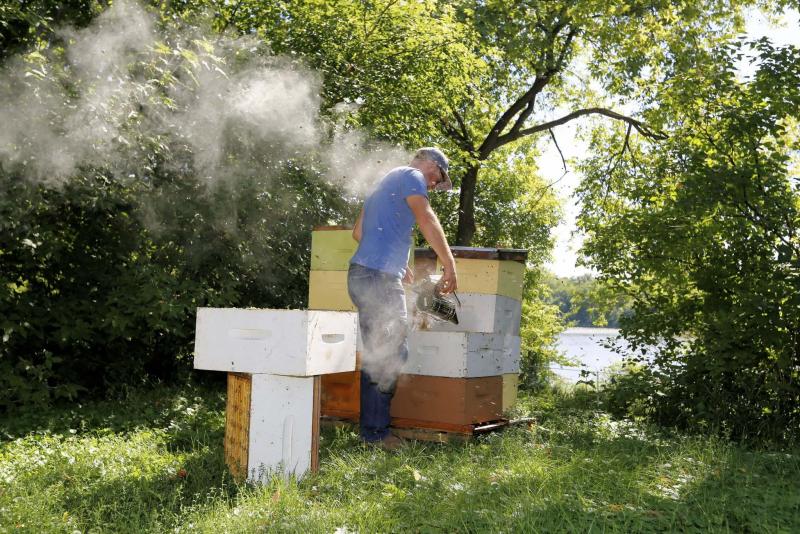
Chris Kirouac smokes the beehives before opening them up on the grounds of Marymound. The smoke is used to make the bees hungry enough to retreat into the hives to gorge themselves on honey instead of bothering the beekeepers.
Chris Kirouac knows there are more than a few Winnipeggers who would cringe at the thought of tens of thousands of bees living and buzzing in their neighbour’s backyard.
But he’s on a mission to show, when it comes to urban beekeeping, Winnipeggers have nothing to fear and a whole lot to gain.
"If you are worried about bees just attacking you and your family or your kids, that’s simply not going to happen," Kirouac said. "A big part of this has been getting the message out that bees and beekeeping in the city aren’t something that people should be afraid of."
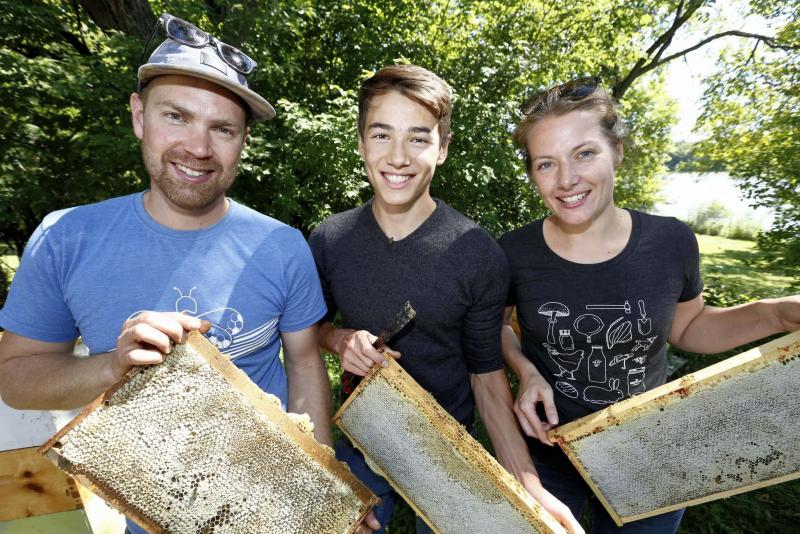
Kirouac, along with his wife, Lindsay Nikkel, make up the two-person team that runs the Winnipeg-based Beeproject Apiaries organization.
Beeproject Apiaries works to install and maintain honeybee hives in the city, while also working to educate people about urban beekeeping and its benefits to communities.
Urban beekeeping has grown in popularity in North America in recent years, and has become known as a way for those in cities to create local food sources, promote sustainability, improve declining bee populations, increase pollination and protect the overall ecosystem.
While many Canadian cities, including Toronto, Calgary and Saskatoon, allow beekeeping citywide, Kirouac said Winnipeg is moving slow when it comes to bees. Currently, beekeeping in Winnipeg is only allowed on the rooftops of downtown buildings and on rooftops at schools and educational facilities.
Beeproject Apiaries continues to push to have it allowed across the city and on people’s properties. But a typical urban beehive has as many as 20,000 bees living and working in it and Kirouac said that number can rise to approximately 50,000 when a hive hits its peak.
He knows it’s those numbers that make some people nervous.
"We know it intimidates people. People need to know there can be hives in their neighbourhood and they are not going to be overrun by bees."
In other cities, Kirouac said, hives in backyards are, for the most part, not something people notice — unless they are standing directly beside them or working with them.
"The only risk is when you’re opening the hives to do a hive check. In that case, you use smoke to control them and, if they are out of the hive foraging, they spread out very easily," he said. "Those with backyard hives tell me they haven’t noticed an increase of bees even in their own yards. Bees travel up to two miles if they have to. They don’t just stick around in the yard or in the immediate area."
He added Winnipeggers should be far more fearful of the wasps that can be a nuisance every spring and summer in the city.
"We understand those perceived risks, but there are large colonies of wasps all over the city that are far more menacing than bees," he said. "Bees don’t like to sting because they die if they sting — they only do that to protect the hives. Wasps don’t even randomly attack people, and they are far more aggressive than bees."
Kirouac has watched as the City of Winnipeg has slowly started to allow more beekeeping.
"Getting those at city hall on board has not been easy," he said. "We’ve had some champions at the city, but policy changes and redirecting just takes forever. It’s like the pace that glaciers move sometimes when it comes to food policy in general in this city."
A bylaw change approved in 2016 led to beekeeping being allowed on rooftops in downtown Winnipeg, and many businesses and organizations were already lined up to start beekeeping before the city even gave the endeavour its blessing. Beehives now sit on rooftops at a number of locations, including the Manitoba Hydro building on Portage Avenue, the Fairmont Winnipeg at Portage and Main and on top of the old orange caboose that sits at the Forks.
Hives also sit at Red River College, the University of Winnipeg, Marymound School and other schools and educational institutions within the city.
The Forks is now in its second season of beekeeping, and currently has four beehives.
Chelsea Thomson, marketing and communications manager for The Forks, said she remembers hearing a lot of fear and apprehension from Winnipeggers when they first found out beehives were coming to one of the city’s most popular destinations.
"The first year we did it, we posted on social media about it, and there was a good percentage of comments on social media from people that were concerned and some even thinking they would never be able to come back to The Forks again," Thomson said.
"A lot of people really don’t know the difference between a wasp and a hornet and a bee, and I had to deal with a lot of questions, so I had to educate myself, and what I learned is they provide far more benefits than they do risks."
One of the reason Thomson said she knows beekeeping is working well at The Forks is because people aren’t complaining.
"They really go unnoticed and that’s part of our teaching tool, to show that they mostly live quietly above and aren’t bothering anyone," she said.
Thomson said The Forks currently has several "green initiatives" that promote sustainability and being friendly to the environment, "so beekeeping was a natural fit for us."
"We understand the importance of bees and that their population is on the decline, and we want to be good stewards for the environment and educate people about the importance of bees," she said. "That’s one of our goals, and now we see it is catching on in the downtown, and we are one of many downtown partners involved in this, and we think that’s great."
The Forks plans to start selling honey from its honeybees at a kiosk sometime next week, Thomson said.
For Kirouac and Nikkel, promoting beekeeping is not just about bees and honey, but also about pushing those in power in Winnipeg to modernize food policies.
"We would like to see policies that promote urban agriculture, and we’d like to see a better and more comprehensive all-around approach to urban food production in the city," Kirouac said. "We all want food security, and this is about multiple issues and a plan to promote sustainability in the city."
They are also constantly working to bring people closer to bees, and push away all those fears.
"We really break down barriers when we have a group of individuals visit a hive. We know it’s a small dent to show 20 people at a time, but it is very effective and really enchanting for people, and can really break those fears and those barriers," Kirouac said. "It’s really empowering for people."
Pictures and videos of the work Beeproject Apiaries does can be found at instagram.com/beeprojectca, facebook.com/beeprojectca and beeproject.ca.