Now they're nesting in an eco-friendly yurt perched high in the hills a few kilometres north of Shawnigan Lake -- just about as far from the Mongolian steppes as could be.
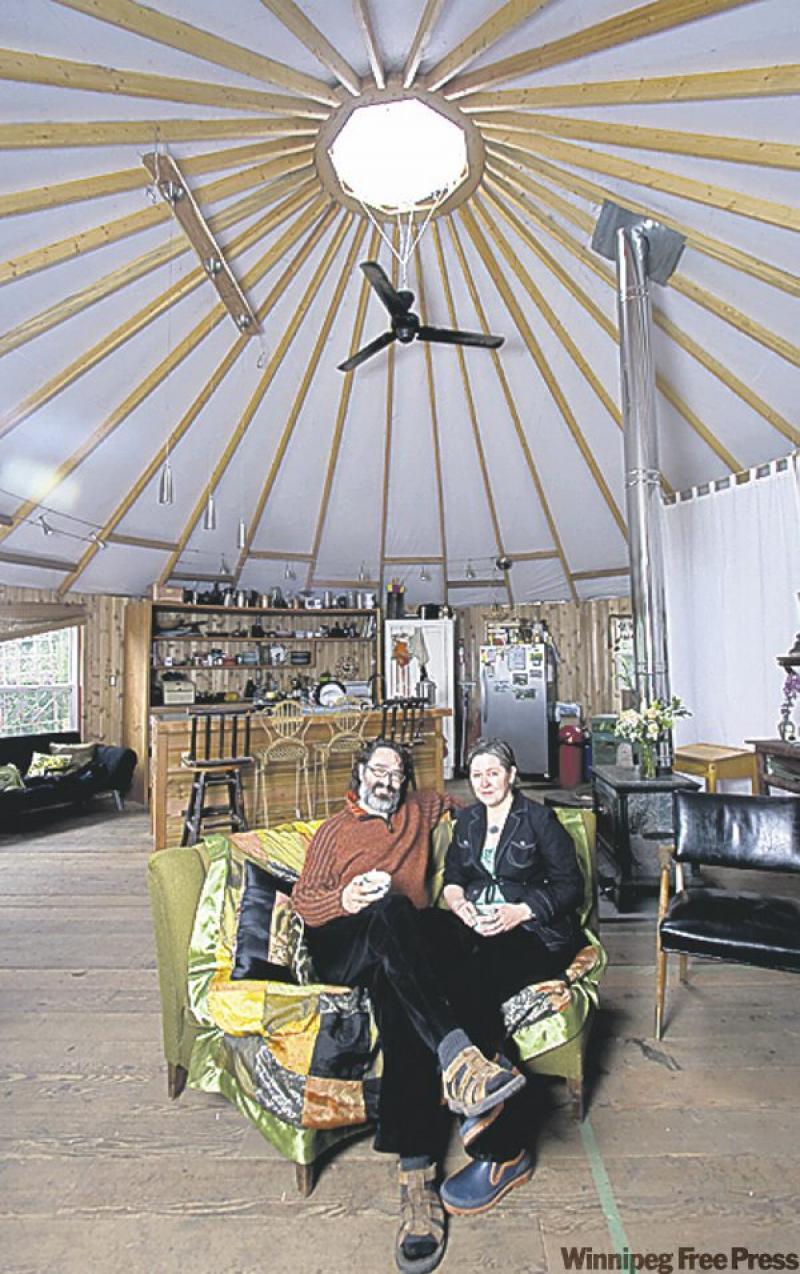
"They're weird spaces but they're beautiful," says co-owner Donna Morton of the family's rust-coloured canvas circular home that is just nine metres in diameter and peaks at a retractable opening 4.5 metres high.
For the executive director of the Centre for Integral Economics, a locally based non-profit that tries to redirect the marketplace toward sustainability, the longtime yurt fantasy came true in a move last June.
It was part of a determined desire to live more lightly and closer to the land -- in a 740-square-foot circle.
When visitors enter the surprisingly airy space supported by 30 rafters, the 42-year-old owner offers tea made from nettles harvested by her son, Wyatt, 10. He lives there every other week with her and her partner of six years, Dominique Collin.
Why a yurt instead of a cottage?
"There's something really different about being in a round space," she says.
Growing up in the mountains in California, Collin, 55, had always dreamed of building a house in the wilderness.
Both had wanted "a place to live that was healthier; that was closer to nature," Collin says, noting that humans have lived in round spaces, such as igloos or teepees, for most of their history. He quit his federal government job to give it a try.
For six months, they lived, worked, slept, entertained and had overnight guests in the yurt. Then they decided they needed more privacy, so they helped build a 200-square-foot sleeping cabin. Bookshelves are in the works and a tiny porch perfect for meditative moments is already there. The cabin contains a loft braced by a huge arbutus branch for Wyatt and topped by a skylight.
"I love sleeping up there," he says, scrambling up the ladder to show how it's done. He also spends adventurous times in his treehouse and is the go-to guy for kindling when the wood stove needs to be fed.
Sometimes they miss the comforts of regular home -- like a washing machine -- but they've taken a shine to a laundromat in Duncan. They do have a fridge, stove and other modern conveniences.
Solar gain
All the windows are clustered on the south side for passive solar gain. At this time of year, they need only a couple of hours a morning of a little electric baseboard heater turned on low. "Otherwise, the solar heat lasts all day," she says. "Same with lights -- we don't turn on lights except at night."
In the winter, the yurt is warmed by a large soapstone wood stove.
It's not all about the yurt.
The duo built a cedar outhouse that contains a composting toilet. A bit downhill sits a recycled shower/bathtub they picked up for $50, braced by a wooden lean-to.
"It's really, really beautiful to shower outside -- but you have to get used to the spiders," Morton says.
They plan to have storage space and a permanent bathroom with a second composting toilet under the yurt, but will keep the natural rock, both for flooring and a tub surround. Guests -- and there are plenty in summer -- bunk in the vintage Airstream trailer on the property, and both adults have work trailers on the property to make sure that Collin can home-school Wyatt in peace and quiet.
The couple acted as their own general contractors/architects and planners, responsible for studying and buying nearly all the used and new green materials. Various tradespeople -- such as an electrician -- were hired and three builders along the way. Aptly named Dan Green helped with "a million little and larger projects," Morton says.
The priority was using the least material possible, with an emphasis on recycled, local, green and non-toxic purchases. They chose to spend more on supplies and local labour in the off-season and less on buying cheap imports to keep down their carbon footprint.
-- Canwest News Service
What is a yurt?
According to yurtinfo.org, it's a circular portable shelter used by central Asian nomads for more than 2,000 years, recently adapted for western use. But the Russian word yurta is a misapplication of the Turkish word yurt, meaning territory, not the trellised tent itself, the website notes.
How a MODERN Yurt works: "The structure of the yurt has three points that create strength -- the ring at the top that holds the rafters, a tension wire (steel cable) that locks to the rafters in a circle and the lattice that walls the round structure and that also rests on the tension wire," explains yurt-dweller Donna Morton. "The bottom of the lattice is bolted to the floor and a circular ring of plywood." The roof is acrylic over canvas.