The patch of grass out back or an unused balcony might be the key to reducing your carbon footprint, lowering supermarket dependence and even eating during shortages, according to 34-year-old environmentalist and sustainable gardener Geoff Johnson.
He is part of an emerging tribe of city-dwellers popularly dubbed "urban homesteaders," an evocative title conjuring up modern-day sodbusters and log-cabin-builders on vacant city lands. But what they advocate doesn't involve squatting, but better utilizing what's available locally and in a sustainable way.
This represents a major shift away from "just consuming things and disposing of them," says Johnson.
Urban homesteaders turn to nature as a model for sustainability.
"We're looking at how vegetation in natural systems functions. What is it that makes the system so stable, productive and resilient," he says.
What those like Johnson see is an integrated system involving growth, decomposition, renewal and natural water conservation.
They then adapt this to their yards, utilizing everything from rain collection to soil preparation to harvesting their own seeds to replanting. Consequently, they reduce the need for outside sources for everything from chemical fertilizers to city water to store-bought produce.
People do want to save water and grow their own food, Johnson says. Such a system cuts energy consumption by reducing car trips to farmers' markets or stores to purchase shipped-in food.
Johnson was a teenager when he first became aware of global warming, now a mainstream concept popularizing such terms as carbon footprint and greenhouse gases.
"Once the talk-show hosts started talking about global warming, it really legitimized it," he says. So did former U. S. vice-president Al Gore's Oscar-winning documentary, An Inconvenient Truth.
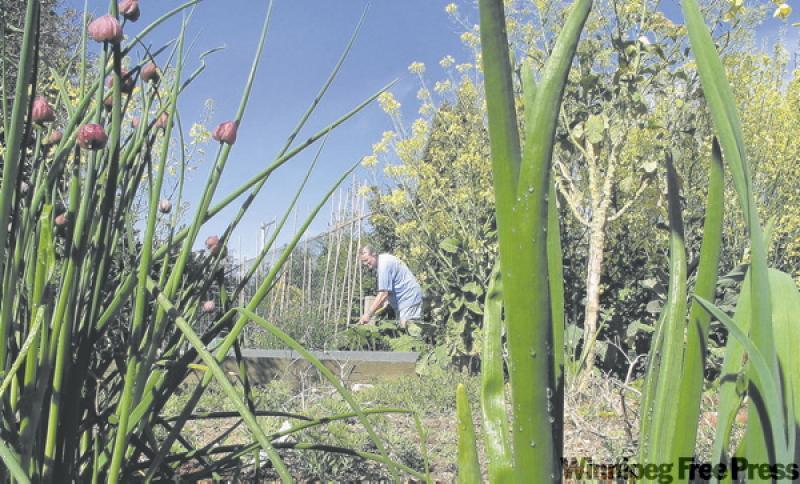
Johnson is in the process of establishing a demonstration urban homestead in his Victoria yard.
Already he has completed the soil preparation and built his greenhouse and trellises for plants. This year's project is a water catchment system. Bylaw-conforming laying hens (eggs and natural fertilizer) are also a possibility.
Well into winter, Johnson continues to eat homegrown produce.
A recent dinner was a "root bake," of parsnips, potatoes, brussels sprouts, oca tuber and daikon radishes with a hot sauce made from his own peppers.
Johnson is not alone in growing his own food. Many have done it here for years. He's aware of six other gardens similar to his in the region. He suspects he'll hear of more and more.
A sustainable back garden helps shrink the carbon footprint. People who grow their food have a degree of autonomy compared to those relying on retail sources. They are sheltered from some rising food costs and shipping interruptions.
Homegrown food is fresher and tastier, according to Johnson. People don't necessarily need a yard to start growing their own food. Tomatoes in a pot and supplemented by kitchen compost can be grown on a sunny balcony.
Salad greens are also a good choice for small areas. Their store-bought equivalent is often expensive and not that fresh, according to Johnson.
"They're really easy to grow -- and shade-tolerant," he adds.
Pragmatism aside, gardening is fulfilling, according to Johnson.
"It fills the void that most people in the past filled through shopping," he says.
-- Canwest News Service