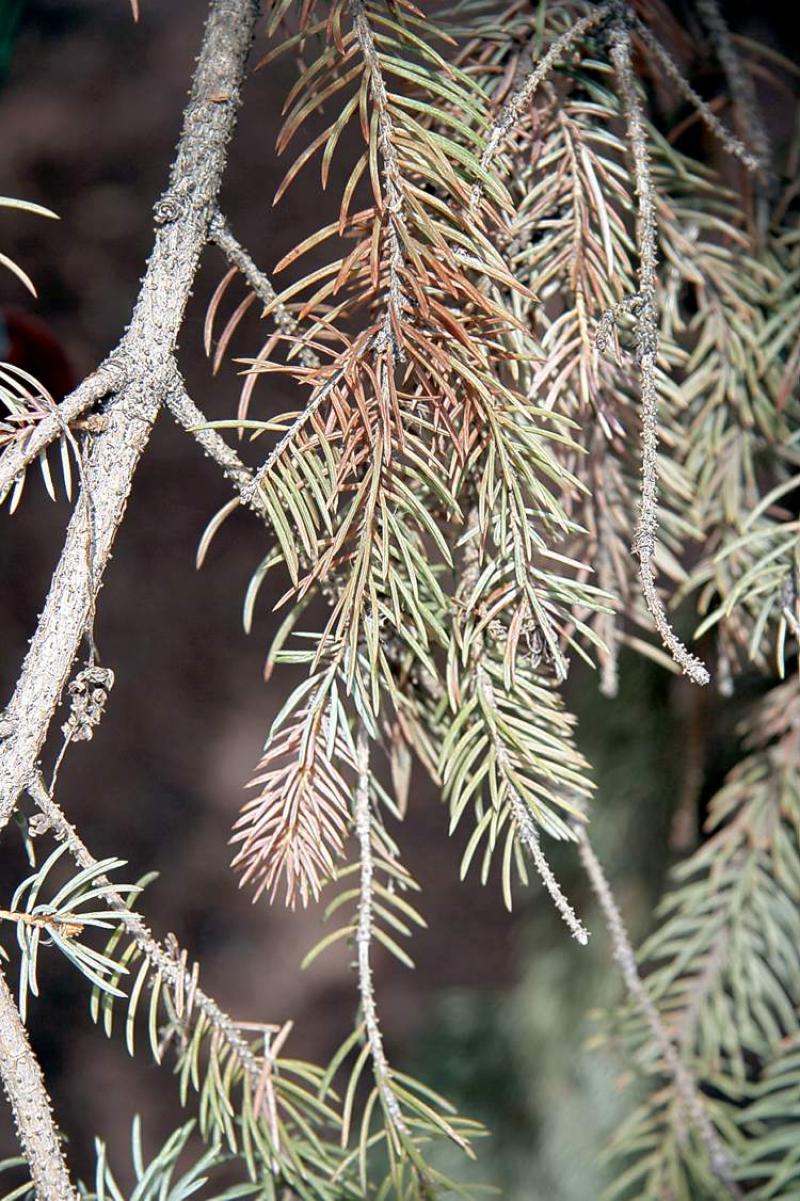
Tip blight in spruce trees has been increasing, and this is the worst year for this disease I've seen in more than four decades.
This spring, I've noticed very destructive levels of this disease, known scientifically as Sirococcus conigenus, in all spruce species, but particularly in Colorado blue spruce.
Spruce trees on rural acreage areas north of Winnipeg have been especially affected. In many instances, large trees have had more than 70 per cent of their twigs and needles infected. Heavily diseased trees are almost dead as they cannot easily recover from severe infections of this disease.
Tip blight is also showing up in most large spruce trees in Winnipeg, but most infections are at what I would describe as treatable.
How to recognize spruce tip blight disease
This fungus disease causes slightly or prominently curled ends of the twigs that are usually denuded of their needles except on one side starting in late May or June. Advanced infections will turn the needles an orange or rusty-brown in colour. In recent years, a second infection period can occur later in July or August.
An early, often-overlooked sign of this disease is bright yellow-green discolouration of the newer needles in parts of the tree. This discolouration is likely to appear in late summer or early fall. The colour pattern can persist over winter and show up in the spring, as it is doing this year.
A small area of Colorado blue spruce twigs near the end of the boughs can have several different colour patterns -- blue, green, bright green-yellow, yellow, orange and rusty brown. The disease occurs in a tree at different stages of maturity, characterized by these colour patterns. Ultimately, all the needles turn a rusty-brown and fall from the tree.
How to treat the disease
The entire tree should be spray treated with an approved fungicide such as copper. Usually two or three spray treatments about two weeks apart are necessary in the spring and early summer (May to early June), and again with a single fungicidal spray in late July to early August.
One year of treatment is not sufficient to control the disease. The fungicide should be applied consecutively in the second and third years as well. For heavily infected trees a fourth and fifth year of consecutive spraying will be necessary.
Michael Allen is a consulting urban forester and certified I.S.A. arborist and owner of Viburnum Tree Experts. He makes house and garden visits to assess tree and shrub problems. He can be contacted by calling 831-6503 or by email at viburnumtrees@shaw.ca