A Canadian economist named Jeff Rubin has a book that everyone should read. It's called Why Your World is About to Get a Whole Lot Smaller and in it Rubin makes a well-supported case for the end of crude oil as a viable energy source for our world.
That's a pretty radical claim -- with huge implications -- but Rubin cites fact after verifiable fact that all point in the same direction. Whether you heat your home with oil, natural gas or electricity, rising crude oil demand and dwindling supplies will have an impact on you. It already does.
This is one reason I cut and split firewood for heating at my place and, although firewood isn't an option for everyone, a tool I came across last fall makes the splitting job much faster.
The hardest part of making firewood is splitting logs lengthwise. This makes wood small enough to handle easily and it also opens up the bark for better drying. Traditional hydraulic wood splitters make the job of preparing firewood easier, but they don't necessarily make it happen faster.
A good splitting axe and a pair of strong arms can produce firewood as fast as a traditional hydraulic splitter in most cases. But a completely different kind of splitter has changed all that.
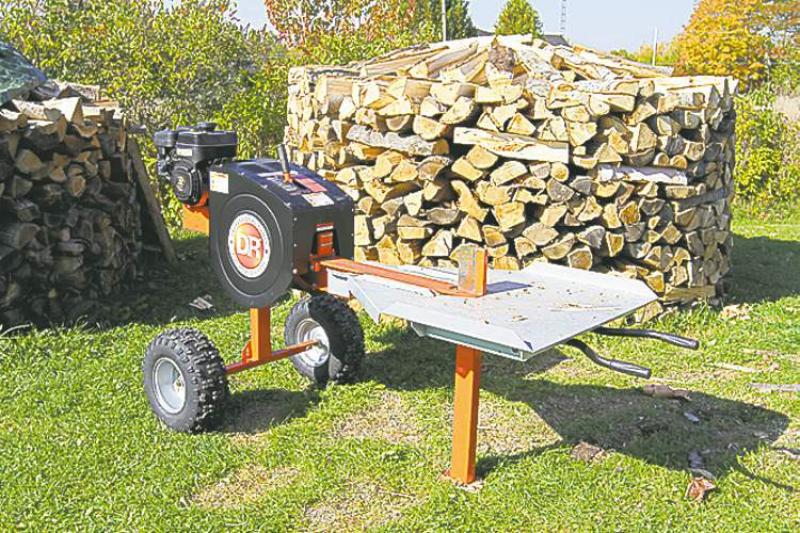
Since last fall, I've been using the DR RapidFire 6-HP wood splitter (drpower.com; 1-800-687-6575) side by side with my 12-HP, 34-ton hydraulic splitter in a comparison test and the RapidFire is at least four times more productive than my big hydraulic machine. It's also lighter and uses less than half the fuel.
The big boost in efficiency comes from the fact the RapidFire completes each split cycle in about two seconds, instead of the usual 10 or 20 seconds required for each hydraulic split. Instead of a pump delivering hydraulic oil to a cylinder through hoses, seals and fittings, the RapidFire uses nothing more than a pair of 75-pound, cast-iron flywheels.
Flipping a lever engages a rack-and-pinion gear mechanism, harnessing the inertia of the flywheels to push the log forward into the stationary wedge, splitting the wood. Release the lever and a spring pulls the mechanism back quickly, ready for the next log. You have to see this kind of speed to believe it. It's amazing. My older boys always dreaded splitting wood with me because they found the job so boring. But they tell me the RapidFire is actually fun to use because it's so productive.
There were two things that I wondered about before using the RapidFire: Is this machine as powerful as my hydraulic splitter and how long will the rack-and-pinion gear last, since the teeth just clunk together without any kind of a clutch every time you begin a split cycle?
Although this machine can't handle the really big, knotty monster logs, the RapidFire breezes through almost every piece of hardwood I've put onto it. In less than an hour of splitting I can make all the wood I need to heat my house, workshop and domestic hot water for a week of the coldest winter weather.
If crude oil becomes too expensive to remain the premier energy source for powering our world, then heating with wood certainly won't insulate you from all the effects. That said, there's still something valuable about being able to heat your home and domestic water in a way that's completely outside the uncertainty and rising prices of international marketplaces.
And for those of us who like to combine time outdoors with exercise that also produces something worthwhile, the firewood lifestyle is one of the big blessings that many regions of our great country offer.
-- Postmedia News