How do you like your roses? In a fresh cut bouquet for easy disposal once the petals have fallen, or do you prefer to grow roses in your garden, with the promise of blooms more exquisitely lovely than almost any other, season after season?
Perhaps neither. While roses remain atop their pedestal as one of the most favourite flowers of all time, with demand soaring worldwide for cut roses, the decline in sales of rose bushes in recent years at garden centres across North America tells a different story.
The temperamental nature of landscape roses has superseded for some homeowners the rose's legendary attributes of beauty, fragrance and longevity. The fact is, most busy gardeners have little patience or tolerance for anything perceived as high maintenance. Indeed, if a plant has the reputation, earned or not, of needing the occasional spray of insecticide or fungicide to control signs of disease, it soon finds itself taking up less and less real estate.
The meteoric success of the Never Alone rose, introduced this past spring, has turned most preconceptions about growing roses, or misconceptions, if you will, on their ear.
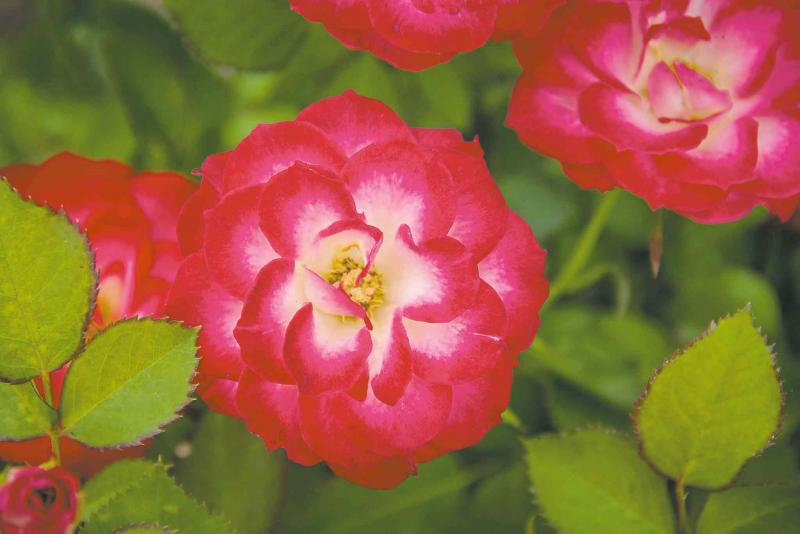
The Never Alone rose has built-in disease resistance but is not totally immune to a bit of black spot. The crimson red flowers with glowing white centres are attractive yet without the spectacular layering of petals or complexity found in a hybrid tea rose.
And yet demand by consumers, non-gardeners included, for the Never Alone rose, some of whom purchased multiple quantities, was so strong that the rose quickly sold out in many areas. In one example, says Michel Touchette, production manager at Jeffries Nurseries in Portage, an order by a B.C. nursery for 4,000 additional roses went unfilled because growers sold out their supply for this year. Fortunately it will be available again next year.
The final tally of reported sales by growers across the country is an amazing 48,000 roses in the first year.
Touchette credits a number of reasons for the success of this hardy dwarf shrub rose. The rose's affiliation with the Never Alone Foundation and its partnership with not only the Canadian Nursery Landscape Association but also Lyle Bauer and the Canadian Football League Alumni Association captivated the interest of a broad audience.
The success of the Never Alone rose was also spurred by the ties to Morden's respected rose program and rose breeder Larry Dyck. In 2007, to create the Never Alone rose, Dyck combined a cross of Rosa Scarlet Meidiland and Rosa x Frontenac with Rosa Yellow Submarine.
With the good traits of both parents, the Never Alone rose shines in the garden. Literally. It retains its glossy foliage throughout the growing season. A prolific bloomer, I planted mine in the flower bed and at one point in late August I counted more than 100 blooms at one time. In a recent phone interview, Touchette said the Never Alone rose is at its best, including its disease resistance, when grown in a patio pot in full sun.
Touchette says there is a generation of homeowners, whether they have backyards or condo balconies, who prefer to plant in pots for decorating their outdoor garden rooms. This trend, combined with the public's distaste for spraying with pesticides or fungicides, is having more and more of an impact on the plant industry as a whole.
Touchette added disease resistance is the number one priority among rose breeders and growers. The next priority is continuous bloom. The quality of the bloom as well as colour, is also important, says Touchette. If it looks good in a pot, adds Touchette, its success is guaranteed.
Next spring will see the launch of the newest rose in the Canadian Artist Series of roses. Named after the Canadian pianist and jazz composer Oscar Peterson, the rose will grow to about one meter tall and wide and will have large, pure white semi-double flowers with a centre of yellow stamens.
This rose was also bred by Larry Dyck who says it was selected for disease resistance, hardiness, upright growth habit and clean glossy foliage. "It is very clean and self cleaning," says Dyck. "It is a unique cross that combines Yellow Submarine and PO2, a selection combining Frontenac and Basye's Blueberry, a thornless rose from the Basye rose breeding program in Texas." Frontenac is Dyck's favourite hardy rose.
Isabelle Coldwell, a Transcona area gardener, grows more than 65 varieties of roses, all of them in beds. Whether this is old school or not, it works for Coldwell. Situated on a corner lot, her rose garden attracts numerous passersby, many of whom go out of their way to walk by her garden. Coldwell started out in 1998 with a mere five rose varieties, Winnipeg Parks, Morden Centennial, F. J. Grootendorst, John Cabot and John Davis.
The original plants continue to thrive in her garden. Coldwell grows both new introductions such as Never Alone and Brothers Grimm as well as older varieties including Alexander MacKenzie, Henry Hudson, George Vancouver, Roseraie de l'Hay, Carefree Wonder, Marie Bugnet, Hansa, and Felix LeClerc.
Coldwell also grows all of the Morden roses. She recommends that novice gardeners start out with a Morden rose such as Blush, Ruby, or Amorette.
As for maintenance, Coldwell considers roses the easiest plants to look after. She recommends using mushroom compost and working rose food into the soil around each plant in the springtime. She is also a firm believer in the benefits of bone meal which supplies phosphorus to promote flower production and root growth. She also gives them a little sprinkle of Epsom salts to boost magnesium levels.
To control any signs of pests such as aphids, Coldwell sprays her roses with a homemade mix consisting of a spoonful of oil and dish soap in a litre of water.
Since Coldwell grows only hardy roses, she does not provide any added protection for the winter.
Trials of tender roses have been taking place at Assiniboine Park. Craig Gillespie, head gardener of the English Garden, says that of the original David Austin roses trialed, only Sharif Asma has wintered consistently. Not to be deterred, this year a selection of 90 David Austin roses consisting of 18 different varieties have been planted.
Most are grown on their own roots and are zone four or five. Gillespie says that all varieties performed well with Crocus Rose the most prolific bloomer. They are healthy and in good shape as they go into winter.
Gillespie says the trial also includes a number of low growing zone four Drift roses which bloomed profusely in their first flush and required minimal deadheading to rebloom. Of the various varieties, Gillespie says that Red Drift was stunning although Peach, Apricot, and Spice performed better.
The real stars of the English Garden this summer, says Gillespie, were two floribundas, Livin' Easy standard roses and Distant Drums, both zone five. Gillespie reports that Livin' Easy produced three exceptional flushes and bloomed again in September while Distant Drums, from the Buck roses collection, bloomed profusely and was trouble free. Any of these would be gorgeous in patio pots.
Mulching your roses in late fall is important for winter root protection. If you grew a hardy rose such as Never Alone in a pot, Touchette recommends planting the entire pot and plant in the ground and mulching. This should be done in mid-October before the ground is frozen. "In spring," says Touchette, "repot in a slightly bigger pot and add a slow release fertilizer."
In July Touchette recommends supplementing the slow release fertilizer with a water soluble fertilizer. Do not fertilize though after the end of July. As for pruning, wait until spring to remove normal winter kill on stems.
On August 19 at the 12th annual national awards of landscape excellence, Dyck's work in the advancement of the hardy rose breeding program was recognized as well as his assistance in the transition of the rose genetics and breeding program to the CNLA team. The award was presented by Michel Touchette. The Green for Life Award, presented annually to an individual that has demonstrated outstanding dedication to the hort industry, was presented to Touchette and acknowledged his hours of hard work and dedication to the Never Alone rose promotion.
Touchette will make a cheque presentation, representing a portion of the sales from each Never Alone rose, to the Never Alone Foundation at their annual banquet October 28.
colleenizacharias@gmail.com