Barbara Damrosch / The Washington Post
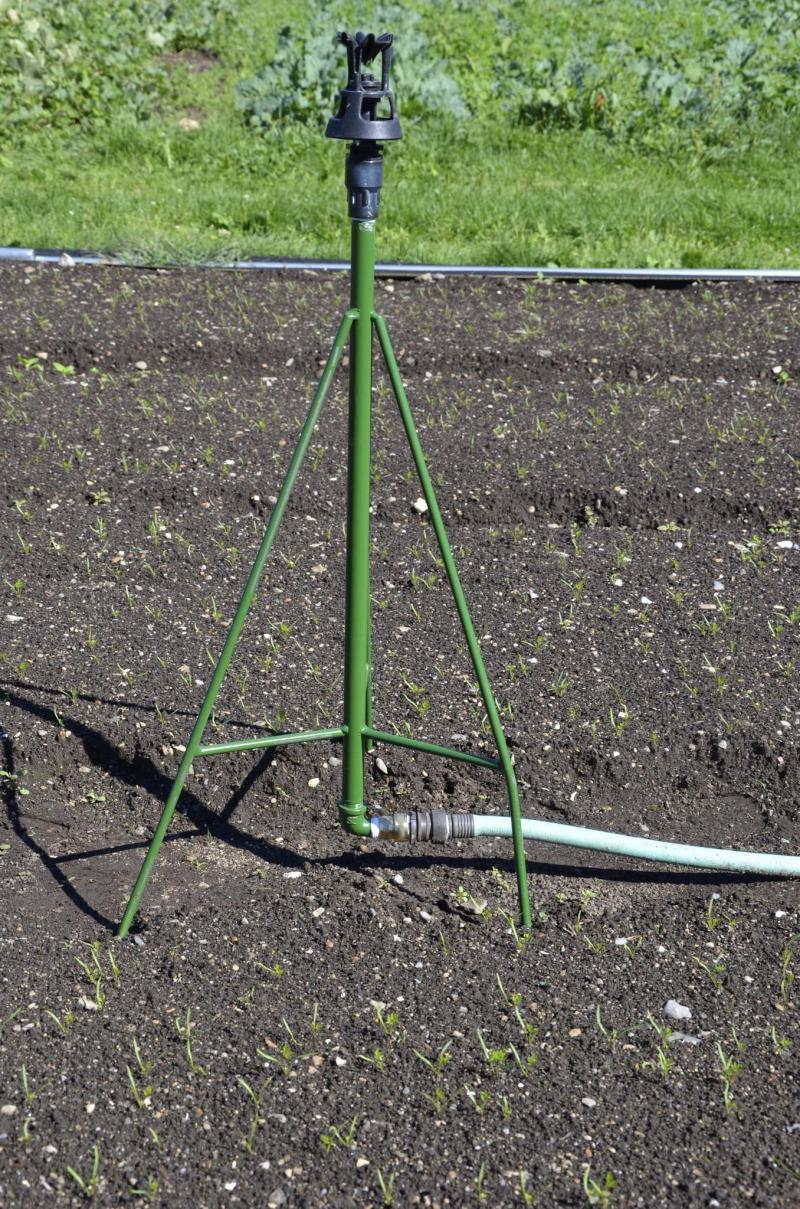
A Senninger Xcel-Wobbler sprinkler mounted on a tripod stand.
As everybody knows, the best way to make it rain is to wash your car. As extra insurance, a superstitious gardener might provoke a shower by ordering a complicated drip irrigation system. Or maybe there’s a better way to deal with drought.
Apart from the lengthening days, there’s little you can forecast about the upcoming summer. If it turns out to be wet, you’ll be inundated with weeds, and soil so soggy you can’t dig them out. Leafy crops will be green and happy — if they don’t succumb to fungus. All you can do is maximize good soil drainage by adding plenty of organic matter.
If it’s dry, your vegetables are at risk, but you have more options. In arid places where watering is restricted by law or conscience, people corral their thirstiest crops into a small area and in some cases don’t water at all. There’s even a name for it: dry gardening.
I’ve always assumed juicy fruiting crops, such as tomatoes, needed water the most, and for better productivity, they do. But lack of water concentrates their flavour so well smaller and fewer fruits might seem like a small price to pay.
That won’t work in my garden, though, because the weather changes every 10 minutes, and it’s inconsistent watering that does tomatoes in, with splitting, cracking and blossom-end rot. The only way to provide perfectly even moisture is to grow tomatoes in a small irrigated greenhouse, which I do, and it works very well.
Still, it’s useful to take a cue from desert dwellers and plant some things that are more drought-proof than others, such as potatoes, melons and squash. And lots of organic matter will help the soil retain moisture just as it allows excess water to drain.
Mulch is useful because in addition to deterring weeds, it keeps soil moisture in, as long as you apply it when the soil is wet. And make sure that when you water, you apply enough to reach deeply.
But next to great soil structure, there’s nothing like an irrigation system to calm a gardener’s jitters about rain.
To a minimalist like me, a system can be something as simple as a good, black rubber hose, or even two or three of them, with first-rate brass fittings. I’m partial to a type of brass coupling called Quick Disconnect (available at dramm.com), which locks securely into place with minimal leakage. I make sure any nozzle or sprinkler device I use has a Quick Disconnect on it so I can easily shift things around.
When people opt for drip or trickle systems, despite their cloggy emitters, dry gaps, ugly appearance and high price, it’s because most conventional sprinklers have one serious flaw: because they atomize the water to a fine spray, they lose a great deal of it to evaporation and waste even more when wind blows the droplets away from their designated target.
I avoid that problem by using a relatively new type of low-pressure sprinkler head called a wobbler (from Sprinkler.com and elsewhere). It spins around, emitting uniform drops too heavy to blow around. The Senninger Xcel model I use is mounted on a tripod sprinkler stand.
For container plants, I leave one solitary hose on the terrace with a wand called the Wonder Waterer (johnnyseeds.com), which delivers a soft, gentle spray. But I also keep handy an old-fashioned, hard-stream, suds-busting, pistol-grip nozzle I can put on that hose if the rain never comes and I must resort to washing the car.
Barbara Damrosch is the author of The Four Season Farm Gardener’s Cookbook; her website is www.fourseasonfarm.com.