It is the ultimate icon of summer.
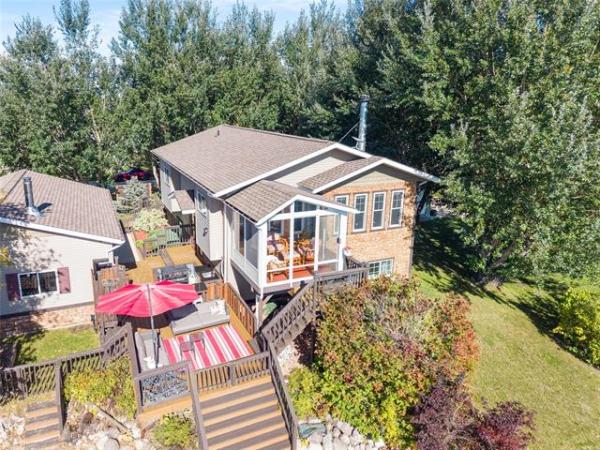
The ubiquitous backyard deck, topped with a barbecue, dining table, maybe even a hammock, is where homeowners love to chill during the hot months.
What began 30-something years ago as a functional platform from which to view the garden is evolving into a highly designed space to rival indoor rooms.
Stephan Beaulieu, owner of Patios et Clotures Beaulieu in Montreal, says the homeowners who hire him to build their decks are influenced by current trends in kitchen design in which zones are created for specific functions.
"I always ask my clients if I can see the inside of their homes," Beaulieu said. "I want to see their space and how they live in it. It's a good place to start."
"They want an area for entertaining guests, a cooking area for the barbecue and they might also want to have an area for a little bistro table where they'll eat breakfast, as well as one for a large dinner table. They want to transfer the feeling from inside the house to the outside."
Moreover, the classic deck design that encompasses a railing and spindles is giving way to a more open look, he says.
As people have embraced gardening and beautified their yards with plants, Beaulieu says, few want to have their view of perennial borders and ornamental ponds obscured by deck spindles.
"Some people are replacing the spindles with tempered glass panels that have black metal railings," he said.
Beaulieu calls it "a simple tweak" that permits a sense of openness rather than enclosure and one favoured by mothers who want an unimpeded view of their children in the swimming pool.
Storage benches are also being integrated into contemporary decks, he said.
"We're also doing integrated hot tubs and built-in bars."
Mike Tustin, a contractor and owner of Supreme Sundecks in Pointe Claire, Que., says decks are getting bigger.
"They used to be little boxes when I started building them 20 years ago. Now, people want to live on their decks. Young families are building them with gates to keep their small children in."
And, says Tustin, many homeowners want way more than just a flat platform.
"I'm seeing a lot of screened gazebos being built on decks," he said. "We build pergolas and benches. Decks are not just platforms anymore."
Nor are they boring rectangles.
Stephan Beaulieu is being asked to create decks with rounded edges, a seemingly impossible feat he pulls off by cutting thin strips of cedar, which are laminated to make them malleable. Homeowners who are conversant with the principles of feng shui want curvaceous edges on their decks to facilitate the flow of chi (energy) in their backyards, he says.
"When you're building rounded decks, you have to take your time to create fan-shaped joists," he said. "I use cedar because it has a long wood grain that allows it to be bent."
Tustin says the era of the square or rectangular deck has given way to hexagons and octagons.
"I'm also seeing wraparound stairs," he said.
Beaulieu, a former high school teacher who began building decks in 1998, says most of his clients are requesting decks made of untreated wood, such as cedar.
"When I started, 100 per cent of my clients asked for pressure-treated wood. Now, it's only 10 per cent. Fewer people are asking for pressure-treated wood because of environmental concerns. Also, in time, it twists."
He says cedar stands up well to the elements.
Beaulieu discourages his clients from having multi-level decks.
"When you have more than one level, you'll always be telling your guests to be careful of not falling off," he said.
Privacy is a key concern of homeowners, particularly on small building lots, says Beaulieu, which is why many are opting for ground-level decks and privacy screens made of trellis or lattice.
"Smaller is better, and as low to the ground as possible is ideal," he said.
The floor space of today's decks is generally larger than it was a decade ago.
"A 12-by-14-foot deck was standard eight or 10 years ago," Tustin said. "Now, people are opting for larger decks because they're buying more stuff to put on them. So they're 12-by-18, 12-by-20 and 14-by-16 feet."
Some homeowners, he says, are requesting decks made of composites, materials made of wood chips and plastic.
"It's for non-maintenance," said Tustin, who confesses he prefers natural materials. "Composite is not wood."
"I don't like composite material," Beaulieu said. "It cannot be recycled at the end of its lifespan, and it eventually changes colour with exposure to UV light."
-- Canwest News Service