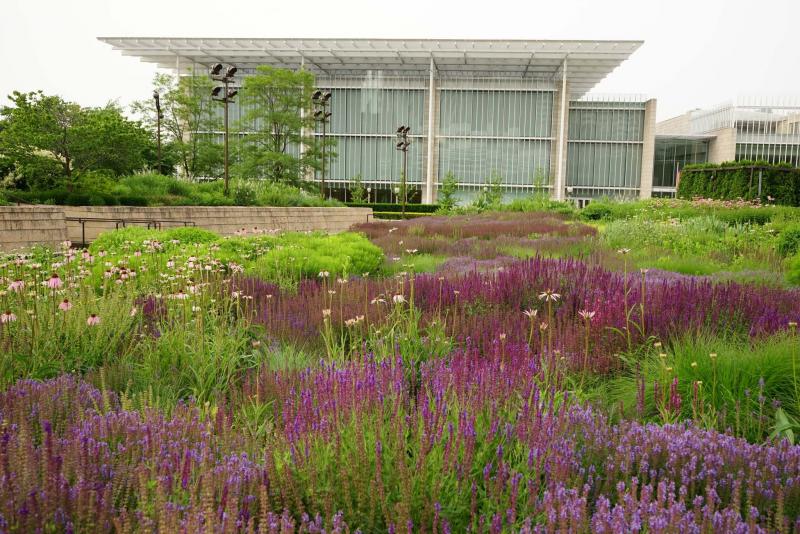
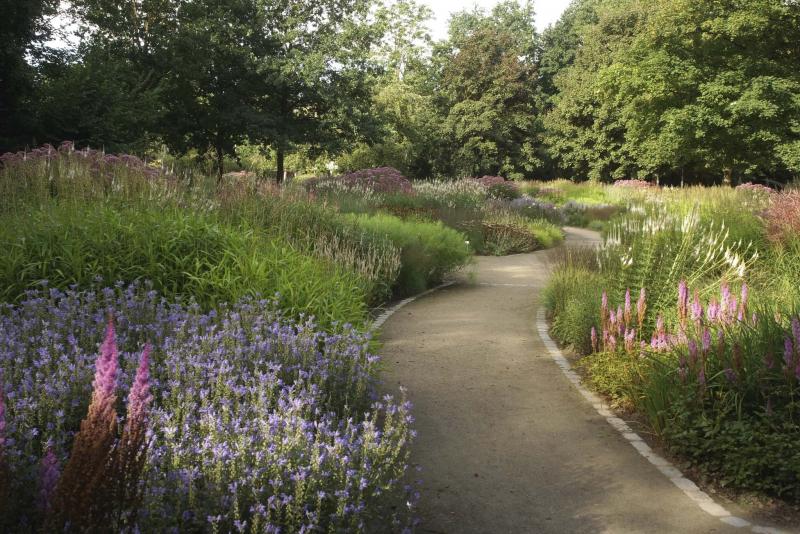
A path runs through this dreamy yet functional garden design by Piet Oudolf which combines long-lived perennials with woody plants (Maximilian Park, Germany)
Supplied / Piet Oudolf

SUPPLIED
Piet Oudolf, internationally renowned Dutch plantsman and author, at his home in Hummelo, the Netherlands. Oudolf worked with the Garden Club of Michigan to design a new garden for Detroit.
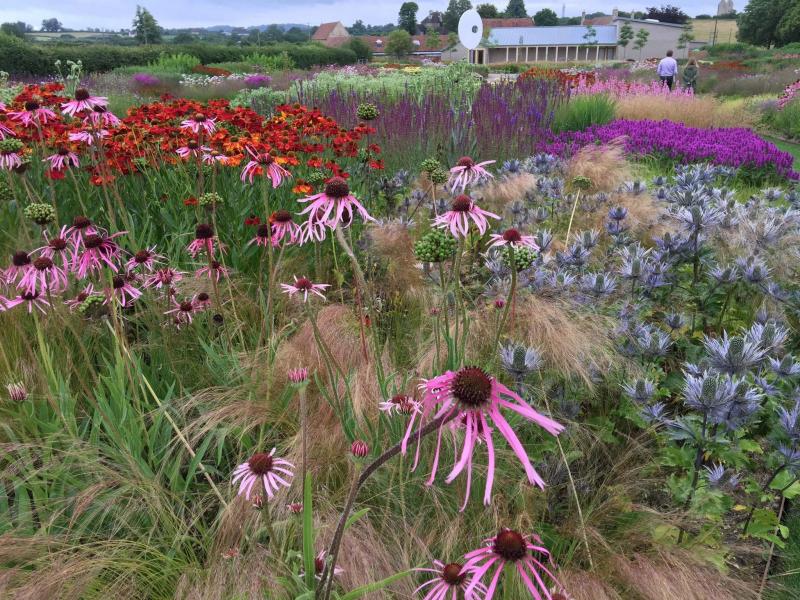
Master landscape designer Piet Oudolf chooses plants that flower at different times during the growing season. (Shown: garden at Hauser and Worth, Somerset, UK)
Supplied / Piet Oudolf
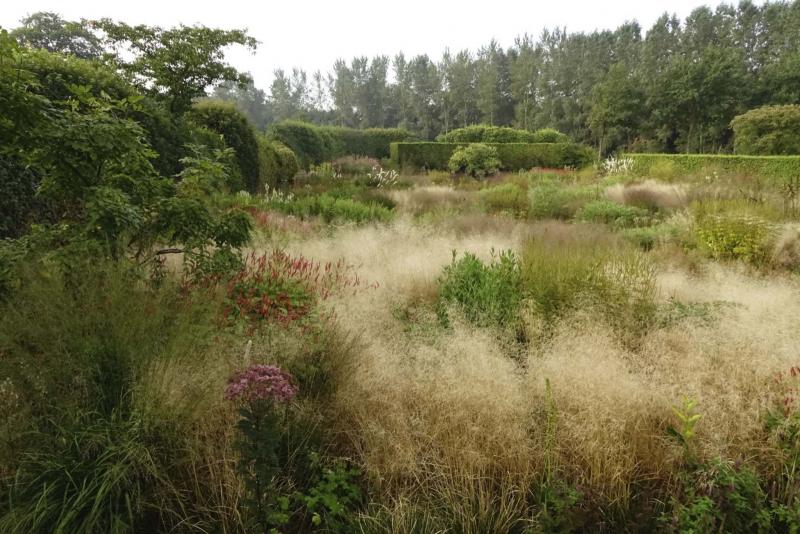
Piet and Anja Oudolf’s private garden in Hummelo showcases his naturalistic garden style.
Supplied / Piet Oudolf
Piet Oudolf, the renowned Dutch plantsman and author, is considered by many to be today’s most compelling garden designer. His name resonates with creativity and innovation, as well as a signature style that gardeners everywhere want to emulate on some level.
Oudolf’s approach to garden design has earned him an international audience, in part because his naturalistic garden style is a template for the sustainable and biodiverse gardens of today and tomorrow.
When the Garden Club of Michigan wanted to do a substantive project that would benefit the city of Detroit, they decided to dream big. In 2016, the 99-member garden club sent a letter to Oudolf at his nursery and private garden in Hummelo, the Netherlands, to ask if he would come to Detroit to design a garden. The first sentence in the letter read, "This is a love letter from Detroit."
To some, it may have seemed like a big leap of faith. But to hear Maura Campbell, who was president of the Garden Club of Michigan at the time, tell the story of what transpired since then, there have been few obstacles to bringing this fantastic idea to fruition. Simply put, Oudolf said yes to the first garden club to ever ask him if he would design a garden.
Speaking by phone from her home in Detroit, Campbell said Oudolf came to Detroit in April 2017. "We had just three weeks notice to pull all the details together and to plan a tour," Campbell said. Belle Isle, a 982-acre island park, originally designed by American landscape architect Frederick Law Olmsted, is located in the Detroit River between Detroit and Windsor, Ont. Finding the site to be a natural fit, Oudolf chose a 21/2-acre space that suited him best. By May 2017, he sent a proposal to the garden club.
"Within a few months," Campbell said, "our garden club raised the US$150,000 to commission Oudolf’s design." The multi-layered process that followed included several different moving pieces, such as the signing of a memorandum of understanding with the Michigan Department of Natural Resources, which manages the public park.
The project moved from the fiscal sponsorship of the Garden Club of Michigan to a new entity, Oudolf Garden Detroit, which is now under the fiscal sponsorship of the Belle Isle Conservancy. Thus far, the project has attracted donations and pledges amounting to more than US$2 million toward an overall goal of US$4 million.
Oudolf will not do a public garden unless there is a plan to take care of the garden for at least 15 years, Campbell said. "Our agreement is to go even further — we’re raising funds to endow the garden so that it can be maintained in perpetuity."
Piet Oudolf’s garden designs have proven transformative. Michele Hodges, president of Belle Isle Conservancy, says the project will have a catalytic effect. "The definition of a garden has changed substantially — it is true art."
Just how excited are the people of Detroit? When the Detroit Institute of Arts hosted a screening of Thomas Piper’s documentary, Five Seasons: The Gardens of Piet Oudolf, on a bitterly cold February evening in its 1,050-seat theatre, every seat was filled. But in addition, volunteers from across Michigan and Illinois, and from around the world, have signed up at oudolfgardendetroit.org to plant the garden starting in September 2019.
Earlier this month, I contacted Oudolf to request a phone interview. What would be my first question? I once read somewhere that Oudolf gardens without restriction, yet we know that many urban homeowners today garden within the restriction of smaller and smaller spaces. So, I asked, how can the average gardener who resides on a property the size of a postage stamp create their own meadow-like planting with drifts of perennials and grasses?
Oudolf, who very graciously accepted my request for an interview, replied matter-of-factly that smaller gardens have their own sort of approach. "Some gardeners collect plants and more plants," he said, "and put them in the garden. They are not necessarily designers, so it’s more that they love plants, which is good."
The pursuit of rare plant specimens that need extra protection in the garden has everything to do with being a plant collector, but nothing to do with garden design. "I love them, too," Oudolf said, "but you lose them or you collect them."
The design element comes into play by ensuring that your garden is interesting throughout the year. Choose plants that flower in early spring, late spring, throughout the summer and into the fall, Oudolf recommended, so that the garden is more than just a disparate collection of plants. "Care about the fact that you ought to have something in flower in fall as well."
If the notion of how to architecturally sculpt and shape with plants and what to plant with what seems too complex, consider this advice from Oudolf: "The presence of trees and shrubs give structure and help to give you a nice winter garden. Grasses and perennials left standing with their seedheads have interesting skeletons and extend the season."
Built elements in the garden are lovely to have, he said, but are not necessarily needed. However, you should be able to walk and circulate through your garden so paths are important.
Piet Oudolf is associated with the New Perennial Movement, a naturalistic style that some believe embraces solely native plants. "No," Oudolf said, "the emphasis is not on encouraging people to use native plants, but rather to use plants that benefit the world — our wildlife, including insects of all kinds. It doesn’t necessarily have to do with native plants because there are also non-native plants that also benefit our garden. It’s always been so."
Don’t confuse performance with behaviour. "Look at it this way," Oudolf said. "Suppose you live in a neighbourhood and you have people from all nations and the community is working well together. It’s the same in the plant world. If a plant behaves well in the garden and benefits wildlife and biodiversity, then it is good."
Oudolf’s design for the Lurie Garden in Chicago, for example, is described in his book Planting: A New Perspective (Timber Press, 2016) as, "Offering a stylized version of the Midwest prairie, its combination of native and introduced perennials and grasses is symbolic of a blend of nature and culture."
To those who take their inspiration from reading Oudolf’s many books on garden design or who make plans to visit one of his famous gardens around the world, Oudolf suggests taking from the experience what you like. "Do with it what you think is best for your own garden," he said. "Gardening is a very personal experience and that is what it always should be."
If you are planning to visit the Oudolf garden in Detroit, you will have to wait until spring 2020, when it opens to the public. In the meantime, plan to attend a screening of Five Seasons: The Gardens of Piet Oudolf, hosted by the Manitoba Master Gardener Association on Feb. 2 at Cinematheque. A Christmas stocking stuffer idea, anyone? Visit mgmanitoba.com to reserve your tickets.
colleenizacharias@gmail.com