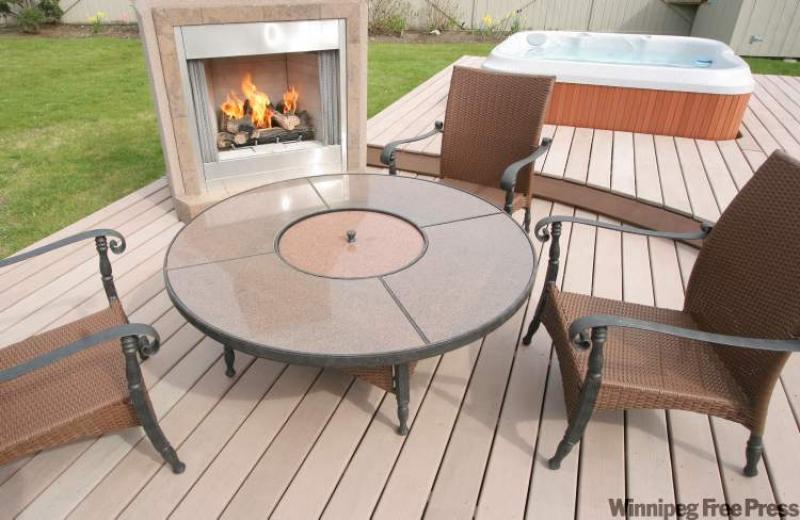
I love a backyard fire pit. It gives you that cottage feel without any of the upkeep or the long drive. You can toast marshmallows and hotdogs and sit out under the stars. There's something primal about a real fire and I've enjoyed a fire pit in my last backyard and an outdoor fireplace in my current one. But I live out in the country and most rural areas will allow outdoor fires.
If you live in the city or a suburb, you need to check with your local municipality and fire department before you have one built. Open fires are illegal in many areas -- and that includes those portable chimineas every garden centre sells these days.
A fire pit is a grown-up's campfire. It has to be nice-looking but more importantly it must be safely contained so it doesn't start your house -- or your neighbour's -- on fire. Check fire code, ordinances and permit requirements for your municipality. There could be restrictions on the type of fuel that can be used, as well.
You definitely want to keep a fire pit far away from any building overhangs, nearby trees and from the house and garage in general. You need to check setbacks and the location of underground pipes and cables before digging. While you're at it, don't forget to check that homeowner's policy to see if a fire pit will require changes to the policy. Check everything to make sure you are safe and legal before you call a contractor.
This is not a project to try on your own, even though it seems pretty straightforward. With a fire pit, if the wrong materials are used, the damage can be very serious. The wrong kinds of brick or stone can explode. So don't even think of attempting this project yourself. It's just not worth it.
Your contractor can help with determining the budget. The lining material for the pit -- whether rocks, retaining blocks or bricks -- will vary in cost. If you mix materials, you'll be able to save some money, maybe by using bricks or blocks for the lower layers and nice rocks for the final layer. Cast concrete blocks moulded to look like stone offer savings and they're flat on top and bottom to stack neatly.
Size is important -- it has to be proportionate to your yard and seating area. But even more important is determining the prevailing wind pattern. Imagine locating a fire pit so the smoke constantly blows into the house.
An option to consider is installing a gas line to provide an easily regulated flame. Installing a line will require excavation and will definitely require a permit but it may prove so handy you'll never end up using wood. Homeowners who love their gas fires don't miss the drifting embers and smoke, not to mention mucking out the fire pit every time. But gas is a trade-off against the satisfying crackle and smell of a real wood fire.
A well-made fire pit should start with a base buried below ground in a hole lined with gravel. This provides a level platform for the wall, drainage and protection against winter heaving. A final above-ground height of about a foot is good for containing a fire while also providing a comfortable footrest. As a precaution, lining the fire pit with a thick steel ring will ensure a more contained fire and protects the concrete in the blocks from drying out prematurely.
A variety of materials can be used as starter, kindling and fuel. The most eco-friendly is what's already in your backyard. Dried prunings, leaves and even evergreen cones make good fire starters. Any seasoned garden shrubbery or timber, dried ideally for a year, will be good fuel.
Once the fire pit is built, you'll want to take proper care of it to ensure lots of fun evenings. After every use, remove the burnt ashes. This will allow oxygen to get into the bottom of the pit for a better-burning fire. It's also a good idea to build the fire pit within reach of the garden hose, just in case things get out of hand and you set fire to those marshmallows. Better to be safe than sorry!
-- Postmedia News
Catch Mike in his new series, Holmes Inspection, airing Thursdays at 8 p.m. ET/PT on HGTV. For more information, visit www.hgtv.ca. For more information on home renovations, visitmakeitright.ca