First impressions are lasting impressions.
So when Rena Semenko contacted me in the summer of 2015 with concerns about her front porch, I knew exactly how she felt.
When I moved into my current home, the only "porch" I had was a prefabricated concrete step, which had already sunk drastically in one corner.
As such, my first curb appeal upgrade was replacing this gaudy urban porch with a larger, more functional wooden version, worthy of the title.
Semenko’s home is one of many charming houses in the River Heights area, tucked away behind mature trees and picket fences.
At our first site meeting, it was evident what troubled Semenko about her front porch — it was falling apart and partially rotten.
The house itself is coated in stucco, as well as the backside of the old, existing porch.
Upon further inspection and before demolition began, we had a discussion about either building an entirely new structure to serve as the porch, or keeping the backside of the existing porch encased in stucco and incorporating that existing feature into the design of the new wooden porch.
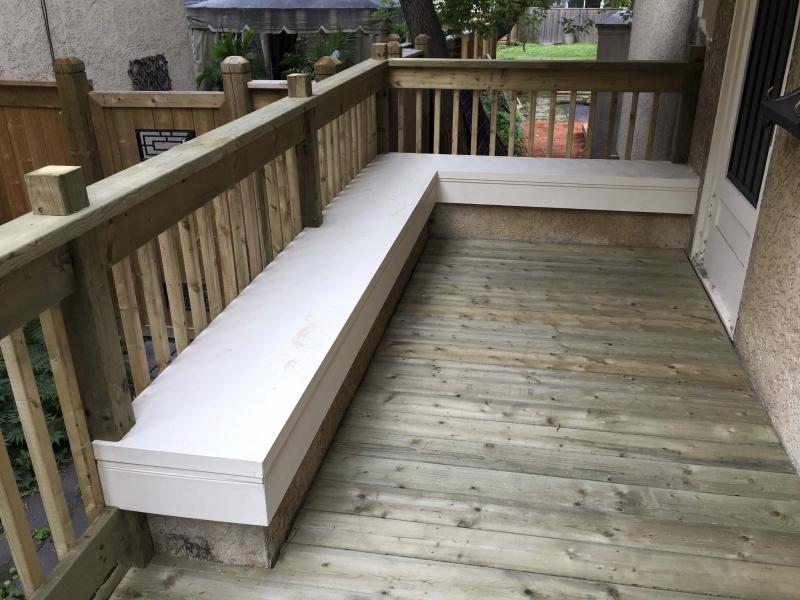
Because the top-side of the "stucco" walls of the existing porch were capped in white trim and could easily be interpreted as bench tops, I designed a new porch that fully integrated them.
The rest of the porch structure was removed and the rebuild began.
The support structure was constructed like a small deck — joists over perpendicular support beams, which sit on posts anchored to the ground. The step side of the porch would have a solid foundation, in that the existing walkway was old, yet solid concrete.
My design, after receiving Rena’s wishlist, elongates the footprint of the old porch top and stretches even further away, past the steps onto a lower tier, which not only hides imperfections in the old walkway but also aligns the entire porch area with the front of the house. This creates the envisioned focal point, which was lacking with the old porch.
"I wanted to make the front entrance more inviting and call attention to the front door, as it is on the side of the house, not so visible from the street," Semenko says.
To match the existing woodwork of the property, green pressure-treated lumber was chosen for both the structural elements and top-decking/fascia of the new porch. Semenko was insistent that the look of the new porch closely mimic her fence, as she "likes the natural look of the wood" and wanted things to remain consistent.
Two-by-six boards were used as top decking and double-up boards for the run of each stair. Two-by-eights were used as fascia and for the rise of every stair, which kept things very lineal.
A banister was built alongside the outer edge of the staircase and continues around the entire upper area until it meets the house on the backside of the porch.
Four-by-four posts were positioned where required and the railings were constructed.
The trimmed tops of the old porch stucco walls now clearly serve as benches, with the new banister behind, acting as the bench seat-back.
To accommodate the height variations from the extended portion of the porch to the bench areas, pickets of varying lengths were installed. A two-by-six cap was then affixed atop the horizontal balusters. For added affect, four-by-four tops were cut and fastened above each post, giving the illusion that the posts go "through" the two-by-six cap rail.
Semenko’s reaction to the finished product made me smile — I could tell she was hesitant about some of the choices that had been made prior to commencement, especially the dilemma of whether to incorporate the backside of the old porch to retain the "stucco" look.
"I absolutely love the design, it totally transformed my front entrance into a functional, usable space where I go to relax, as well as entertain," she says.
And then, she adds, "I had a party last night in fact and many of my friends were hanging out on the front porch. It’s made me revisit suggestions to extend it to the backyard."
Sometimes old and new collide. In this instance, the upgrade merely enhanced an existing layout. Thoughtful contemplation often renders the appropriate design. And it truly feels good when, upon completion, checkmarks appear after every point on a client’s wish list, despite challenges encountered along the way.
Hey Rena — when would you like to start the extension to the backyard?
BossEnterprise@outlook.com