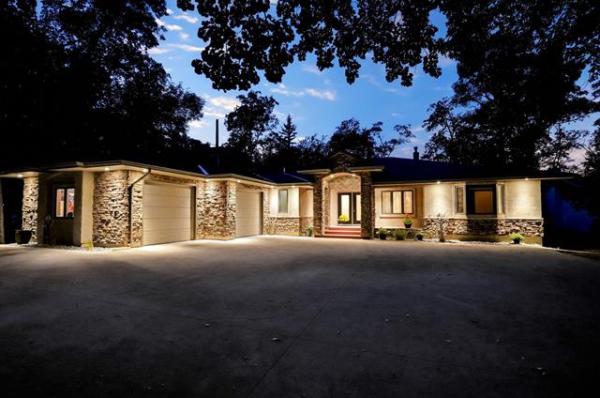
Their custom-designed house from High River, Alta.-based Willow Creek Homes was delivered in four pre-finished parts, on board flatbed trucks. The crane picked up each piece and swung it into place over the basement foundation they'd already prepared.
"It did look a little strange when all the modules arrived," Bev says.
"But I must say that when they fit them together and did all the finishing, they did a great job."
So much so that it's impossible to view their home as being different from homes built traditionally, on site. There are no visible joins, no signs that this house was built in a factory and trucked to its permanent home.
"In the last few years, there's been a lot of attention paid to modular homes among the architectural and design community," says Kathleen Maynard, executive director of the Canadian Manufactured Housing Institute.
"We're seeing a lot of interesting designs come out of the factories -- the whole cookie-cutter concept has gone by the wayside."
What hasn't disappeared are the advantages. "They're being built in a controlled environment with a permanent crew," says Chris Andersen, president of the Modular/Manufactured Housing Association of Alberta and Saskatchewan.
"It's a very efficient process with very little material waste, the building is out of the rain and snow, and you have the consistency of a trained, stable workforce," he says.
This aids quality control, as do the in-factory inspections by the Canadian Standards Association (CSA), which replace some of the on-site building inspections.
Although modular homes are more often thought of as rural homes, they're moving into cities and even entire subdivisions -- as long as the trucks and the cranes can get to the site, experts say, they can deliver the home.
And delivery can be fast. Darryl Cockx, regional sales manager for Airdrie, Alta.-based Best Buy Homes notes that its customers can order a home, choose its decor and have it delivered to their site within 90 days.
"If the customer has the power and heat on, we can complete the exterior and interior finishing within about two weeks after that," he adds.
Some outlets sell their own homes; others, like Best Buy, sell homes from one or more manufacturers. Going with a custom builder can take longer, but you can design the home you want.
"Some people come in with a very detailed plan in mind, while others come in with a sketch on the back of a napkin," says Lisa Bauer, Willow Creek Homes general manager. "We do in-house computer-assisted drafting, so we'll sit right there with them and work on a plan."
She notes that cost varies, depending on the home's size, complexity and finishes.
"We thought it would be cheaper going the modular home route, but as it turned out, it was comparable to a site-built house," says Dan Fox.
"It has, however, turned out to be a very good house."
-- Canwest News Service
From building site to stately home:
Step 1: Find a building site that's accessible for delivery (sales outlets can often help customers find or assess suitable locations).
Step 2: Carefully research designs and sales outlets or custom builders.
Step 3: Order your home. Plan to visit the factory to check progress and adherence to your specifications.
Step 4: Stay in touch with your sales outlet to ensure co-ordination of basement or foundation construction and utility servicing.
Step 5: On delivery day, cranes will position the modules on site.
Step 6: The sales outlet's crew will join the modules and complete remaining finishing details, including garage construction and landscaping if desired.
Step 7: Move in and enjoy the view!
Questions to ask before you buy:
Is the builder CSA-certified?
Are the builder and the sales company (if they're two different entities) both licensed as businesses through the provincial government?
Are the business(es) insured and can you see the insurance documents?
Are the business(es) members of modular housing, home builders or consumer associations?
Where will the home be built?
Will it be built inside a factory (not outside, exposed to the weather)?
Can you tour the factory?
What options do you have for customizing floor plans and finishes?
How energy-efficient will the home be?
What's the delivery time?
Is delivery included in the price?
How long will the home take to finish after delivery?
What's the warranty and who underwrites it -- i.e., if the builder goes out of business, does the warranty survive?
What's the homeowner inspection process, and what happens if there's a problem with the finishes or fixtures?
Green construction
Modular homes can incorporate the same energy-efficient technology as site-built homes, including solar panels that provide heating and domestic hot water or electricity.
Vancouver Island-based Jenesys Buildings Corp. uses a flat-pack approach rather than a true modular system. The home's elements are constructed in a factory, shipped and then put together. It designs prefabricated houses that generate more energy than they use.
"Soon we're going to have a new generation of electric cars, and we mean to be ready with a house that can actually generate the energy to power that car in addition to the energy that the house requires," says architect Carsten Jensen.
Resources
Modular/Manufactured Housing Association of Alberta and Saskatchewan: affordablehomes.ca
Best Buy Homes: bestbuyhousing.com
Canadian Manufactured Housing Institute: cmhi.ca
Jenesys Buildings Corp.: jenesysbuildings.ca
Moduline Canada: moduline.ca
Triple M Housing: triplemhousing.com
Willow Creek Homes: willowcreekhomes.ca