By early September, summer-flowering perennials and most annuals are past their prime. While careful attention throughout the summer to deadheading, pinching back, feeding and watering on a regular basis can extend bloom life, the effects of wind, scorching sun and the vagaries of weather from drought to rain-soaked periods are in full evidence.
Fall, though, has much to offer -- a gentler light and perennials that shine in cool, crisp temperatures, all against a vibrant backdrop provided by foliage that begins to change colour as the days grow shorter.
As you contemplate the tasks of pulling up, cutting back, and putting away all the remnants of the summer garden from containers to tools and accessories, why not revitalize your landscape with the addition of a cool-season plant in full spectacular bloom?
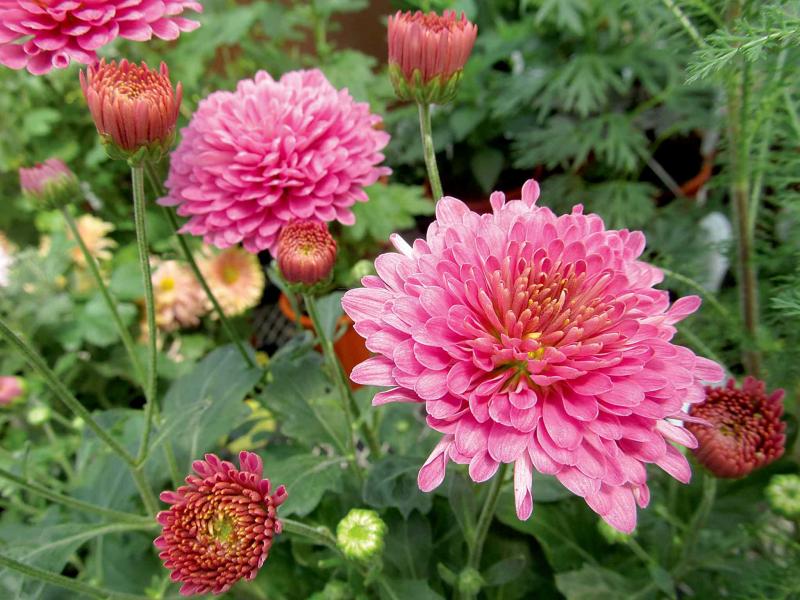
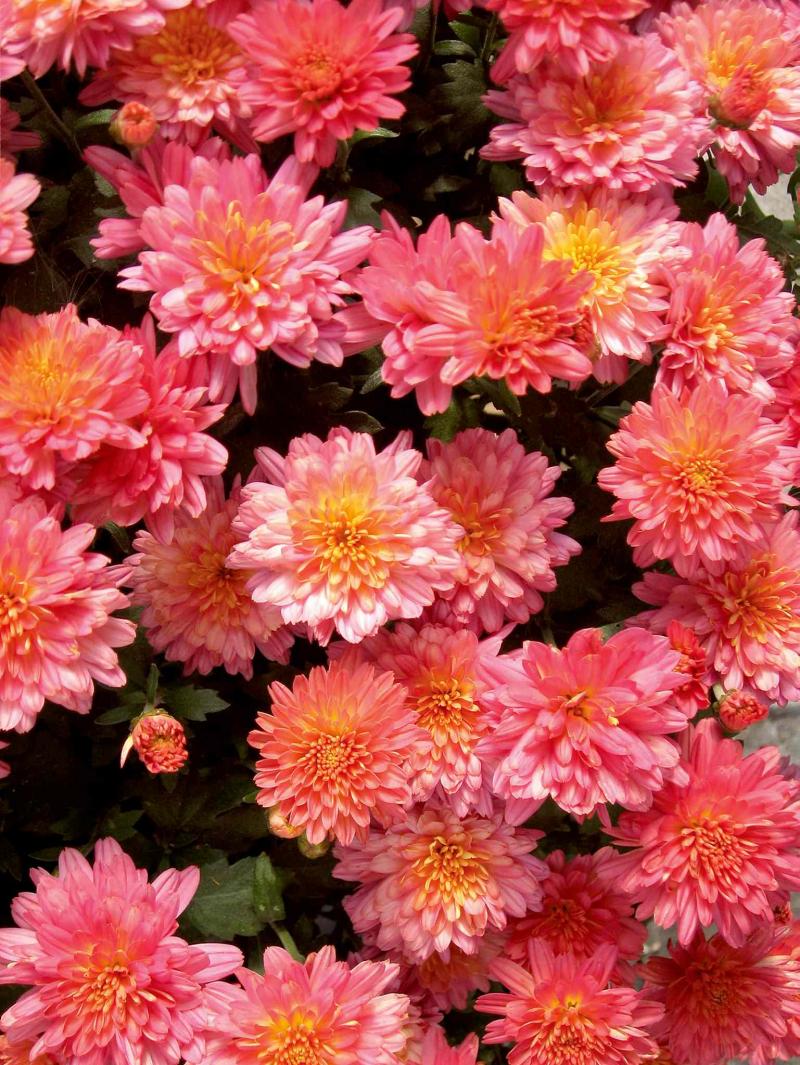
Local farmers markets and garden centres are brimming with pots of perfectly mounded mums bursting with hundreds of buds in a wide range of colours. From shrub-size mushroom-shapes in 61 centimetre pots that will cost you as much as $49.95 for a massive display of colour to the more typical-sized pots that start as small as 12 cm, their perfectly uniform abundance of blooms will carry your garden through to the first frost and even beyond.
In towns and cities across Canada, mass displays of florist or pot mums are synonymous with the start of fall because of the plant's ability to withstand three to four degrees of frost as well as an early snowfall, their perky daisy-like blooms remaining vibrant oftentimes right through to early November. In Winnipeg, visitors to the downtown area will soon see a fresh new display of garden mums at the legislature along Broadway.
Not to be confused with the hybrid herbaceous perennial chrysanthemum developed for cold hardiness on the Prairies by legendary plant breeders Bert Harp, Henry Marshall, and Wilbert Ronald at the Morden Research Station in the 1960s and '70s, annual mums come from the same original parent (originating in eastern Asia) but have been forced into bloom for the fall market.
While some gardeners have experienced marginal success in overwintering florist mums, similar to overwintering florist hydrangeas in a mild winter through the use of heavy mulching, these floriferous mums are meant to be treated as annuals and enjoyed for their seasonal beauty.
Hardy mums produce underground shoots, or stolons (creeping stem). Annual mums put all of their energy into producing larger blooms, hence few or no stolons so are unlikely to survive a harsh winter.
Duayne Friesen, sales representative for Ball Seed, says as recently as 10 years ago, the market for annual varieties of mums in Manitoba was almost nonexistent. Today, the market is thriving, largely based on the popularity of having six to eight weeks of late-season blooms together with the ease of low-maintenance.
"The work is done for you," said Friesen. "Just water regularly."
Today's annual garden mum is not necessarily more uniform in shape and size than, say, five years ago. Friesen says growers, though, are emphasizing a longer bloom period and offering a greater number of colour variations of yellow, purple, pink, orange, bronze, red, white, and salmon.
Friesen said varieties are divided into categories based on their reaction time or flowering. "There are a ton of varieties to choose from, but the determinant is reaction time so that they will be ready for the fall," said Friesen.
Bloom time is very predictive through growers' use of opaque material called black cloth, designed to manipulate or modify mums' photoperiodic response (amount of time the plant is exposed to light). Mums, similar to poinsettia, are so-called short-day plants, forming flowers only when day length is less than about 12 hours.
Sue and Rob MacLeod, owners of Glenlea Greenhouse, begin selecting varieties from catalogues as early as February based on colour, vigour and the number of weeks plants take to flower. Cuttings arrive during the first week of June and are planted into pots.
After two weeks," said Sue, "we apply predators to the mums as a biological control strategy for thrips, a tiny insect that can suck the life out of developing plants. Each protective sachet will last the duration of the mum crop."
After three to five weeks, the MacLeods begin covering the mums starting at 6 p.m. until 9 a.m. The 15-hour nights trigger flowering in time for early September sales at both their greenhouse in Glenlea and kiosk at the St. Norbert farmers market. Large mums can be as big as 91 cm across. Varieties include Pink Frenzy, Five Alarm Red, Venus Purple, Yellowstone Yellow, Bedazzled Bronze, and Blazing Orange.
Shelmerdine Garden Centre is the largest retail grower of annual mums in Manitoba, selling 20 different types, each infused with colour variations, for a total of about 2,000 plant at a uniform 61 cm wide by 61 cm high.
Chad Labbe, co-owner, says Shelmerdine is able to extend the season by offering very early to later-blooming varieties by utilizing a black-cloth program and covering plants at different times.
How big would you like your mum to be? For just under $50, Lacoste Garden Centre is selling jumbo shrub-size mums. Stewart McLeod, greenhouse manager, says mums are heavy drinkers. Place them in full sun and do not skimp on water. "Water deeply until the water drains freely out of the bottom of the container," said McLeod.
What captured my eye at Lacoste was the rhythmic pairing of rows of mounded mums interspersed with 25-cm pots planted with 76 cm tall annual fountain grass. And oh, so affordably priced at only $14.95. The narrow, arching foliage and pinkish feathery soft and fluffy plumes of fountain grass serve as a gorgeous companion to potted mums throughout the late fall.
McLeod, though, stressed fountain grass is not as frost hardy as mums so pull them into the garage if frost is in the forecast.
Why not revitalize some of your existing container displays by removing stragglers, fading flowers or poor performers and adding some cool-season plants such as mums together with ornamental kale? If your container is roomy enough, tuck in a perennial such as heuchera or sedum, which can be planted into the ground in the late fall.
Friesen says the bold colour of celosia intenz works well with mums as well as pansies, the cool wave series in particular.
Jeffries Nurseries in Portage la Prairie began selling annual mums on the wholesale level in just the past two years. Jeffries, though, has played a significant role in developing hardy chrysanthemums for Prairie gardeners. Building on the breeding work done at the University of Minnesota and at the Morden Research Station several years ago, Jeffries developed and introduced between 2004 and 2006 several new hardy mum varieties from crosses made among earlier chrysanthemum varieties.
The Firecracker series includes two early-flowering varieties, Dreamweaver and Suncatcher, that both feature unique fluted petals that are quill-like. Both are taller varieties that grow to 75 cm. Shawna Ronald from Jeffries Nurseries says Tiger Tail, another tall variety in the series, is particularly unique because of the colour break when the buds are tight and peachy-coloured. As they open, they become more of a tangerine, eventually fading to a light yellow.
Hardy chrysanthemums can be a bit tricky, says Carla Hrycyna, co-owner of St. Mary's Nursery. "Improving their success rate is dependent on not planting them in an area that is going to have sustained dampness in the spring," said Hrycyna. "Think of the ideal planting site as a pitcher's mound which sits on slightly higher ground than the surrounding area. Higher ground allows excess moisture to be redirected away from the plant's roots so it isn't sitting in a pool of water. Mums will not tolerate cold, wet, soggy areas in the springtime so don't, for example, plant mums near the area where your sump pump is going to be blasting out water in the spring."
For best performance, divide perennial mums every second year. Using a sterile, sharp knife, divide by cutting the heavy woody roots that are joined together in the root ball, ensuring that each division has roots and one or two buds.
Whether annual or perennial, mums deliver colourful season-long impact.