I am a self-declared naturalist. You can't really go to college or university to become one. It's more of an ethic, a kind of deep seated value that you accept all of what Mother Nature has to offer - the good and bad.
Native plants are big in this scheme of things. This does not mean rejecting all the beautiful cultivars that can be integrated into the residential landscape. It just means that one subscribes to the creed: "the right plant for the right place," and native plants are as right as you can get.
So how did my family property find a balance between being a garden collection of perennials, shrubs, and trees, and a statement of bio-regional diversity? One day, after I had finished working on the house foundation, I pondered what to do with all the clay and subsoil. I wandered over to the nearby Living Prairie Museum on Ness Avenue to take some cues from nature, and there my landscaped life changed forever.
They say once the blood gets infected with garden fever, one will never be the same. Collecting the latest hosta, for example, becomes a balancing act of budget and persistence.
Some gardeners need to have every colour of the latest coral bell cultivars while others covet the fanciest of the iris. But what if I told you of a kind of plant that needs little water once established, will bloom under the lowest of light levels, will attract a myriad of beneficial insects and birds, and can stand up to the harshest Manitoba storms? Would you rush out and spend that exorbitant sum you dished out for a beautiful fern-leaf peony? Well, you needn't rush to the bank, as our own native plants of Manitoba are versatile, tough, and of great value.
I wanted to talk to the true guardians of our native plants, and see what their favorites were, and why they continue to be so enamored with true Manitoba species to stake their livelihood on this passion.
John Morgan of Prairie Habitats, and his wife Carol, are now into large-scale restoration projects, but some time ago John operated a retail nursery and sold me a Culver's root and a tall meadow rue.
It was a modest orientation into the native plant world to say the least, but it was the catalogue that he gave me that was exciting. There were plants for every condition you can name: clay, wet, dry, saline, acidic, woodland. Even plants with spring blooms while the snow is still on the ground, such as the Manitoba crocus.
This is a mysterious new world of gardening, and obviously well beyond the petunias and geraniums of the box stores. And yet, upon more research, you realize that native plants have been with us for millennia, a large part of aboriginal culture, and incredibly important for Manitoba's web-of-life to be whole and intact.
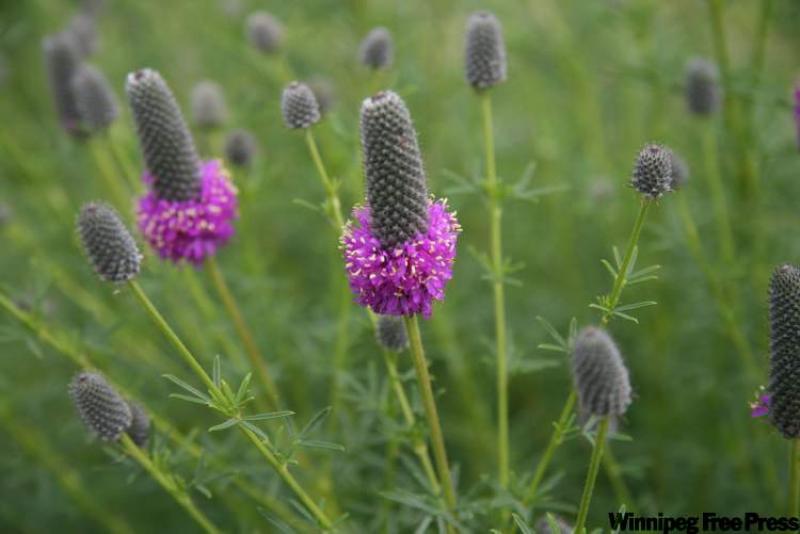
John goes on, reluctantly, to name some of his favourites (like picking your favorite child, this probably shouldn't be done): prairie smoke, with its masses of pink seed clouds and evergreen leaves, and purple Prairie clover, a legume, so it takes nitrogen from the air and makes its own fertilizer, enriching the soil.
Wes and Aimee McDonald, of Prairie Flora, are the heirs to John's nursery business. One of their favorites is the Lewis wild flax, with a mass of baby blue flowers, delighting you with new blooms every day. They love the way native plants let them feel closer to the land in which they live, always appreciating the ever-changing landscape, with the prairies constantly giving them new things to learn.
Shirley Froehlich, of Prairie Originals located in Selkirk, does a great job propagating true native shrubs and trees. Her catalogue points out that certain trees will act as host to many different butterfly species, let alone all those berries you can produce for jams and jellies -- even homemade natural wine. Even the beer drinkers can join in on the fun; she sells hops (humulus lupulus), a native vine.
Her favorite shrub is the nannyberry (viburnum lentago). And did you know the genetic strengths of the native shrubs and trees are being bred back into the nursery-available cultivars? The villainous pathogens of black knot fungus and fire blight could be beaten after all.
If more of us realize the amazing benefits of our own native plants, our biodiversity factor would go up exponentially, bringing more birds, butterflies, and beneficial insects into our neighborhoods. For more guidance on how to be a part of the naturalization movement, check out Fort Whyte Alive's Backyard Naturalization program. It is based on the great 2006 book Naturescape Manitoba. Visit the Canadian Wildlife Federation and National Wildlife Federation (USA) websites. Community groups and schools can check out the Evergreen's Common Grounds and Learning Grounds programs. Many of these organizations will provide signage that you can display in your garden to show that these natural native plantings are purposeful and beneficial.
You may inspire others to follow your lead. And hey, it is a good proclamation for those more fussy gardeners to let them know that you are purposely letting those plants self-seed and be more chaotic than usual.
Sustainable gardening, and embracing native plants, is not about perfection. It is emulating what is naturally occurring in your bio-region, but within the restrictions of the aesthetics of your residence -- at least that's what I tell myself when I am too tired to do any more yard work.
William Dowie is an independent environmental management consultant and Master Gardener Candidate. He is the guest designer at Jensen's Nursery and designer-in-residence for Prairie Flora. You can find him on LinkedIn.
Local plants great
NATIVE plants are generally hardy, reliable performers. As attracted as we are to the countless new varieties introduced to the market each year, many of us are not familiar with the diverse varieties of hardy plants native to our prairie region. William Dowie recommends some of the lesser known, exotic-looking varieties native to Manitoba. The stately Culver's Root, for example, attracts hordes of bees and is wonderfully disease and pest resistant.
Got bunnies? Next week, Sarah Coulber, of the Backyard Habitat Program, Canadian Wildlife Association, will share tips on how to garden with visiting rabbits, deer and raccoons that may be interfering with your idea of perfection.