Charles Beliveau's condominium is proof that it is possible to find serenity and balance in the centre of a buzzing city.
Beliveau had a strong vision of the kind of soothing oasis he wanted when he bought his Old Montreal condo in 2008. It would be an urban pied-à-terre where he and his girlfriend would live when they weren't at home in Quebec's Eastern Townships.
The Sherbrooke businessman, a partner in Imobia, a real estate company that owns and manages office space, enjoys a lifestyle that is the opposite of many Montrealers. His primary residence is in the country, on the shores of Lake Magog. The condo, his second home, is in Old Montreal. It's the place he heads to when he needs a jolt of urban life.
"There's a lot to do in Montreal," he said. "More nightlife. But if I want to go into the city from the Eastern Townships, it takes an hour-and-a-half. And when I dine out and have a glass of wine, I don't want to drive home at the end of an evening."
Despite his need for urban activity, Beliveau wanted a condo that would screen out traffic noise. He loves Old Montreal, but figured it would be difficult to find a soundproof building with underground parking amid the historic housing stock in the neighbourhood.
Following a six-month search, he found a unit in a building in the historic district that had been constructed in 2006.
Despite the building's newness, Beliveau gutted the condo's interior and started afresh with a new design. Renovations cost $700,000.
He hired architect Nataly Houle and interior designer Jean Monet to mastermind the redesign. The apartment would have to be outfitted with smart home technology. It would need two bedrooms to accommodate the friends he entertains. It would have an ultra-contemporary look, quite different from the more traditional design of his home in the Townships. And, although it was the winter of 2008, it would have to be ready by summer.
"I'm a tennis fanatic and I wanted to be able to live in it during the tennis tournament at Jarry Park," Beliveau said.
There were a few challenges in starting afresh, Monet said. Because the unit was in an existing building, it was impossible to punch through floors or ceilings to accommodate new wiring and plumbing.
"We raised the kitchen and bathroom floors to lay in new plumbing," he said. "Fortunately, there are 12-foot-high ceilings, so it didn't make the space cramped."
In the kitchen, custom cabinetry in white lacquer and a dark exotic wood extends to the ceiling. Brushed aluminum appliances share the space with a deep farm-style sink. The floors and counters were covered in one of Monet's favourite materials: white quartz.
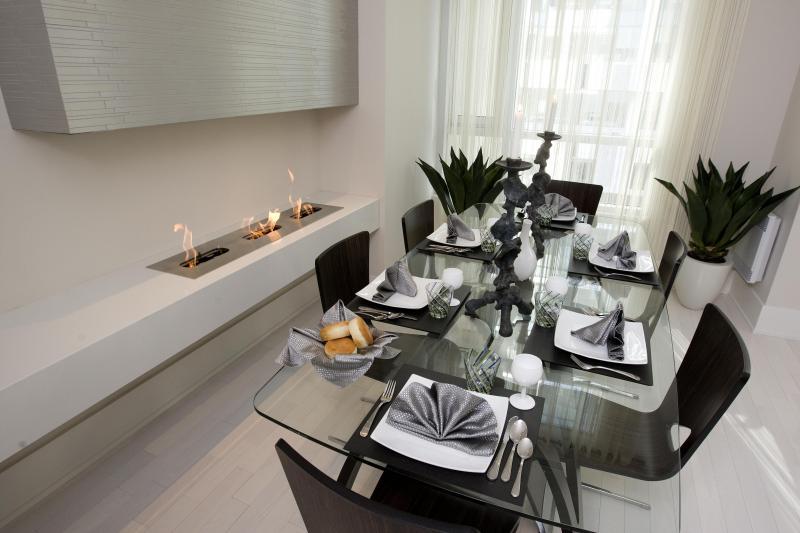
Because Beliveau enjoys cooking and entertaining, the food-preparation area is open to the dining room, which is decorated with a glass-topped zebra-wood table and chairs. The Ligne Roset fibre-optic chandelier above the table, which has tiny blue lights, is a conversation piece. It reflects off a large aluminum sculpture on the wall, designed to resemble etched metal bricks.
Houle opened the space by removing a wall that divided the kitchen from the condo's hallway. She also removed a hall closet to create a contemporary version of a butler's pantry. It features three temperature-controlled wine fridges and a display case for several pieces of ceramic art.
The large wall across from the butler's pantry seemed naked until Monet found the perfect piece of art for it, a painting by Lucille Marcotte of a young woman in shades of taupe, white and black, which measures a whopping three by two metres.
The doors in the condominium, made of exotic wenge wood, are as tall as the ceilings.
"I saw doors like this in Panama," Beliveau said. "Some of the nicest buildings there had doors that were between (3.5 and four metres tall). It's not an easy element to integrate because the ceilings have to be very straight. Each door weighs 250 pounds, so we had to install five heavy hinges on each door frame."
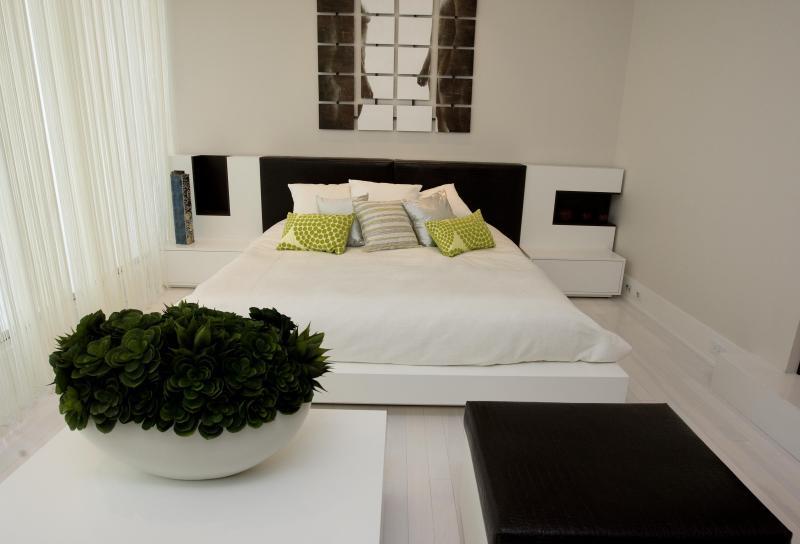
Beliveau also wanted smart home technology, electronics that would open and close window coverings, for instance, and run various other high-tech systems.
The living room and each of the two bedrooms have large-screen televisions and sophisticated surround-sound speakers that fill the space with music.
"I didn't want to see any wires," Beliveau said. "I wanted all the architectural lines to be very pure."
As a result, all the electronics are hidden inside walls and the electrical outlets are in the baseboards, where they're barely noticeable.
The living room TV seems to hang in the air. In fact, it pivots on a custom built structure that houses all the wiring.
Behind the television, an alcove is the location of a small home office and a sofa-bed. When the room is used to accommodate guests, a remote-control device lowers a room-divider blind from the ceiling to create privacy.
One of Beliveau's friends uses the condo when he's in Montreal two days a week on business and the two share the operating expenses.
"Each bedroom has two closets," Beliveau said. "My closet permanently has my clothes in it and so does my friend's closet. But there is space in the other closets if I have other friends staying in the condo when I'm not there."
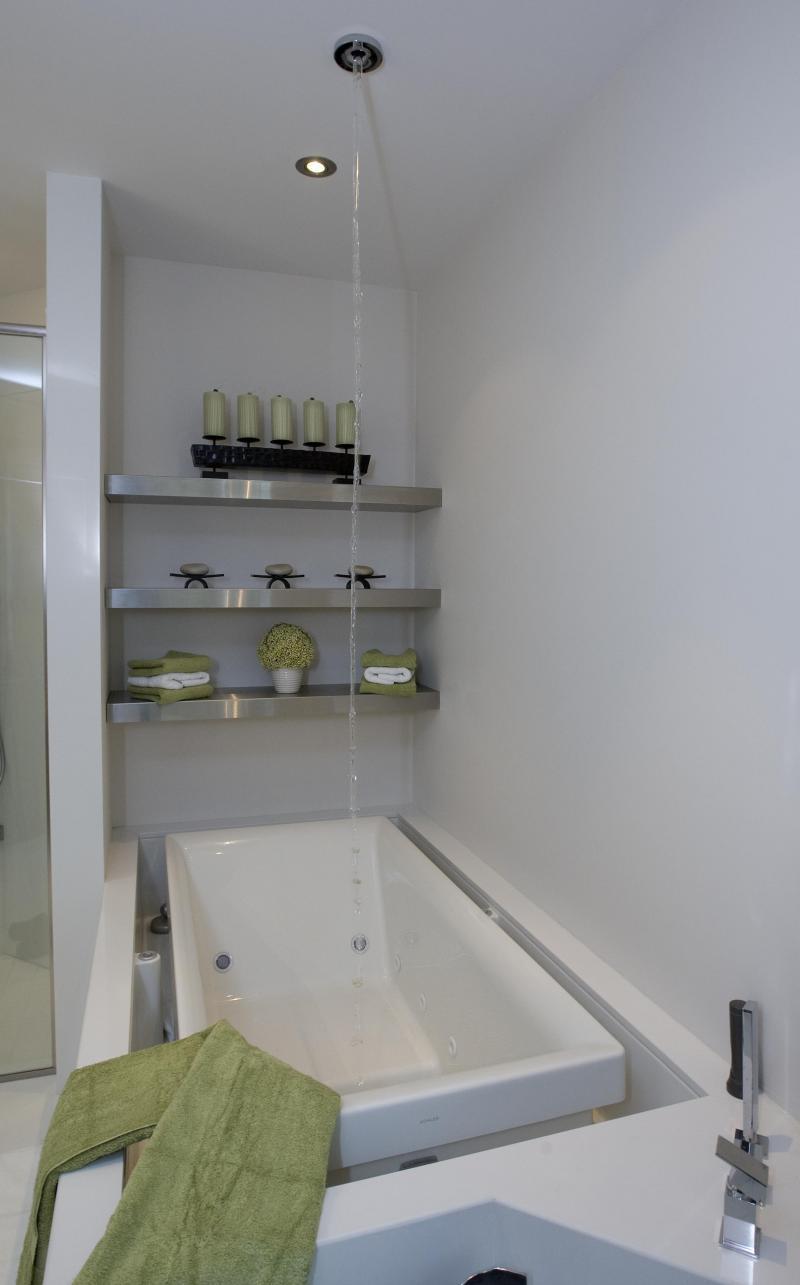
The master bathroom, which boasts a separate water closet, is a Sybaritic retreat. A deep bathtub is filled by a stream of water from a ceiling-mounted faucet as is the bathroom sink. The challenge in mounting the faucet above the sink, Beliveau said, was to centre it.
"The plumber had to use a laser to make sure the faucet would be right over the middle of the sink."
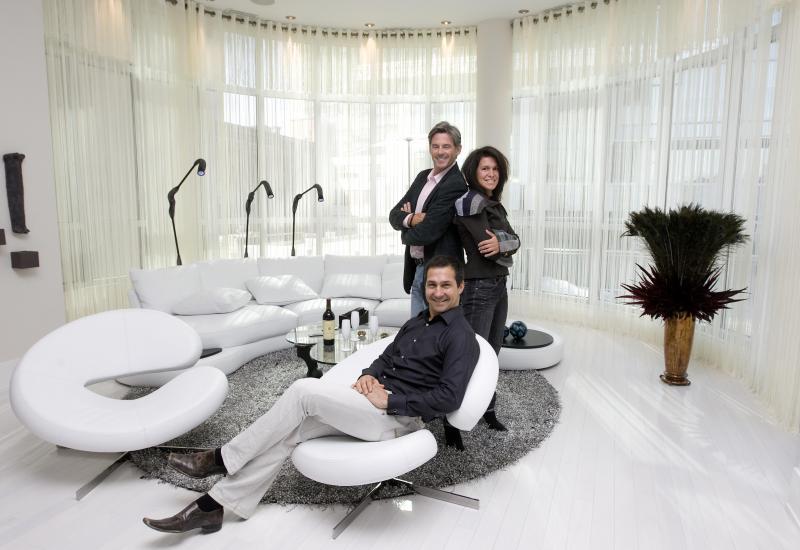
He says he loves the condominium best in the evenings when he can view the lights of the city from the bay window in the living room.
Monet says the rounded architecture created by the bay windows proved to be a challenge when it was time to buy living room furniture.
"No one was selling round white sofas," he said. "So we bought two sectionals and had them cut and resewn into a rounded shape."
The sofa faces two space-age style chairs in white calf's leather.
Beliveau says he enjoys a boutique hotel ambience in his condominium.
"I feel as if I'm staying in the best hotel in the city except that it's bigger and I'm at home."
-- Canwest News Service