
My wife and I were recently cross-country skiing with the family dog -- a big male retriever -- when he abruptly disappeared. He'd slipped off the trail, sinking over his head into the deep snow. A rescue was not required, as he managed to bound back onto the trail with a thrust of his powerful hind legs.
The incident did make me wonder if the regenerative spring will ever return. At this point, it would seem we can dream only of new greenery, open lakes and, yes, outdoor living and those exhilarating DIY projects associated with it.
I'm happy to report I experienced a hint of mudluscious spring when I attended the Cottage Country Show in Winnipeg this month. On display were cedar docks, pine cottages, rural homes and many other reminders of the rejuvenating vernal equinox.
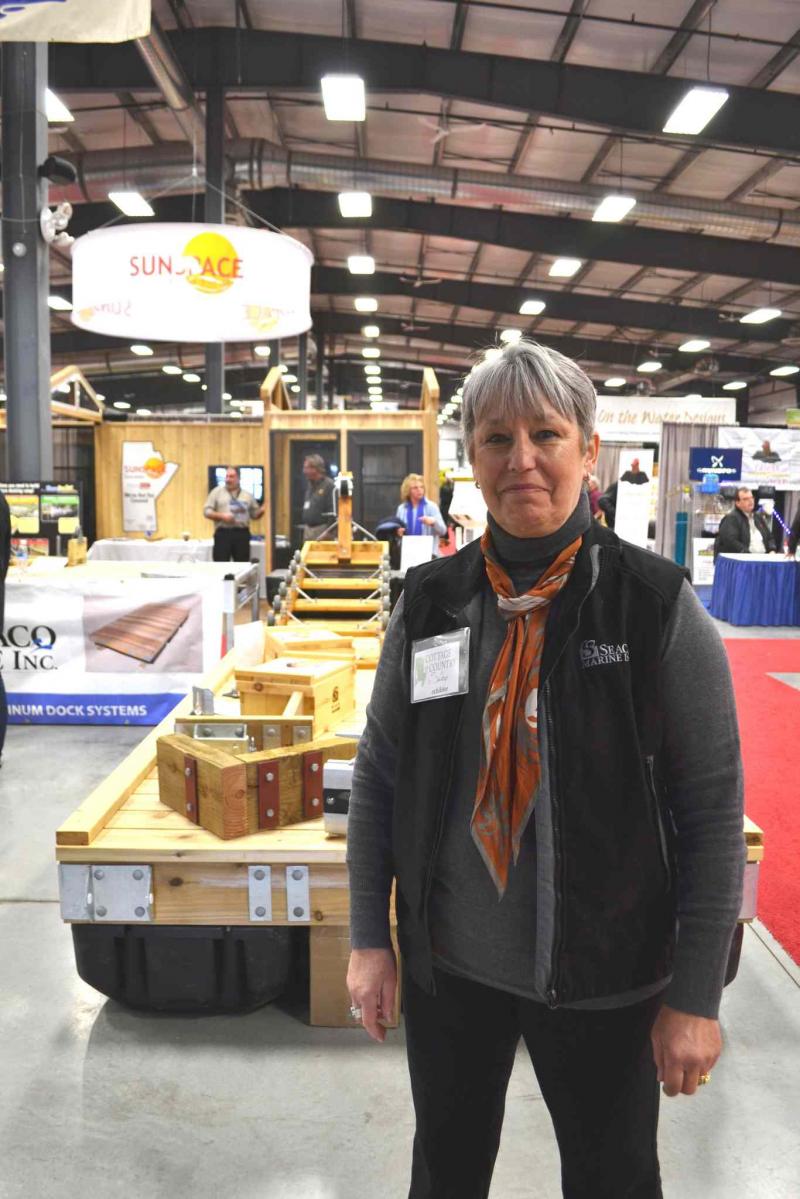
The first item to catch my eye was a 16-foot cedar-planked dock by Seaco Marine Inc.
President Tom Hopper, co-owner of Seaco with his wife, Harriet, said dock packages are assembled at the company's five-employee shop in Oak Bluff and shipped, in most cases, to customers by truck on a single pallet.
This is the least expensive way to buy a dock; however, Tom added if a client requires a pre-assembled dock, it can be loaded onto a flatbed truck and delivered to almost any destination.
Packages include galvanized corner brackets, extra bracing (if required), hinges and other hardware, as well as hot-dipped deck screws and foam-filled, polymer-shell floats with a 15-year warranty.
"To this point, we don't sell wood. Customers are advised to purchase Western Red Cedar from local lumber dealers for the top planking and Douglas fir for the sub-frame," said Tom, who does not recommend green or brown treated lumber because the chemicals in the wood are bad for the environment.
He added he is thinking of selling packages comprised of pre-drilled Douglas fir for DIYers who want to assemble their docks quickly and without the hassle of outsourcing lumber.
Said Harriet, "Standard dock sizes are six feet wide by 16 feet long and eight feet wide by 16 feet long; options are six and eight feet wide by 20 feet long."
Depending on the size, dock packages (excluding wood) retail for about $1,500 to $1,600, shipping not included, though a package can be fitted into the back of a half-ton for people who want to pick up their docks in Oak Bluff, said Harriet.
She added ramps secured to the shore are recommended to increase the stability of docks, as are interior brace kits to reinforce docks exposed to strong winds or currents.
Ramps are generally the same width as the dock to maximize stability and are sold as six-foot or eight-foot wide by 10-foot long packages (wood not included) for about $800, Tom said.
Docks and ramps come with a complete set of plans and templates for DIYers; shipping mileage rates are quoted at the time of sale and orders take about two weeks to process.
One of several dock accessories available is a solid cedar bench selling for about $259; for a complete price list including Seaco's line of aluminum DIY boat ramps, call 1-800-665-2008.
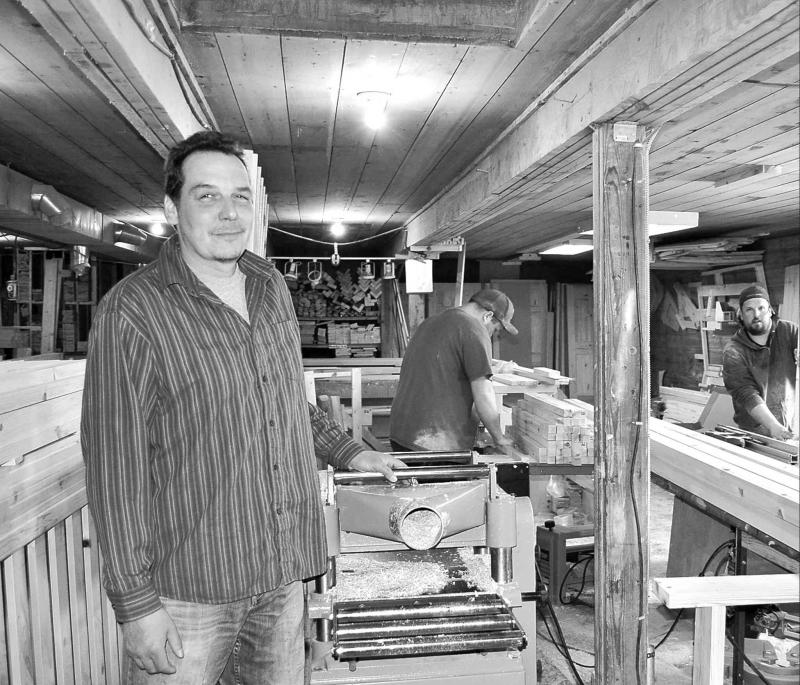
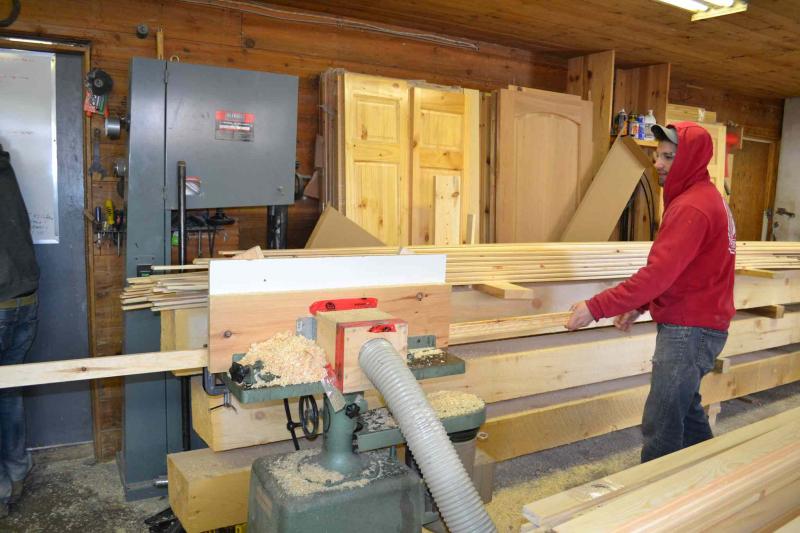
Another exhibit that appealed to my DIYers' spirit was a display of pine building products distributed by Mopress Manufacturing near Birds Hill Park.
"We provide a lot of solid pine to people who want to upgrade their cottages," said Ralf Kaletsch, owner of the business.
"I started out as a builder of futon frames in the mid-'90s," said Kaletsch, who began to manufacture pine bunk beds, stairways, handrails, casings and mouldings in 2004, and distributing pine doors and siding, targeted mostly at the DIY cottage market.
He said the demand for siding became so strong he stopped manufacturing it himself and began to order pre-machined products straight from lumber mills in Ontario.
"Because of shipping costs, it was cheaper for me to order a load of finished siding than to ship unfinished boards to my shop and machine them myself," Kaletsch said, adding he still manufactures most of the pine baseboard, moulding and casing he sells.
For the most part, he said his trims are knot-free or have solid knots that do not affect the structural integrity of the product.
Prices are reasonable, starting at 49 cents per lineal foot for 2 1/8-inch by 7/16-inch casing and running to 85 cents per lineal foot for 3 º-inch crown moulding; 7 1/2-inch by æ-inch baseboard is $1.15 per lineal foot, 1 º-inch by 1 º-inch brick moulding is $1.25 per lineal foot.
These prices drop according to the amount of trim ordered; for example, 2 º-inch crown starts at 65 cents per lineal foot for an order of up to 4,999 feet, dropping to 40 cents for an order of 25,000-plus feet.
All of the above trims are available with a lacquer finish for an additional 30 cents per lineal foot.
Kaletsch's one by six-inch T&G cottage grade pine siding is very competitively priced at 38 cents per lineal foot.
The material has some loose knots and the occasional damaged tongue or groove, but for the most part it is a good product for a DIYer who wants to add a classic look to the interior or exterior of a cottage or other building.
His No. 2 or better one inch by six inch, two inch by six inch and two inch by eight inch log siding sells for 56 cents, 97 cents and $1.10 per lineal foot, respectively.
Kaletsch said the sidings he sells including T&G, ship lap and log can be purchased with a lacquer finish for interiors or a Sikkens finish for exteriors at an additional charge.
"A barn board stain that imitates the look of naturally weathered wood has also become very popular with customers," said Kaletsch, who says rough-faced boards will turn darker than smooth-finished ones because the coarse texture absorbs more stain.
For people who like the warm, rustic look of a wood floor, Kaletsch sells three widths of T&G unfinished pine flooring, as well as three widths of T&G unfinished ash flooring.
"The pine ranges from 49 cents to 92 cents a lineal foot, depending on width; the ash is all priced at $2.25 a square foot. If customers want it pre-finished, it costs about 40 cents a square foot for stain and $1.50 a square foot for clear coating," he said.
Solid pine doors that complement pine floors, walls and trims retail for $149 to $169 in popular widths; bifolds come in 24-inch, 30-inch and 36-inch widths; add $45 for a lacquer finish on any door choice. Specialty items Kaletsch manufactures on site include detailed square pine spindles at $4.20 each; detailed square newel posts at $57 each; handrails and shoe rails for $4 each; and key stock for 49-cents per lineal foot. (As with other items sold, the prices for most of these products become lower depending on the number of pieces ordered.)
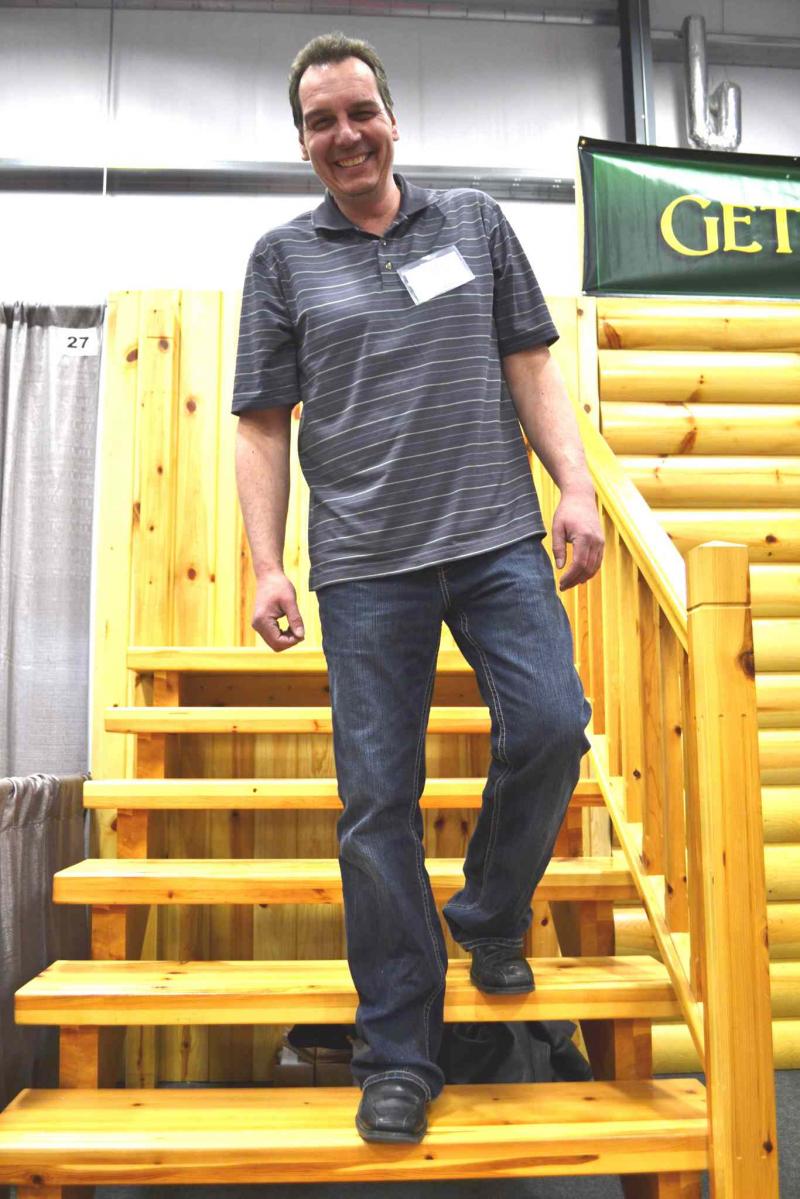
Curved casings for arched windows are priced per order; costs vary according to size, arch radius and quantity, he said, adding prices for custom pine stairs (indoor or outdoor) and handrails vary according to design specifications.
Bunk beds are also built on site and are sold in single, queen and kings sizes with two-inch by 10-inch pine frames for $220, $240 and $260, respectively; add another $60 per unit for a clear-coat finish.
For further information and pricing call Mopress Manufacturing at 1-204-793-5074.
Yet another booth that sparked my interest featured a display by Jay West Country Homes Ltd., an independent distributor of Viceroy homes.
"One advantage to purchasing a Viceroy house is that the building process is flexible so a DIYer can put as much sweat equity into the construction process as he or she desires. This can save a handy individual a lot of money," said a spokesman for Jay West County Homes.
He added the company has professional architects and engineers on staff available to answer DIYers' questions during the construction process.
Moreover, he said the company manufactures its own building materials, selling them directly to clients who benefit from better quality lumber (kiln dried by the company) and Energy Star-approved "Super Windows" that qualify for Zone C applications, including most of Manitoba.
"Our lumber comes with a heat certification guarantee that assures clients that each piece has been subjected to a temperature of 56 degrees C for 30 minutes. This process kills harmful insects such as termites, worms, nematodes and other pests, including their eggs and larvae," he said, adding factory-built walls speed up the construction process and reduce off-cuts so the amount of unusable lumber is minimal.
"Computerized design equipment can eliminate unnecessary studs, add blocking, pre-drill for plumbing and electrical and make many other framing alterations, a time-saving feature that saves money for DIYers and contractors alike," he said.
For further information on designs, prices and delivery, call 204-890-4003.