Summer is the time of year when DIYers prematurely unholster their hammers to remedy the bad and the ugly at the family cottage, often before consulting their significant other.
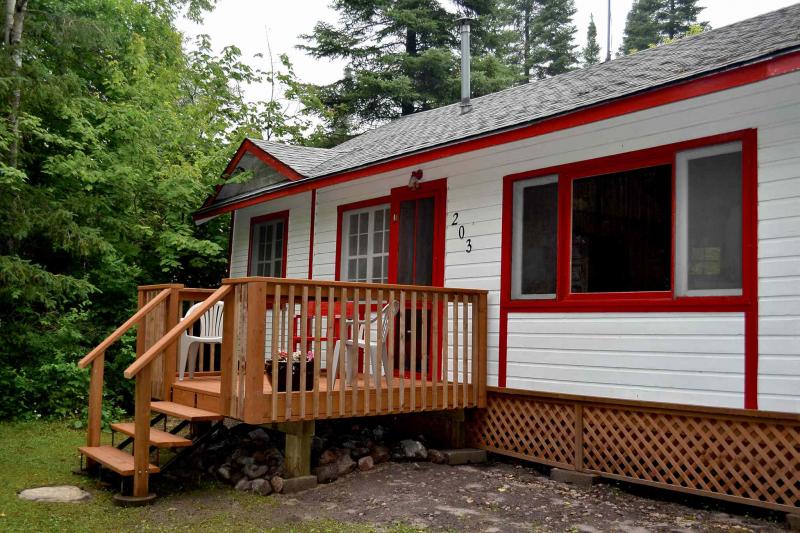
We recently undertook a fairly extensive reno of our cottage including the removal of a nine metre field stone footing, as well as the almost complete demolition of a concrete stairway comprised of mortar and small beach boulders. We replaced the footing with a laminated beam supported by treated beams. That might have been the final shot, however, it then occurred to us we required some means of ingress into the cottage. Ideas flew like skeet, each one blown out of the air for one reason or another. It was finally decided the most expedient method to remove the last tenacious bits of the stairway was to use dynamite or build a deck over top. To keep the peace, we decided on the latter. I believe Marshal Dillon and Festus would have approved of our non-aggressive approach.
The deck is eight feet square, allowing me to calculate the amount of lumber required with some ease. I used steel stair stringers for the stairs; the ready-made wood ones are, in my experience, crap. It's still possible to pull out the steel square and lay out your own stringers, but this requires two-by-12-inch lumber which is expensive and generally needs to be special ordered. (Some people do cut stringers from two-by-10 lumber but the skimpy spine is a source of concern.) Another possibility is to plow dadoes into two-by-10s to receive the treads. This technique produces a solid stringer. However, depending on the tools at your disposal, it can be time consuming. Back in the Wild West, the dadoes would have been cut with a back saw and a chisel. Nowadays, various power devices from a builder's saw to a router can be used for this process.
While at work on the deck, it occurred to me ordering a ready-to-go package from a lumber store is less economic than taking the time to calculate your own materials. In order to maximize profits and simplify code requirements, wood package sellers will include the same size of joists, beams, pads and hardware for a small deck as for a large one. This means you may pay for eight-by-eight joists and six-by-six posts when smaller, less expensive dimensional lumber will meet the live load requirements recommended for deck construction. (Caveat: If you plan to add a hot tub or build a roof over the deck, then heavier timber is required.) Take a gander on the Internet at Winnipeg's zoning and construction requirements for open non-sheltered wood decks for residential buildings. It contains code tables with the size, spacing, support and length of lumber to build a deck with a 40-pound per square foot rating, similar to the main floor of a house. Using these tables, you can design your own cost-efficient deck that meets code but will not overburden your wallet. I also suggest a trip to the lumber yard to pick your own lumber to ensure you get the best quality products. You're paying top dollar for them. By the way, you need a permit for an attached or unattached deck in Winnipeg. Anything more than 60 centimetres from the ground also requires a railing and balusters.
A newly built deck of pressure treated cedar-stained lumber is as beautiful to behold as the redwood boardwalk in Marshal Dillon's Dodge City TV set. Alas, unlike an indoor site, our severe climate rides roughshod with stain, causing the colour of the deck planks to fade like Dillon himself. Two to three years is the expected lifetime of most clear deck or semi-transparent stains. Removing the discoloured residue is an arduous task involving pressure spraying, machine sanding and, in the worst scenario, heat guns and scrapers. (Blasting powder was outlawed years ago.) After eons of stripping and re-staining decks, I have come to the conclusion there is not a stain on the market that will last more than two years in Manitoba, though Kansas could be different. My solution is a two-part one: either let your deck go grey naturally or remove the planks and replace them with fresh, new cedar-stain boards. If you think this sounds cockeyed, consider that four litres of top-notch stain can cost up to $80, then add the time and effort you spent preparing your deck for re-staining. I did this calculation. The smoking summation was I could easily unscrew (using a screw gun, of course) and replace the planks on an eight-by-14 foot weathered deck (the undercarriage was still fine) for $256, compared to $80 for stain and innumerable other products and untold labour required to clean up the vintage planks. Taking into account the cost of materials and the work output on both sides of the equation, I concluded it was cheaper to replace the boards.
If there's a moral to this episode, it's to keep your piece in the holster until you speak to Miss Kitty.
davidsquare81@yahoo.com