

Every two years I delve into the problems with fast-growing poplar trees such as Swedish aspen and tower poplar. It seems like everyone who has large columnar trees is looking at the piles of 'sawdust' at the base of their trunks. This is a very serious and potentially dangerous problem. From a visual-impact perspective, the tall columnar poplars have an obvious visual appeal. The following is an abstract from a book dating back to the early 1800s on arboretum specimens that refer to these Lombardy poplars:
"By increasing the length of the perpendicular lines formed by the (upright Lombardy poplars), (the trees) not only produce variety and richness, but by increasing the length of the perpendicular lines formed by the poplars, (they) confer a degree of sublimity on the picture: Since it is allowed by all writers on the material sublime, from Burke to Dugald Stewart, that gradually tapering objects of great height create the emotion of sublimity."
-- John Loudon, Arboretum et Fzuticetum Britanmcum, Vol. III (London. 1838).
Some of the fastest-growing trees on the market today are tall columnar poplars such as Swedish aspen and Tower poplar. Their size and fast growth rate make them popular for privacy screens between yards. Lombardy poplars are generally not available anymore. There is a saying in the tree business: The faster the tree grows, the quicker it dies. Early death can be the result of growth stresses caused by pests and diseases.
I want to talk about the most common of these problems in columnar poplars -- the carpenter worms. Along with the insects, there is a common poplar fungal disease that attacks these trees as well. Unfortunately there is no treatment for this disease.
Carpenter worms or poplar borers
This is a wood-boring grub that attacks stressed columnar poplar trees in particular that are usually diseased. The adult moth looks like a hornet as it is black and yellow. The eggs the moth lays develop into tiny grubs that chew their way into the bark and wood. The carpenter worm or larva can grow up to 75 milimetres in length and up to 15 mm in thickness while feeding on stressed wood. They are one of the largest known wood-boring grubs in North America.
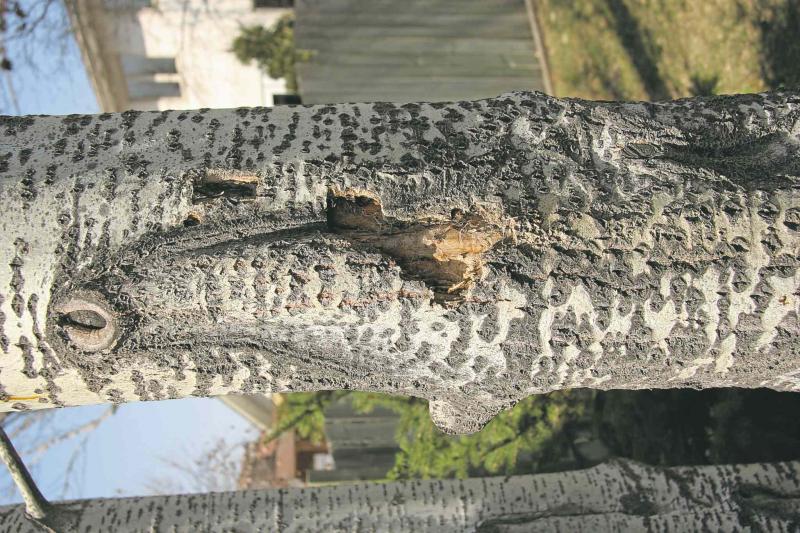
When it is present in the tree, large irregular shaped holes about 15 mm in diameter can be seen on the trunk bark. Depending on the number of holes, there can be a lot of 'sawdust' (called frass) at the bottom on the tree trunk. The worm pushes out its feeding waste, referred to as frass, through these holes. Often it can be seen in the crotches of branch attachments to the trunk.
The infested tree may or may not show dead branches, but the upper branches will have a thinner crown of leaves. The leaves will turn yellowish-green before they turn brown and curl up. Eventually, the upper branches die. Lower branches will soon follow in another year or so.
Heavy feeding by the worms will riddle the trunk wood with numerous holes and tunnels. This will make the tree structurally unsound and subject to breakage by strong winds. There is no known practical treatment to eliminate the grubs once they are well-established in the tree, especially in the middle to upper trunk areas.
If you live in the United States, there are products that reputedly can be used to deal with this problem earlier on in the cycle of the pest. There is no control product licensed in Manitoba for the control of these wood-boring grubs. These trees quickly become a hazard and should be removed, preferably by a Manitoba-licensed arborist, as the potential for unexpected breakage during the removal is very high.
I have attached illustrations I have taken of the grub and the damage it does to wood inside the standing tree. Strong winds earlier this summer destroyed many of these columnar trees through trunk breakage.
Damage to buildings and vehicles can be a cause for concern, depending on how tall these trees are. I personally would not live with one of these trees on my property. I have noticed younger and smaller columnar poplars, especially Swedish aspens, are getting infested earlier with these worms than was the case in the past. If you have lots of frass (sawdust-looking piles) at the base of your tree, look up and count the number of feeding holes. Are these trees you want to keep?
Michael Allen M.Sc.F., RPF is a consulting urban forester and certified ISA arborist. He owns Viburnum Tree Experts, a Manitoba company that provides objective assessments of the condition and the care required for trees and shrubs on home and business landscapes. He makes home and garden calls. He can be reached at 204-831-6503 or viburnumtrees@shaw.ca His website is www.treeexperts.mb.ca
Michael's new book 'Dr. Tree's Guide to the Common Urban Prairie Diseases'
is available from the author or from McNally Robinson book store.