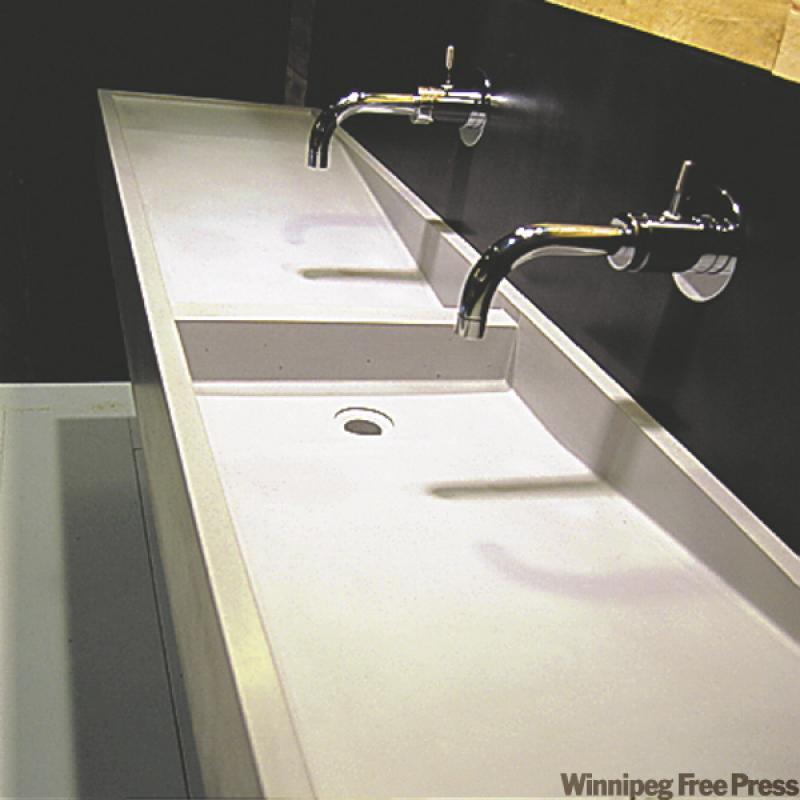
It's humble enough to start. Concrete, made from a mixture of cement, sand, crushed rocks and water, performs many basic functions all around us, as sidewalks, bridges, foundations, posts, blocks.
But since decorative concrete was developed sometime in the 1950s, with polishing techniques appearing in the late 1990s, this blended material has moved into the home, and is now seen in rough or smooth finishes and a variety of colours as countertops, floors and even tables and sinks.
In the atelier of artisans like Claudia Croteau, you might say concrete has attained the status of functional art.
Croteau, 36, who graduated from environmental design at L'Universite du Quebec a Montreal, formed Design M3beton with her concrete artisan brother Guylain, 35, in December 2007, after both had completed apprenticeships in Geneva, Switzerland.
"Concrete is sustainable for different reasons," she said. "Durability, for one. Also, it's very good for the quality of the air because there are no fumes, and it's easy to clean because it has no joints. It's a very clean, very modern, natural product and visually, it's really relaxing, very beautiful."
Croteau likens the mixtures they use to make different kinds of concrete to the ingredients of a cake, with cement playing the role of the flour. Metal wire or organic fibre are used to reinforce the concrete, while sand and water are other essential ingredients.
Then the composition varies depending on the type of aggregate. If they use 3/8-inch rock, for example, the rock will show after polishing.
On the other hand, there's no texture in the extra-thin concrete, which they call "svelte," made only from sand and fibre.
"We can do a countertop with the original mix with rocks and wire," she said. They can also make a countertop that is only two inches thick, like the one called rustre, made with silica sand.
"We can match specific colours, from white to black, brown, terra cotta, yellow, ochure or blue."
Concrete work can be done on site or in their Rosemont studio, which is the chosen method at Design M3beton, where all the concrete is cast by hand.
"This way, we have better control of the elements," she said. "We work the pieces upside down, again a bit like a cake."
The creation of the mould is where it all starts, she says, since it's in the nature of concrete to copy what it touches.
"So if you have a shiny mould, or a rough mould, that's the surface you will get in your concrete product."
Of all the products they make, Croteau says, the countertops are the most popular.
"People invest a lot in their kitchen; they're attracted by the esthetic, how tactile the material is, the fact that it's natural," she said.
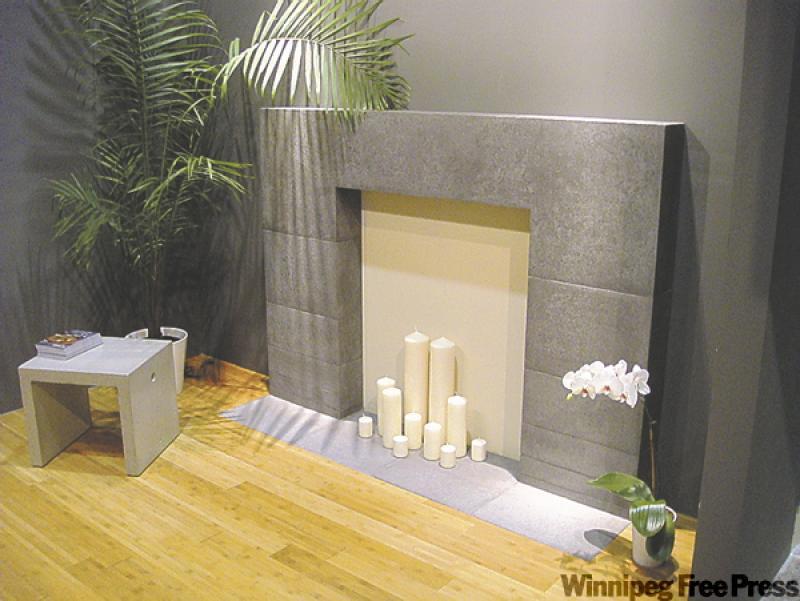
The fireplace mantel comes a close second. Because concrete doesn't burn, the opening can be close to the fire, she says, while the material also retains heat and lets it go slowly.
"You can frame a gas fireplace the way you frame a picture. Plus, we can do it all in one piece so there are no joints," Croteau said.
They can also add custom touches, like a bench or shelving to match the mantel.
The price, while not inexpensive, is competitive with other material.
On average, Croteau says, kitchen countertops will cost between $3,000 and $5,000, while bathroom vanities will start at $1,000.
"If anything is three-dimensional, which means we have to work on them from both sides, it will be more expensive," she said.
Dining tables can average $5,000, while fireplace surrounds start from $2,000.
Quite a bit of work comes their way from designers and architects, she says, or from clients interested in sustainable, handmade products, and those who like to buy locally.
For more information, go to www.m3beton.ca.
-- Canwest News Service