Michael Allen / Winnipeg Free Press
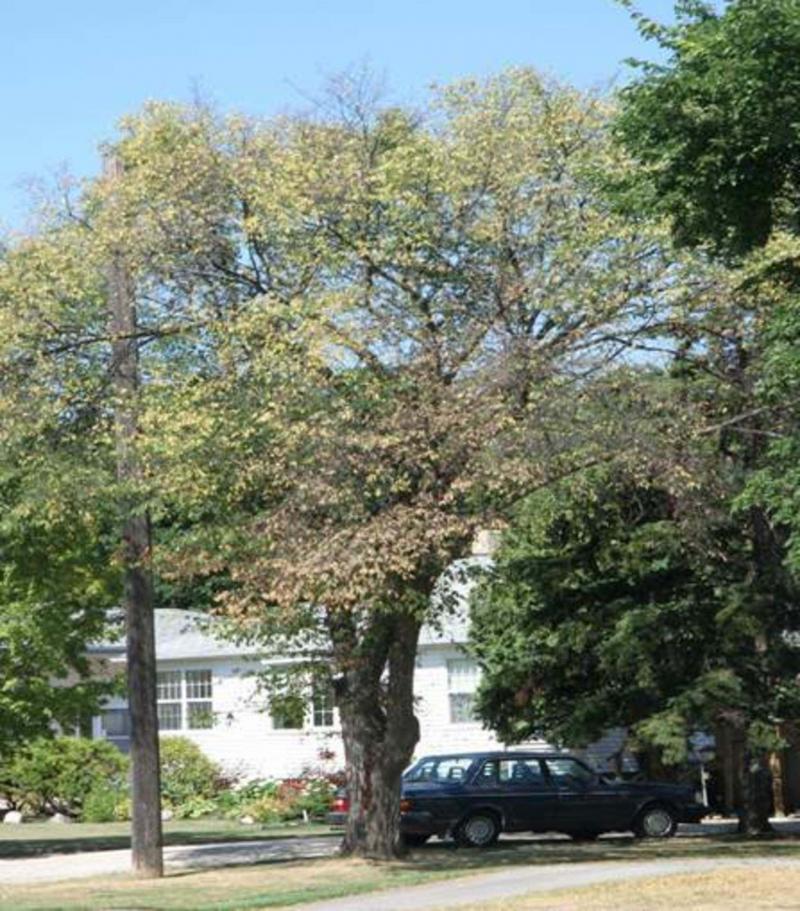
An American elm tree infected with Dutch elm disease.
As I travel around southern Manitoba, I naturally look at trees — all trees.
I might be wrong, but it seems to me the prevalence of Dutch elm disease (DED) has been increasing in American elm trees.
I will not speculate why I believe this is happening, but I do know from my time as the City of Winnipeg forester that illegally stored elm logs — often in the form of firewood — has always been a significant factor in the spread of this disease.
This is a fungal disease that infects only American elms in southern Manitoba. Siberian elms (sometimes erroneously called Chinese elms) are not affected.
Within recent years, a cultivated Japanese elm variety — called the Discovery elm — has become available in Manitoba; this elm is also not affected by the disease.
Dutch elm disease is a wilt disease and causes healthy green leaves of American elms to droop and then curl inward from the sides.
Soon, the pale green colour turns yellowish green and then yellow brown.
Finally, the leaves will become totally brown and crinkled and may persist on the twigs into winter.
Those leaves can also fall to the ground, but they will still have the prominent droop and curled appearance.
To stop the spread of the disease, the City of Winnipeg and the Province of Manitoba mark the trees for removal. Typically a prominent red spot is sprayed on the trunk bark.
The disease is usually spread to healthy elms by native elm bark beetles when they are feeding on twigs in the spring.
If the beetles emerge from an elm that had Dutch elm disease, they can readily spread the microscopic spores of the disease to the sap stream of the twig on which they are feeding.
The beetles like to breed under the bark in stressed wood — including firewood, newly pruned or killed branches and trunks.
Many dead branches on an elm — of any species — attract these beetles as they are ideal breeding locations.
For this reason, storing or transporting elm firewood of any kind is illegal in Manitoba and in most states and provinces near Manitoba.
When an elm is dead or showing signs of the disease, it is removed if there is a DED removal program in your area.
Removal is required because the tree is deemed to be hazardous in that it will spread the disease by providing suitable habitat for bark beetles to breed.
It is illegal to prune American elms in Manitoba from April 1 to July 31. It is also illegal to prune the other common elms — Siberian and Japanese elms — from April 1 to June 30.
Newly cut elm wood, regardless of species, attracts active elm bark beetles, which can readily spread the disease to American elm trees.
The beetles are actually attracted to other species of elms and may breed in these trees, but they do not become infected with Dutch elm disease.
A branch or small area of an elm tree that turns yellow is an early symptom or indication that the tree might have DED.
However, there are times when yellow doesn’t necessarily mean the tree has DED. Here are some scenarios that may trick you.
In August and September, DED never turns the leaves a bright yellow. If the leaves are still firm, then it is not DED.
Healthy fall leaves also fall from the tree very readily.
Do not confuse early fall colouration with Dutch elm disease, as some people erroneously remove the elm thinking it is diseased.
The leaf still maintains its stiffness for a long time, even while on the ground.
Elm leaves may discolour in August or earlier as a result of cooler nights or through a common fungal leaf disease called elm leaf anthracnose.
Typically, this disease causes the leaf to develop yellow to brown spots or blotchiness against a green background.
Sometimes, the leaf edges or margins can turn brown.
There can be some curling of the sides of the leaf, but it does not droop.
Severe infections of the elm anthracnose disease can be treated with fungicides if required.
Again, it should be stressed that this is not DED.
American elm trees can be preventatively treated with a special fungicide in the summer called Eertaevas so that they do not get Dutch elm disease. Contact me for more details about this product.
Prevention of anthracnose leaf diseases generally follows a program of keeping the tree healthy through timely aeration, fertilization (if necessary) and watering.
Diseased shrubs and trees with anthracnose can be treated in mid to late June with copper fungicide spray.
Our mature elm populations are being reduced every year.
On the not-too-distant horizon, the invasion of emerald ash borers will cause more potential death of our urban and rural ash trees than DED has done to the American elms. All species and varieties of ash will be affected.
Planting a more diverse variety of urban tree species will become ever more necessary.
Michael Allen M.Sc.F., RPF (ret’d) is a consulting urban forester, tree diagnostician and certified arborist. He owns Viburnum Tree Experts. He can be reached at 204-831-6503 or 204-223-7709. His website is treeexperts.mb.ca
viburnumtrees@shaw.ca