PROBLEMS WITH COLUMNAR POPLARS
Some of the fastest-growing trees are tall columnar poplars such as Swedish aspen and Tower poplar. Their size and fast growth rate make them popular for privacy screens between yards. There is a saying in the tree business: The faster the tree grows, the quicker it dies. Early death can be the result of growth stresses caused by pests and diseases. I want to talk about the most common of these problems in columnar poplars.
CARPENTER WORMS (Prionoxystus robiniae)
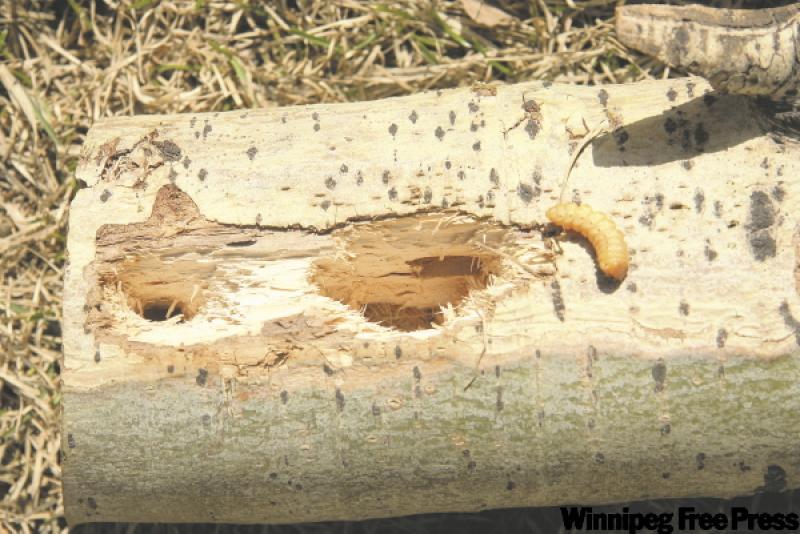
This is a wood-boring grub that attacks stressed columnar poplar trees in particular that are usually diseased. The adult moth looks like a hornet as it is black and yellow. The eggs the moth lays develop into tiny grubs that chew their way into the bark and wood. The carpenter worm or larva can grow up to 75 mm (2 to 3 inches) in length and up to 15 mm in thickness (1/2 inch) while feeding on stressed wood. They are one of the largest known wood-boring grubs in North America.
When it is present in the tree, large irregular-shaped holes about 15 mm (1/2 inch) in diameter can be seen on the bark. Depending on the number of holes, there can be a lot of saw dust (called frass) at the bottom on the tree trunk. The worm pushes out its feeding waste through these holes. Often it can be seen in the crotches of branch attachments to the trunk.
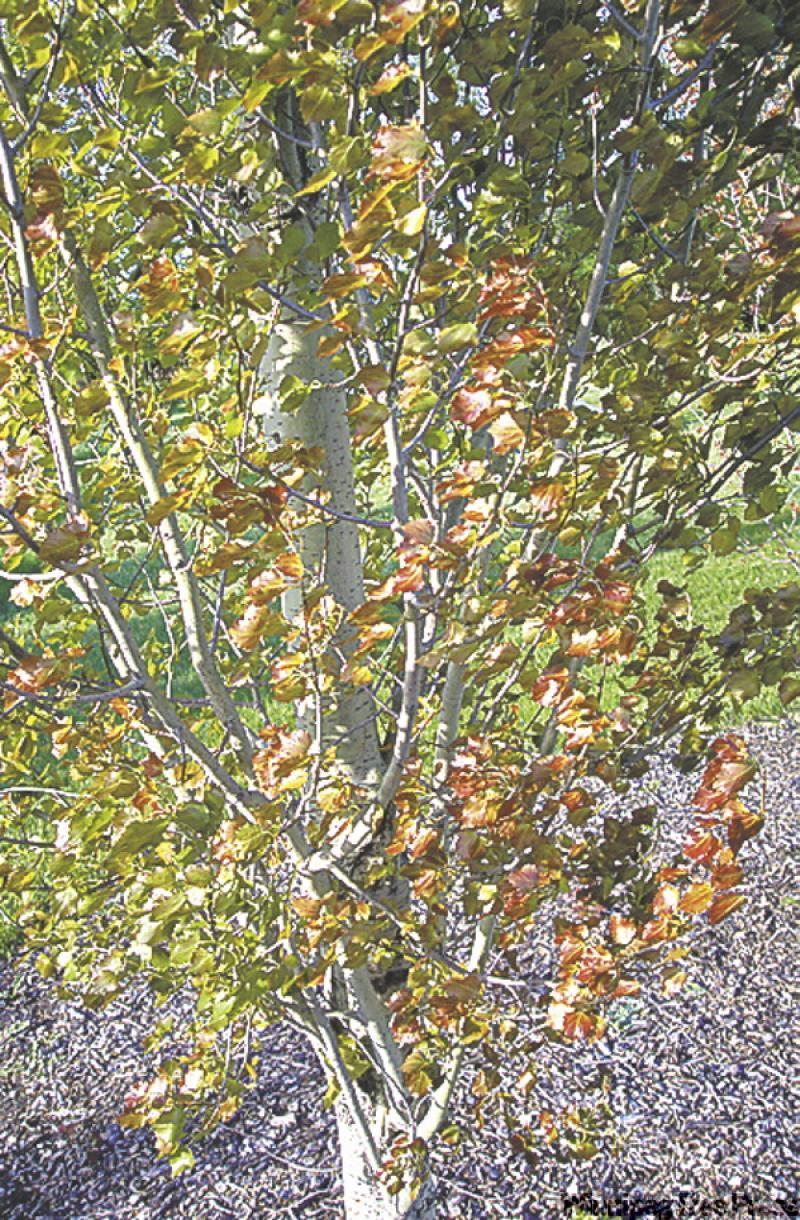
The infested tree may or may not show dead branches but the upper branches will have a thinner crown of leaves. The leaves will turn yellowish green before they turn brown and curl up. Eventually the upper branches die. Lower branches will soon follow in another year or so.
Heavy feeding by the worms will riddle the trunk wood with numerous holes and tunnels. This will make the tree structurally unsound and subject to breakage by strong winds. There is no known practical treatment to eliminate the grubs once they are well-established in the tree especially in the middle- to upper-trunk areas. These trees quickly become a hazard and should be removed preferably by a licensed arborist as the potential for unexpected breakage during the removal is high.
BRONZE LEAF DISEASE OF POPLAR (Apioplagiostoma populi)
Tower poplar and Swedish aspen are known to be highly susceptible to this fungus disease. The disease progressively kills the leaves, twigs and branches on infected trees. The leaves become prominently discoloured going through colour phases of yellow to orange to red brown to bronze. Often very distinct colour edges of the disease can be seen adjacent to bright green areas of the leaves. One part of the tree is infected for awhile, but after two or three years the entire tree is affected killing twigs and branches. Peeling back the bark on these twigs will reveal patterns of brown staining. Stressed trees can be attached by carpenter worms and by a lethal pathogenic fungal diseases called hypoxylon and cryptosphaeria.
HYPOXYLON FUNGAL CANKER DISEASE (Hypoxylon mammatum) and CRYPTOSPHAERIA FUNGAL CANKER DISEASE (Cryptosphaeria lignyota) OF POPLAR
There are no common names for these diseases. Hypoxylon and cryptosphaeria are the most virulent and most common fungal canker diseases on Swedish aspens and Tower poplars in southern Manitoba. In fact, all varieties and species of poplars are attacked by these diseases. The full disease cycle lasts up to four years. The disease fungal spores often enters the tree through broken twigs and branches, damaged surface roots or the damaged surfaces of trunk bark. Large areas of the tree's leafy crown quickly die.
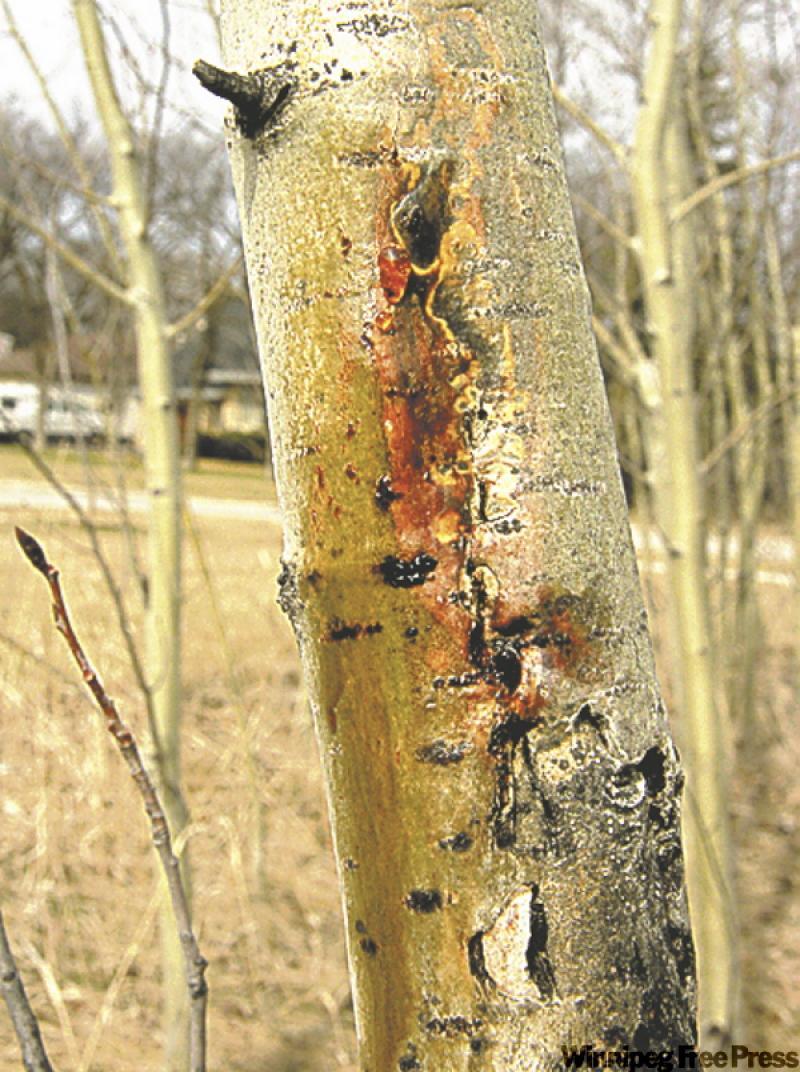
Both canker diseases start out as yellow-orange colours on the bark soon turning into brown-grey colours. As the hypoxylon canker disease ages, the mottling pattern turns blistered with short, irregular grey or black galls. With the cryptosphaeria canker disease the bark appears soaked. There are usually small vertical cracks or openings in the bark that weep a dark viscous fluid. The sapwood under the bark can turn black or dark red brown in colour. Infectious fluids are quite viscous and flow slowly from the cracks. As the fluids dry they leave dark rust-coloured stains. Advanced disease symptoms will show up as dead branches and very soon after the entire tree will be dead. Numerous wood pecker holes are common at this stage.
SUMMARY
There are no treatments for these diseases and for the carpenter worms once they are established in the tree. The problems are usually too advanced by the time most people notice something has gone wrong. These issues were once problems associated with older trees. I now see them occurring in trees less than 10 years of age, especially the diseases.
Annual June copper fungicide spraying (two or three times, 10 to 14 days apart) will help kill early disease spores on the tree. However, poplars are easily damaged by wind and by birds leaving exposed wood to be infected by airborne fungal disease spores. Infection in these columnar poplars is inevitable. I know homeowners who cut down the decayed and damaged trees and replant new ones. They do make good privacy screens.
Michael Allen M.Sc.F., RPF is a consulting urban forester and certified I.S.A. arborist. He owns Viburnum Tree Experts, a Manitoba company that provides objective assessments of the condition and the care required for trees and shrubs on home and business landscapes. He can be reached at 204-831-6503 or viburnumtrees@shaw.ca His web site is www.treeexperts.mb.ca