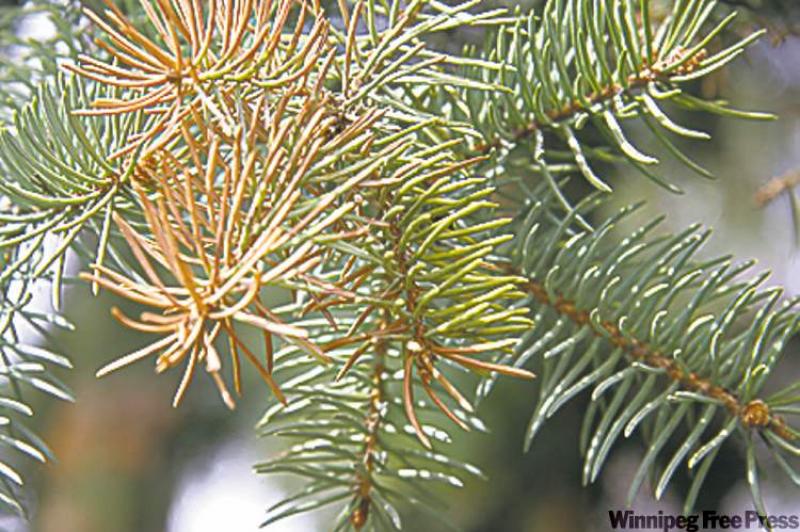
QUESTION: I noticed that the needles on my spruce tree are turning a yellow-green. It started last summer. Can you tell me what I can do about this?
ANSWER: This has been a common complaint with spruce trees (especially the Manitoba white spruce), but it is also common in the Colorado spruces. After a wet summer with a period of high humidity, the needles, especially near the tips of the twigs, turned yellow or yellow green. In most cases I discovered that this is a result of spruce tip blight, a fungal disease infection.
The scientific name for the disease is Sirococcus conigenus. Usually this is a minor disease in spruce; however, in 2010 and again starting out this year I have seen nearly whole trees with yellowing needles. Soon the yellowish needles will turn brown as they die. This spring is shaping up to be a damp one in southern Manitoba, and I am already seeing an increase in this problem developing.
For most trees, only the needles near the twig tips are infected. The infections are usually scattered around the lower to middle areas of the tree boughs. The twigs with the yellowish green needles are usually curved or slightly bent. This is a sure sign of the disease. Needles that turn brown will fall off. With early infections, needles can be green on one side of the curved trigs and completely absent on the other side. The contrast between healthy needles and dying needles should be very obvious right now.
Spraying the entire tree at least twice 10 to 14 days apart in June with copper fungicide is a recommended control for this disease. If rain occurs within 24 hours of spraying, the treatment will have to be re-done as rain will wash off the fungicide from the needles and twigs. The blight can re-appear on other twigs later in July or August, so a third or fourth spraying may be necessary.
The spruce tree can regrow new needles from new buds that appear in the summer, but the infected boughs will have a sparse appearance until the disease is under control. Heavily infected untreated trees will eventually die. If you do not see new buds in July and August, then the twig is dead.
Stressed spruces should always be fertilized for three or more continuous years either in the spring or fall. Readers should refer to my Oct. 9, 2010 Tree Care article on the proper fertilization of trees for more information.
Michael Allen is a consulting urban forester and certified I.S.A. arborist and owner of Viburnum Tree Experts. He can be contacted by calling 831-6503 or by email at viburnumtrees@shaw.ca