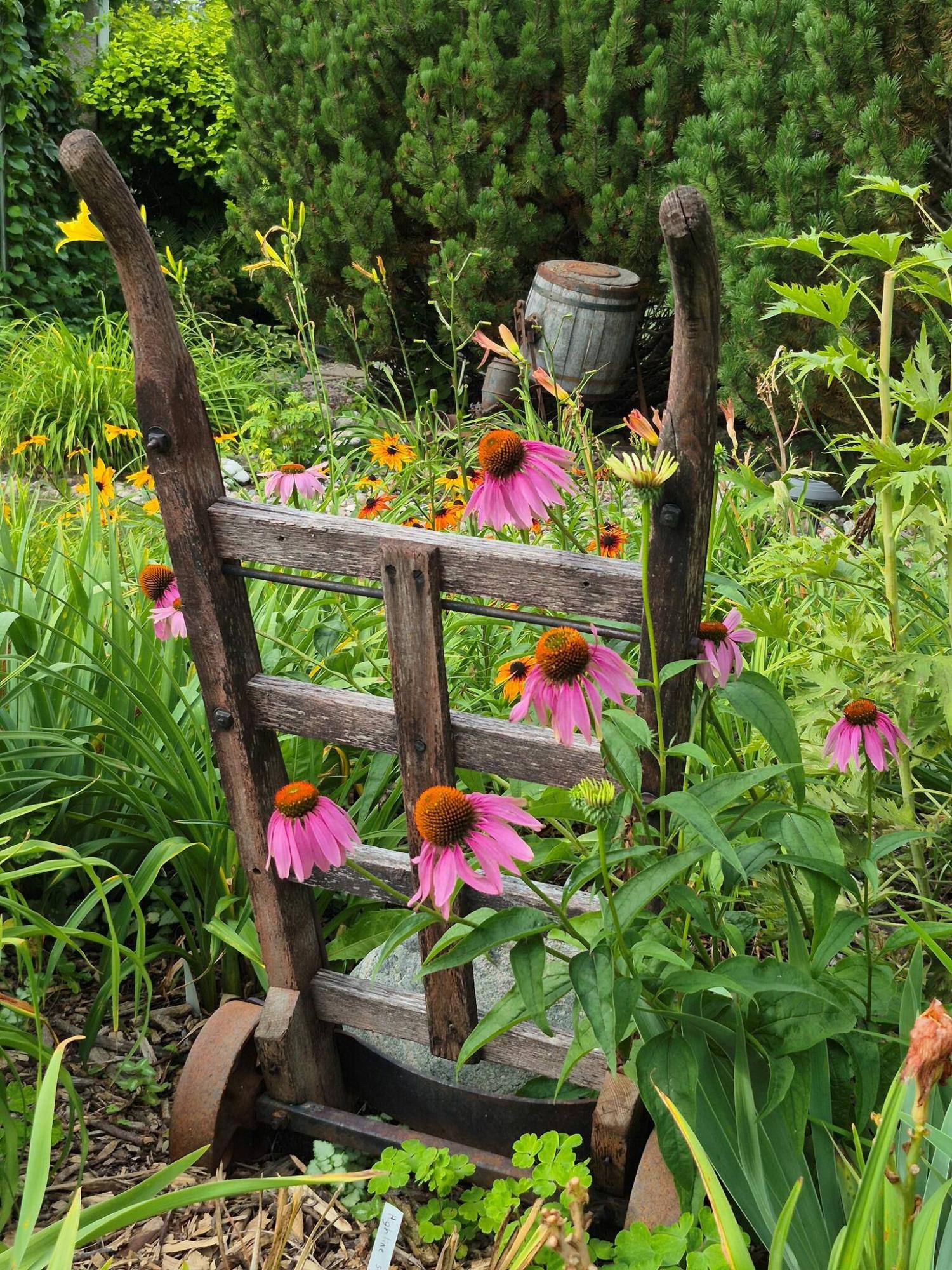
Intentional focal points like this weathered hand truck are not immediately revealed, leading to surprise and discovery.
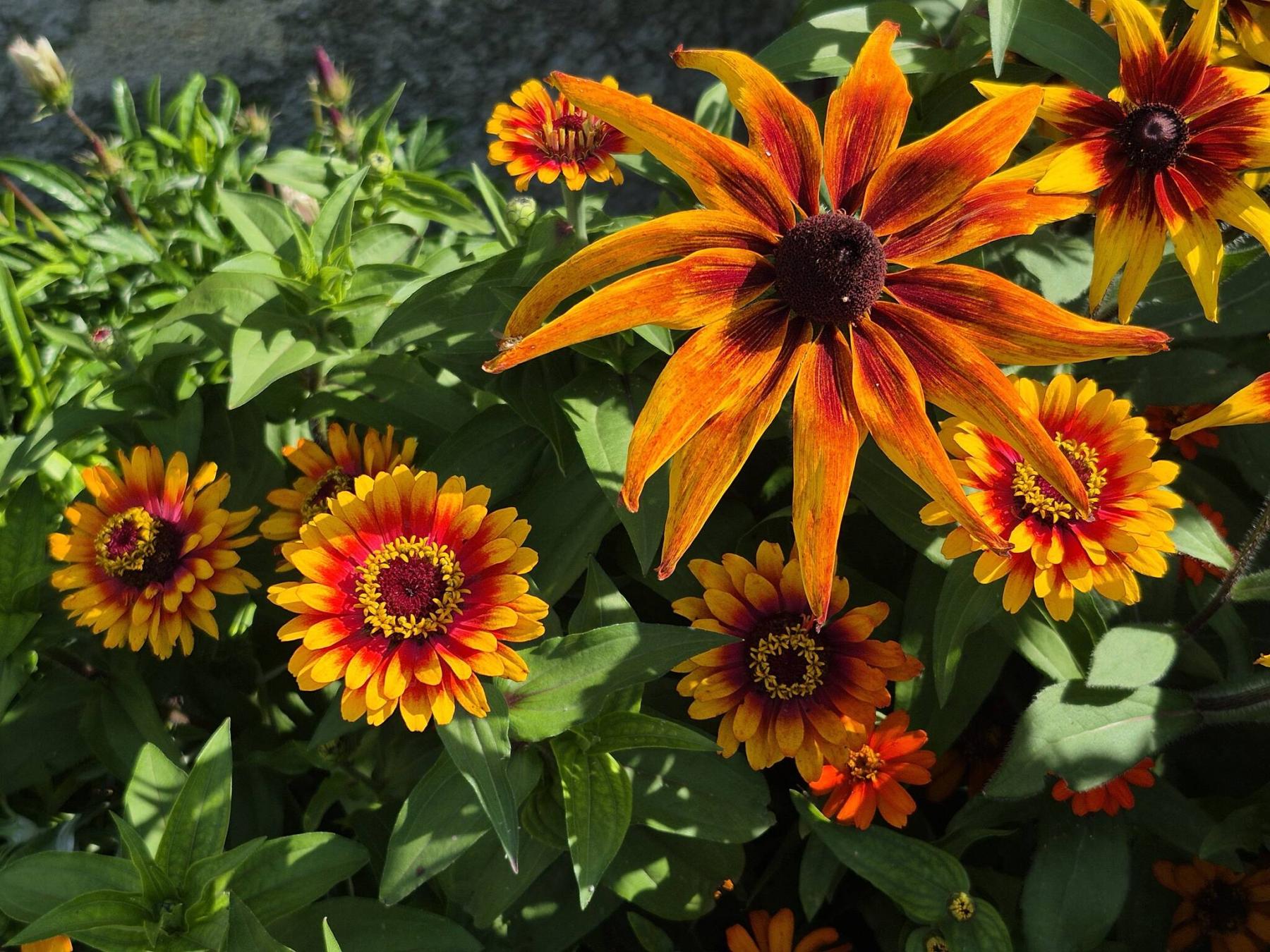
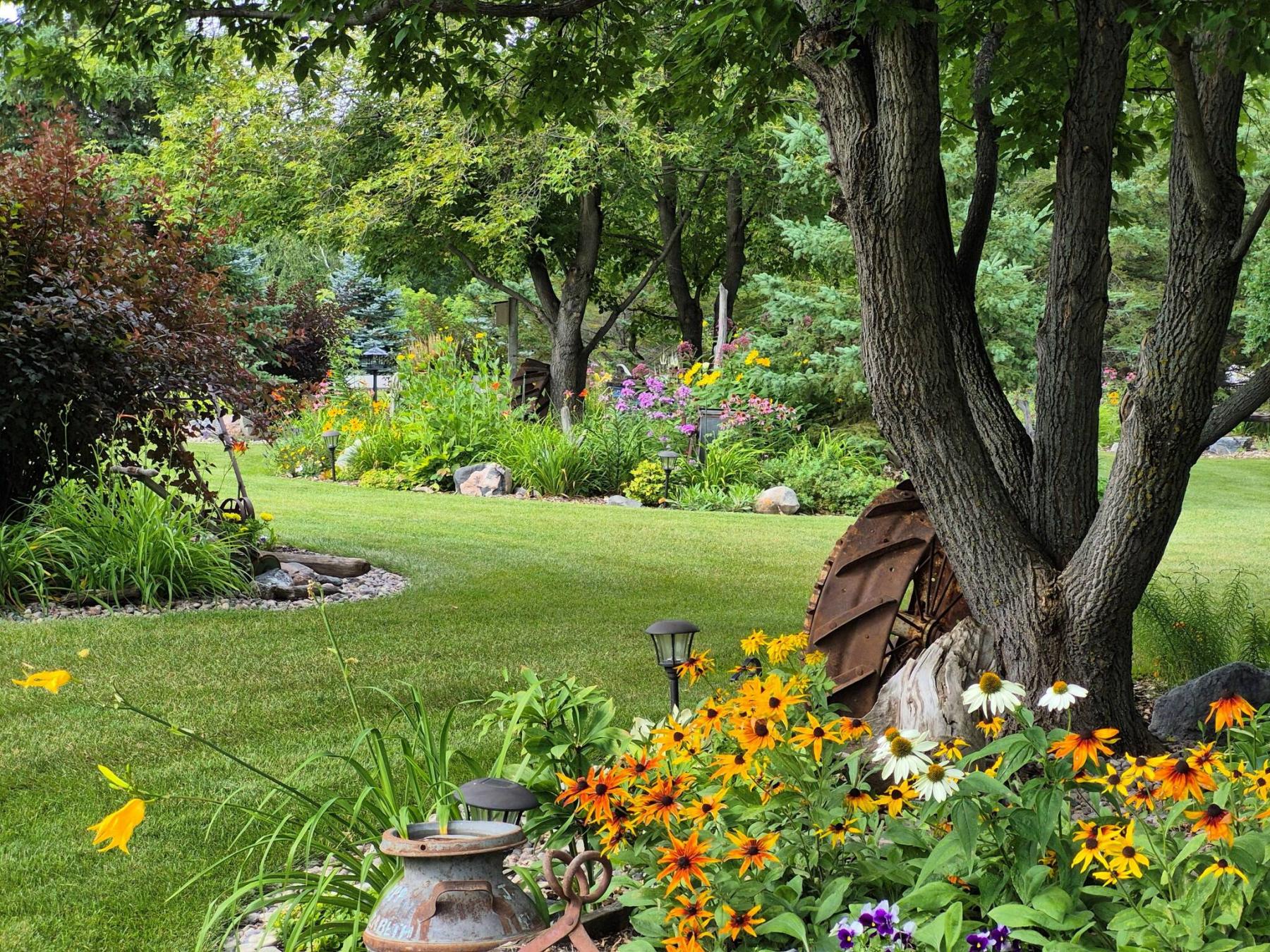
Bountiful zinnias and sweeps of self-seeding Rudbecia create glowing colour in the September sun.
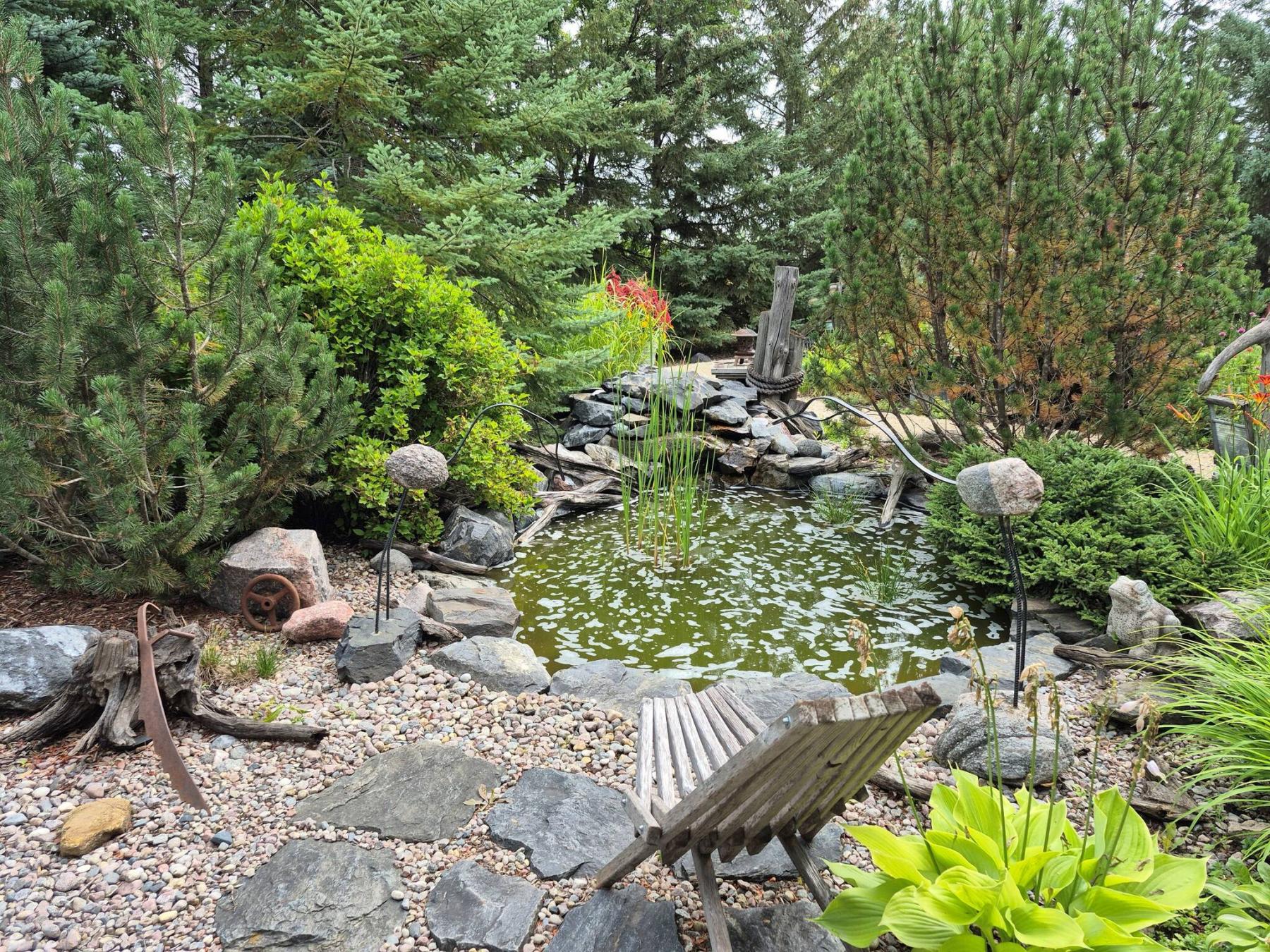
Nestled against a backdrop of evergreens sits a scenic pond with sculptural handcrafted cranes and stone pathways.
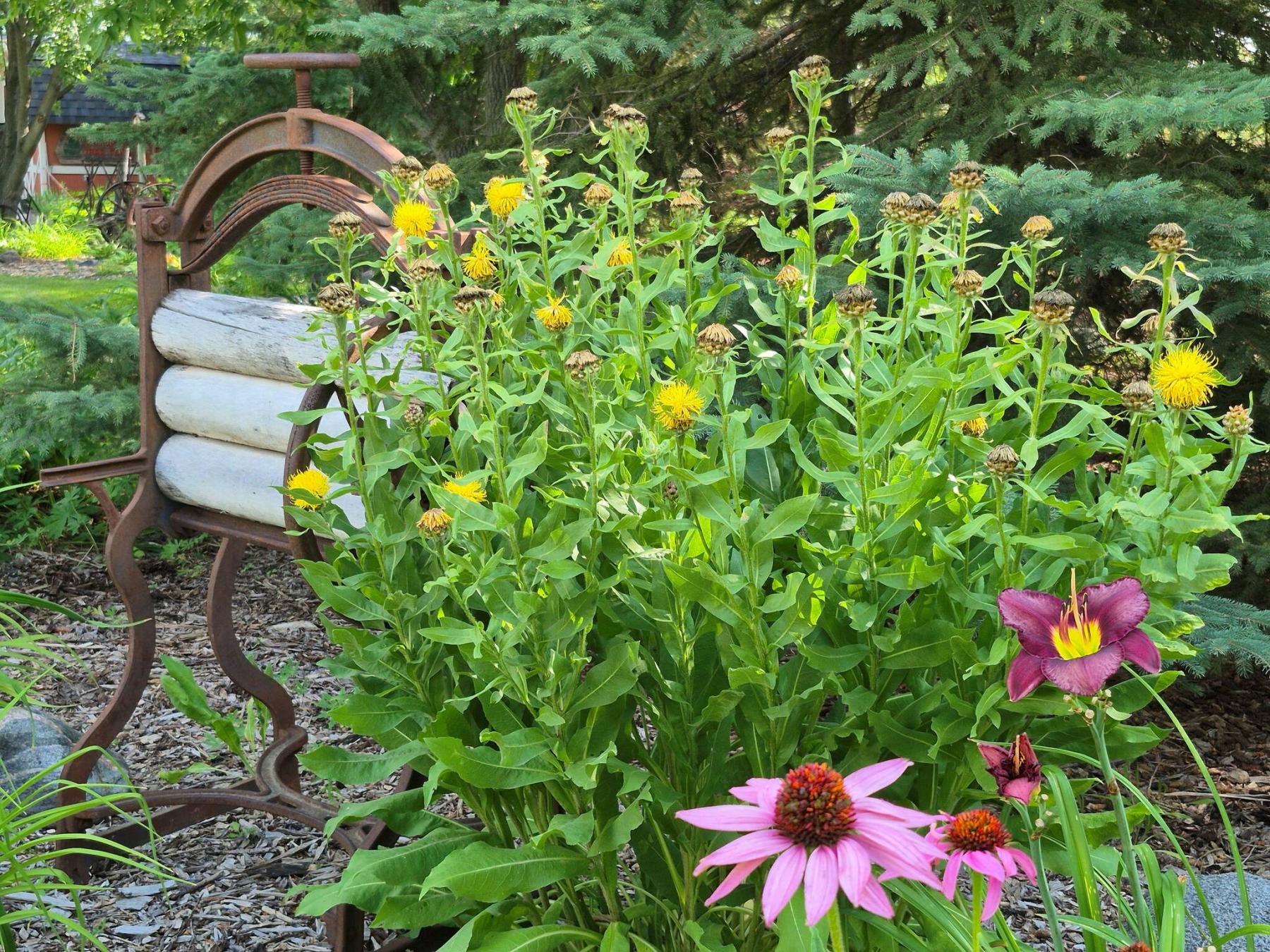
A vintage mangle (wringer) mingles nicely with yellow-flowered Inula helenium, an architectural perennial herb.
Every garden, large or small, has its own personal narrative to tell. Its design is a canvas for the owners to express themselves through visual elements like colour, shapes and composition.
Karl and Mary Loepp have a broad, living canvas with breathtaking garden vistas around every curve. Situated near the end of a winding road framed by majestic trees in historic St. Andrews, their stunning half-hectare property is a story of surprise and discovery.
Formerly a farmer’s field bereft of a single tree when the Loepps purchased the property and built their home in 2002, it was an apple orchard decades ago. When Karl first began working the soil and building the garden, he found coins dating back to 1908.
Both Karl and Mary spent their childhoods on family farms. They have a deep connection to nature and a passion for preserving history. Avid collectors of vintage farm equipment and hand tools, they are regulars at auctions, always searching for that one special piece to integrate into their garden where it becomes an intentional focal point.
Over the years, the Loepps have planted countless trees on their property. Large, spacious garden beds are anchored with a single, specimen tree. One of my first observations on my recent visit was the visual impact of mature trees allowed to grow to their full potential — developing wide crowns with large branches free to spread out in all directions. It’s an entirely different look from an urban tree confined to a cramped space, competing for adequate sunlight, water and nutrients.
Every bed features curved lines and different light conditions varying from dappled shade beneath the tree canopy to glistening sunlight along the outer border. And every bed features a colourful, diverse selection of plants aptly paired with fascinating vertical elements.
If you have ever tried to breeze through multiple garden rooms with little more than a passing glance, it’s not possible here. It’s not a matter of pausing to focus on an area of interest but a desire to linger, experience and explore.
Perhaps I was the city mouse who had never seen a vintage wire dairy crate before or a wooden hand cart, but it’s the way in which the Loepps display rusted metal pieces or repurpose weathered wood and antique farm implements to complement the natural textures of their surroundings. In one example, an old mangle with three rollers and a rusted steel frame is paired with Inula helenium, an architectural perennial herb with wavy, coarse leaves and yellow, dandelion-like flower heads. Nearby are yellow-throated purple-flowered daylilies along with purple coneflower.
“We try to incorporate the pieces we collect,” says Karl Loepp, “but we also don’t want them to take away from the garden either, where it just becomes a graveyard. We want every piece to accent the garden. We’re not continually adding. As we acquire new pieces, we’re also removing something else. Or sometimes we see something with fresh eyes and find a better utility or space for it and realize we should have thought of that years ago. It’s nice how it just evolves again.”
None of the vintage pieces have been painted or altered. Some come from their family farms or past generations of farmers. “It’s a bit of our history,” says Karl.
Some items are acquired at auctions without immediate plans for its use.
“But its potential use somehow reveals itself later,” he says.
How different is that from buying plants at a garden centre and figuring out later where to plant them?
There are elements of surprise, too. Some of the vintage items, hidden by a tall stand of flowers, are suddenly revealed as blooms fade and stems bend downwards as summer shifts to fall. Near the edge of their vegetable garden sits an old metal mechanics cart with an insert and a drain on either side. Purchased for just $20, it doubles as a planter for peppers.
It’s more than just whimsy — it’s endless inspiration and creativity. Take the vintage scale, for example, that sits in a bed of natural wood chips. “We do have rain gauges,” says Karl, “but I also measure rain by how heavy it is.”
There are interesting rocks and boulders, too, artistically blended into the vignettes that Karl and Mary create.
“I’ve been a rockhound since I was a little kid,” says Mary. “I still fill my pockets. Wherever we travel, we always come back with rocks in our luggage.”
Great sweeps of Echinacea coneflowers and Rudbeckia black-eyed Susans throughout the landscape provide glowing colour in the autumn sunlight. These are allowed to freely self-seed, increasing their colourful displays each year. Innovative containers — wooden boxes crafted from reclaimed wood, old laundry tubs, even the occasional bathtub or wringer washer — are filled to the top with the blooms of gomphrena, zinnias, cactus dahlias, marigolds, gazania or luxuriant lisianthus, elevating the display and adding interest to every garden bed.
In a rectangular raised bed built from reclaimed wood, Mary has combined royal purple lisianthus with zinnias and marigolds in vibrant pinks and oranges set against the backdrop of a massive mugo pine with its emerald green foliage. She and Karl visit garden centres throughout southern Manitoba every spring. But I was especially interested to know where they bought their fabulous gomphrena.
“Petal Place Greenhouses, 235 River Road, not far from where we live,” said Mary.
They also grow abundant stands of milkweed. On my visit we counted more than 20 monarch butterfly caterpillars on one plant. Daylilies are a favourite — Karl and Mary grow more than 160 varieties. More recently they have fallen in love with martagon lilies and plan to grow a large selection in an area that was once their original garden space, now partly shaded by tall trees.
“We’re getting to know more and more of the people at the Manitoba Regional Lily Society,” says Mary. “They are very generous in their suggestions and knowledge.”
Here and there are rustic chairs and benches made from thick branches by Mary and her father. Other accents include driftwood gathered from areas where Karl and Mary go fishing each year. Bird feeders made of weathered cedar, each with its own handcrafted design, sit atop salvaged wooden posts and punctuate the landscape. All were built by Mary’s father.
At the end of a curved path is a scenic area sheltered by mature evergreens with stone pathways and a pond accented by handcrafted stone-and-metal crane sculptures.
“The area was a natural low spot in our yard. As snow melted, water would accumulate, so we dug out the area by hand and created the pond,” says Karl. “A nearby shed with electricity made it easy for us to provide power for the pumps.”
Their fully developed property has astonishing depth and richness.
“Sometimes we struggle, is it too much, should we add, subtract?” says Karl. “But I think we’re at a nice balance.”
Indeed, it’s perfectly beautiful.
colleenizacharias@gmail.com