Lee Powell / Washington Post
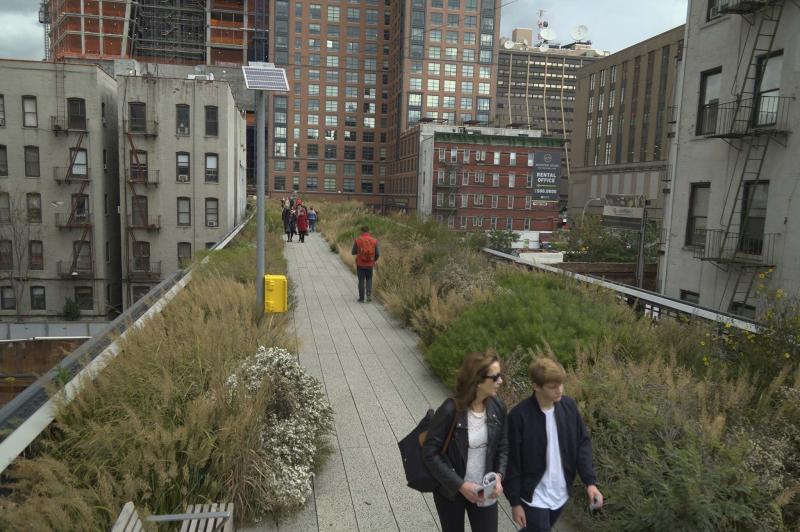
While most gardens become shadier as trees around them grow, the High Line loses light to the high-rise towers springing up around it.
In what may be one of the most successful adaptive-reuse projects in history, New York’s High Line is a compelling shrine to the post-industrial life of a great city.
Some might say too successful: the former elevated rail line on Manhattan’s West Side draws close to five million visitors a year and is a catalyst in Chelsea’s long — and to those who remember the district’s bohemian flavour, not entirely welcome — gentrification.
At its core, however, the High Line today is a linear park through its own narrow garden.
The first of three sections opened in 2009, the last almost three years ago. Its southern point begins next to the new Whitney Museum of American Art and it snakes its way north until it forms a loop that wraps around a rail yard close to the river. Above this cluster of parked rail cars, a 28-acre development named Hudson Yards is in the process of becoming a mini-city of skyscrapers.
Most gardens become shady by the growth of their trees. The High Line is losing some of its light to sprouting high-rises.
If you have been there, you’ll know that the experience is strangely bisected. The promenade is a perch to observe the surrounding cityscape and yet is an immersive urban experience. It is usually crowded by out-of-towners and a great place for people-watching. What is felt more subliminally is the High Line’s verdancy. It’s worth stopping to smell the prairie dropseed (an oddly fragrant native grass). Anyone remotely interested in plants will find beauty and inspiration at their feet.
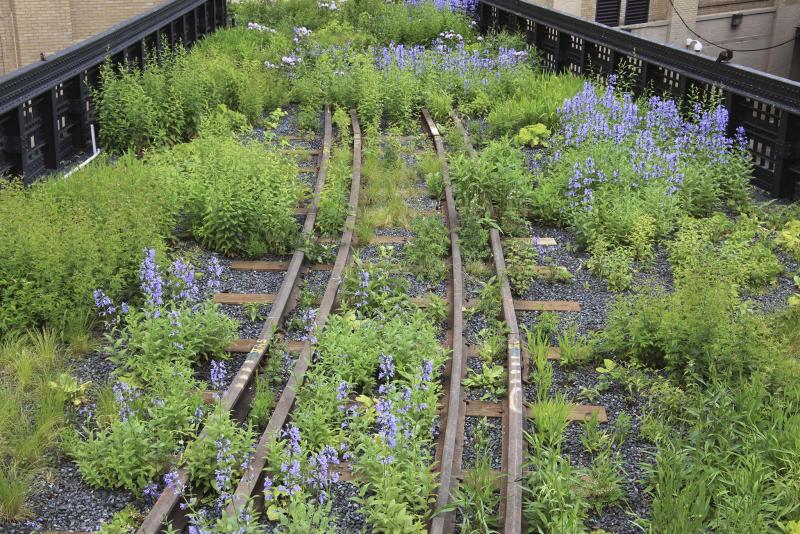
There are three featured stands of trees along the High Line’s 2.5-kilometre length, but most of the planting beds are defined by human-scale plantings of grasses, perennials, bulbs and ground covers. There are a couple of reasons for this plant palette. First, the High Line is essentially a rooftop garden, and the soil extends on average down to only 40 centimetres. That isn’t much of a universe for tree roots. Second, the plant designs draw inspiration from the wildflowers and weeds that overtook the High Line after its abandonment. The last train ran in 1980; afterward, 161 species were blown in by the wind or deposited by birds and found purchase in the stone ballast beneath the rails.
But these wildlings are merely an inspiration; most of the plants today, while supremely natural in feel, are anything but accidental. They are the work of the plantsman and designer Piet Oudolf, a leader in the contemporary, perennial-rich style of gardening known as Dutch Wave. Oudolf has teamed up with the American landscape designer, author and photographer Rick Darke for a detailed look at the horticulture of the High Line in their book, Gardens of the High Line.
If you can’t get to the High Line, the image-rich publication is the next best thing. In some ways, it’s better, because its pictures bring home the seasonality of the plants, which ebb and flow from month to month. Autumn and winter have their own sublime moments, even if the wind is whipping off the Hudson. Draped in snow, the High Line looks positively romantic, quite a feat for a structure built for noisy freight trains.
Oudolf has expanded the palette to 400 plant species, massed and mingled in a way that provides abstractions of colours, textures and forms. The plant design may look haphazard, but it reflects a contemporary plant choreography that breaks down the edges of the old herbaceous border for a more naturalistic effect. What you lose in delineation you gain in layers of interest and a plant’s continual transformation in the company of its neighbours.
Just in terms of plant ideas and combinations, the High Line is supremely inspirational. The last time I was there, I was struck by how pretty and garden-worthy the native grass called side-oats grama (Bouteloua curtipendula) is and the way masses of another grass — Korean feather reed grass (Calamagrostis brachytricha) — caught the declining sunlight in its flower heads. The latter, it should be noted, is a prolific seeder.
Thumbing through the book, there are others I want. Lead plant (Amorpha canescens) is a leguminous shrub with fine, grey-green leaves topped with clusters of purple blooms. The prairie smoke (Geum triflorum) is a perennial whose blossoms turn into tufts of red filaments that last for weeks. All the spiky, long-blooming penstemons are champs in my book; the foxglove beardtongue (Penstemon digitalis) is a white species that blooms from late spring into summer.
Some are clump-forming, such as the dropseed, others spread by runners and yet others seed aggressively.
Darke and Oudolf note that gardening on the High Line "requires a non-standard amalgam of horticulture, ecology, soil science, entomology, ornithology and artistry." This to me sounds like the right recipe for any gardener.
Eight years after the first section opened, the gardeners have learned to monitor and adjust the spread and decline of plants, but not to keep the original plan static.
"Caring for these ever-changing gardens involves artful stewardship, not maintenance," the authors write. "There is no status quo on the High Line."
The gardeners also avoid rigorous grooming so that dead top growth, seed heads and stalks provide visual interest to humans, shelter and food to birds and insects, and a measure of winter protection to the plants themselves. The whole assemblage of about 100,000 plants is cut back in March by an army of volunteers and staff, at the threshold of bulb season. The High Line is owned by the city, but is run and maintained by the Friends of the High Line in partnership with the Department of Parks and Recreation.
All the plants were selected to grow in a hostile environment. The elevation and lack of soil depth puts stresses on the plants year-round. Thus, the chosen ones are tough and a good bet for gardeners in a wide swath of the continent. You’d need to check the hardiness and heat tolerance of each species if you want to try it in your garden.
Take a camera phone and notepad if you visit, or pore through the book if you cannot make it to New York, so that you can introduce some of these plants into your world. As the song about New York goes, "If I can make it there, I’ll make it anywhere."
— Washington Post