Michael Allen / Winnipeg Free Press
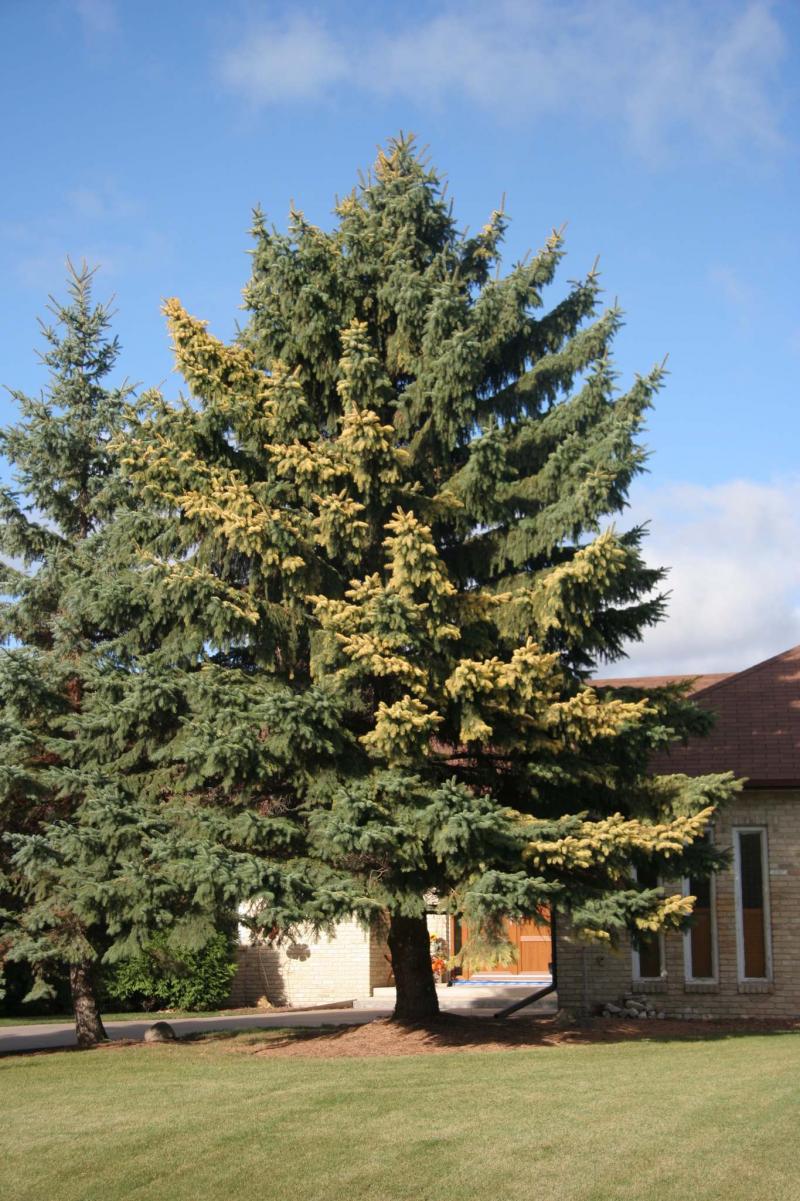
A Colorado spruce tree may be vulnerable to disease if it’s not maintained.
I have written a few times about the problems plaguing Colorado blue spruce and the native Manitoba white spruce that have been planted over the years on urban and rural properties in southern Manitoba.
Each year I continue to get numerous inquiries about problems with spruce trees. No other tree generates more concern from readers and clients than this species of tree.
Typically the problems arise because evergreen coniferous trees are only suitable for growing on well drained coarse loam, or sandy loam, or even fine stony soils. These soils are simply not found in many urban areas of the province where silty clay and clay loam soils occur over gumbo clays.
The maturing spruces usually develop two very common diseases that naturally occur in the northern boreal forests: Sirococcus tip blight in the twigs, needles and Cytospora canker in the branches and trunks of the trees. Both diseases cause browning and death of the needles.
In the 1920s, tree scientists predicted the Colorado blue spruce would have numerous growth and survival issues in the future as a result of continued breeding of the trees for the most vibrant and colourful blue needles. Scientists refer to this problem as "inbreeding depression".
Sirococcus tip blight, which is a fungal disease, can be treated at an early stage with an approved commercially available fungicide.
The late May to early July period is usually the best time to treat the trees in this manner.
Early infection of the tips of the needles usually turns them yellow or pale yellow brown.
This disease can definitely be controlled, especially in its early stages, but not eradicated — especially in older trees. Enriching the soil at the rooting environment zone of a conifer with appropriate nutrients can help.
Sapsucker and other woodpeckers can spread this disease, as well as other diseases from spruce to spruce with their beaks when they are pecking horizontal rows to gain access to the tree sap.
In small trees, it is relatively easy (and legal) to discourage the sapsuckers, but as the tree grows taller, it is simply impossible to control the feeding activity of these birds.
Attaching reflective strips of flexible aluminum or silver-coloured paper will discourage the birds when breezes blowing through the tree cause those strips to suddenly reflect the sparkle of sunlight. The birds get ‘spooked’.
Colorado spruce trees are infested with more mites and insects than any other urban tree in southern Manitoba.
Disease stresses spruce tree growth, which sends signals to destructive feeding pests to inhabit the tree, including spider mites, bud scales, needle scales, saw fly larvae and pitch mass borers.
A great deal of effort can be applied to spruce trees growing outside their natural environment to make them look presentable, but it will take much resolve and annual commitment.
If you have one of these spruce trees you will know what I am talking about; if you do not, I strongly urge you not to acquire a Colorado blue spruce tree.
There are many fine landscape trees out there, but unfortunately Colorado blue spruce is not one of them.
Michael Allen M.Sc.F., RPF (ret’d) is a consulting urban forester, tree diagnostician and certified arborist. He owns Viburnum Tree Experts. He can be reached at 204-831-6503 or 204-223-7709, or visit his website at www.treeexperts.mb.ca
viburnumtrees@shaw.ca