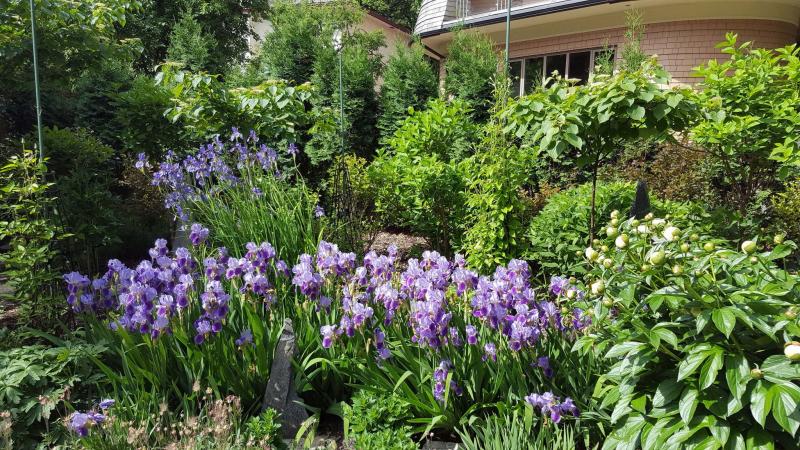
A sweep of Siberian Iris sparkle in the sunlight against a backdrop of lush, elevated planting layers including two umbrella-shaped Pagoda Dogwoods.
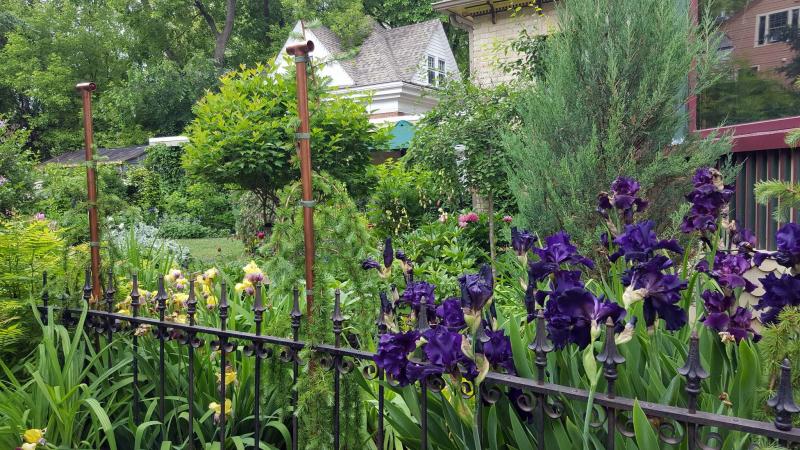
A glimpse into the backyard of Melva Widdicombe’s Armstrong Point garden reveals colourful blooms, foliage and a myriad of shapes and forms.
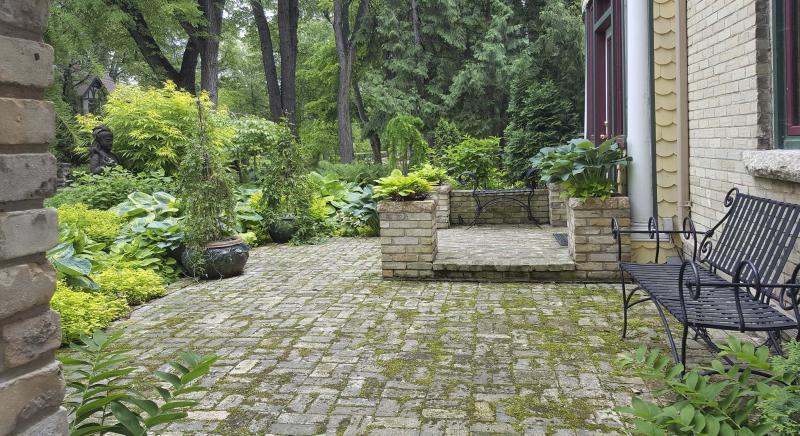
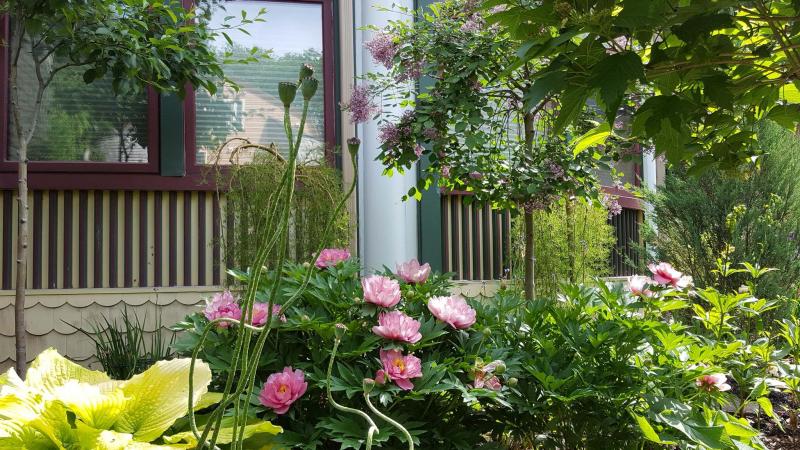
A narrow side garden (left) planted with peonies, poppies, lilacs and a weeping caragana tree. Golden Elder (right) frames this elegant courtyard.
In leafy neighbourhoods, the effects of the varying degrees of shade and light are nuanced by the surrounding tree canopy.
Too dense of a thicket and the resulting diminished light places limits on the diversity of plants that can be grown in the understory.
It takes skill and perspective and even, sometimes, a window of opportunity, to bring colour and light into a deeply shaded garden.
In developing her Armstrong Point shade garden, Melva Widdicombe observes where the shadows are and which areas are lit up by streams of sunlight at different times of the day. She takes pleasure in how the light moves through petals and foliage, creating transparencies.
By lifting the skirt of some plants and deftly training others, she adds layers of light, creating depth and shape in her garden. Through her imaginative selection of plants, the garden is a tapestry of texture.
Widdicombe, who has a passion for fabric and medieval costume and who once led a medieval dance troupe, says that her garden is an extension of an artful way of life.
Unexpected surprises, strangeness of proportions, randomness and chaos amid imposed tameness — these are the things, says Widdicombe, that give a garden momentum.
The architectural framework of her garden is exceptional. Beneath the understory of mature elms, Widdicombe has incorporated numerous woody plants, adeptly training some into striking tree forms.
In one example, a Pagoda Dogwood (Cornus alternifolia), its creamy white flowers borne in flat-topped clusters on horizontally tiered branches, grows in a shady bed as a full-size specimen.
Nearby, in a full sun bed where Widdicombe is creating a living wall with structured and layered plantings to define her property’s boundaries, stand two dainty umbrella-like Pagoda Dogwood tree forms. These are strategically placed behind a dramatic sweep of bearded iris and in front of hedges of dark-leaved ninebarks and tall, emerald green cedars.
Originally shrubs, Widdicombe meticulously trained and shaped the dogwoods into small trees, taking the time to establish an attractive framework of evenly spaced branches. What’s great about training a shrub into a tree form, says Widdicombe, is that it allows for much more planting space. "Often you are creating something more interesting," she adds.
On two sections of antique wrought iron fence, one at the edge of her backyard patio and another along the side of her property, Widdicombe is training weeping larches to grow either horizontally along the top or vertically on copper pipes. The graceful form of Weeping Larch with its soft, airy fronds is a clear favourite as numerous examples can be found throughout the landscape.
Of the many flowers that grow in her garden, Widdicombe says irises are her favourite. She grows bearded, Siberian, and Japanese varieties.
"What I particularly love about Siberian iris," she says, "is the interest they create in the garden with their tall, robust foliage."
In early June, clumps of Butter and Sugar Siberian iris provide an arresting display in a long, narrow garden tucked away on the side of the house. Planted with a trio of Weeping Caragana and lilac standards, poppies, hostas, Keiko Adored Itoh peonies with pink petals and yellow stamens, and a dense carpet of trailing sedum that travels the length of the slightly raised bed, this secret garden elicits pleasure and a sense of discovery while serving as a visual link with numerous other elements in more prominent areas of the landscape.
There are also planting beds that are luxuriantly deep. In Widdicombe’s backyard, the shadiest portion of one bed has been planted with room enough for giant hosta cultivars such as Empress Wu, Abiqua Drinking Gourd, Grand Canyon, Sum of All, Blue Mammoth, and Cup of Grace, to name just a few. The intensely corrugated or puckered foliage of these mammoth hostas and their rich tones of blues, greens, and golds look splendid beside the plum-purple shades of Otello ligularia and against the textural backdrop of weeping larches, red cone Norway spruce, and the undulating, pendulous branches of Uncle Fogy Contorted Jack pine.
This same bed includes a sunny border which is home to numerous peonies including Sarah Bernhardt, Fernleaf, and Itoh Bartzella. Other large flowering shrubs include varieties of lilac, hydrangea, and ninebark together with more compact selections such as Crimson Kisses weigela, and Ruby Carousel barberry.
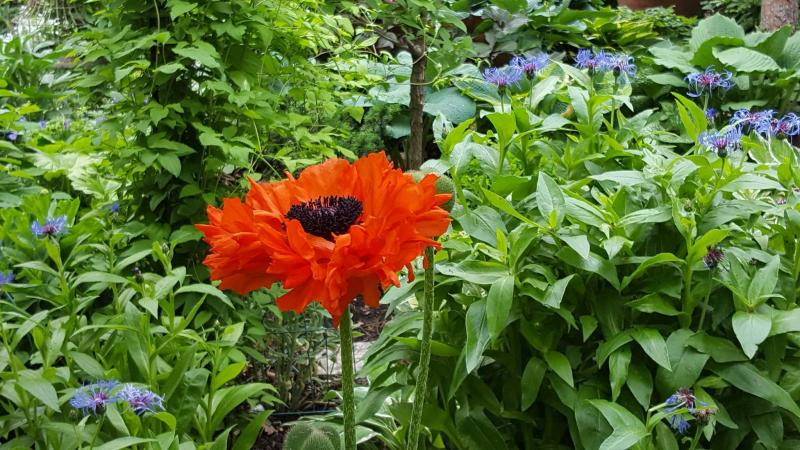
In keeping with Widdicombe’s love of the unexpected, one might suddenly come upon in late spring a fiery orange-red Turkenlouis Oriental poppy next to blue-flowered Centaurea cyanus (bachelor’s button). Throughout sunlit areas of the garden, accessed by stepping stones, large-flowered clematis varieties climb up tall pyramidal metal obelisks. Some are repeat bloomers, such as white-flowered Gillian Blades clematis which produces 12- to 17-centimetre sepals with ruffled edges.
Widdicombe uses the occasional white-blooming flower to good effect throughout her landscape. Variegation, too, adds glints of light. Vinca, with its distinctive creamy-white edges, or Golden Prince euonymus, a low-growing Zone 4 evergreen plant with foliage edged in golden yellow, can be found growing in her container garden. In spring she lifts these from the garden together with other plants such as Chocolate Ruffles coral bells and chartreuse Aralia cordata Sun King (Japanese spikenard), planting them in brick planter columns and terracotta pots. In fall she returns each of these hardy perennials to the garden to overwinter.
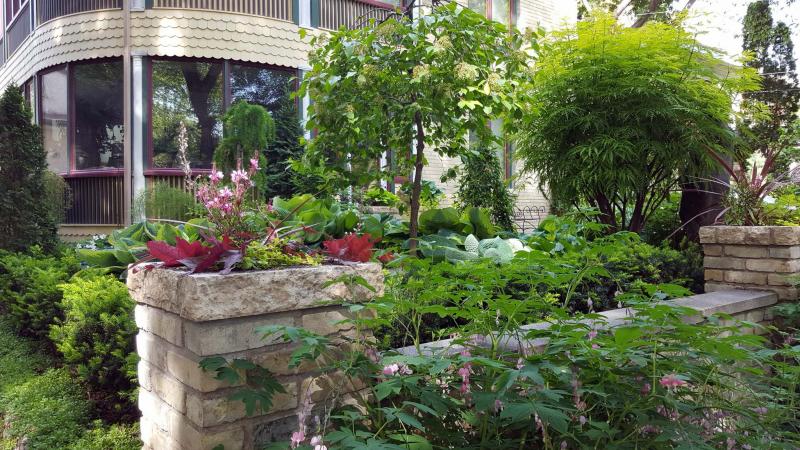
In someone else’s hands the colour palette in the front yard, shaded by majestic elms, might have been more muted and plant selection less imaginative. Here too, however, Widdicombe has made brilliant use of the dappled light, utilizing colour, lush layers of foliage, and textural, vertical forms. At the lower level, easily viewed from the street, a low brick wall with a series of brick planter columns is lined with an old-fashioned garden favourite, Dicentra spectabilis Bleeding Heart and giant hostas.
Behind the low brick wall, on a slightly higher elevation, is a courtyard framed by a tightly clipped yew hedge. The style of the courtyard is understated elegance: not brash or cluttered; frankly, not easily replicated. Varieties of hosta, peony, and hydrangea complement one another. Sunsation barberry provides plashes of chartreuse. A trained Golden Elder with beautifully dissected foliage brushes against the life size bronze sculpture of a woman. Nearby is a common nannyberry which Widdicombe has trained from a shrub into a surprising weeping form.
As someone who enjoys creating artwork, Widdicombe says that her garden translates into another way of working with texture, except that it’s continually alive and holds unexpected surprises. And that’s a wonderful thing.
colleenizacharias@gmail.com
Notices:
Mark your calendars and plan to take in this summer’s self-guided garden tours, rain or shine.
Saturday, July 8, Gallery in the Garden in Birtle will feature gardens together with art by more than 30 artists. 10 am to 4 pm. For more details visit theclassicgarden.ca
Also on July 8, Nature Manitoba hosts its annual garden tour, 10 am to 4 pm. For tickets and details, visit naturemanitoba.ca
The Manitoba Master Gardener Association will host its 5th annual garden tour, July 15, from 9 am to 4 pm. Visit mgmanitoba.com.
Transcona Garden Club hosts the Hidden Gems of Transcona garden tour on July 22, 10 am to 3 pm. Tickets are available at the Transcona Biz Office, 108 Bond St.