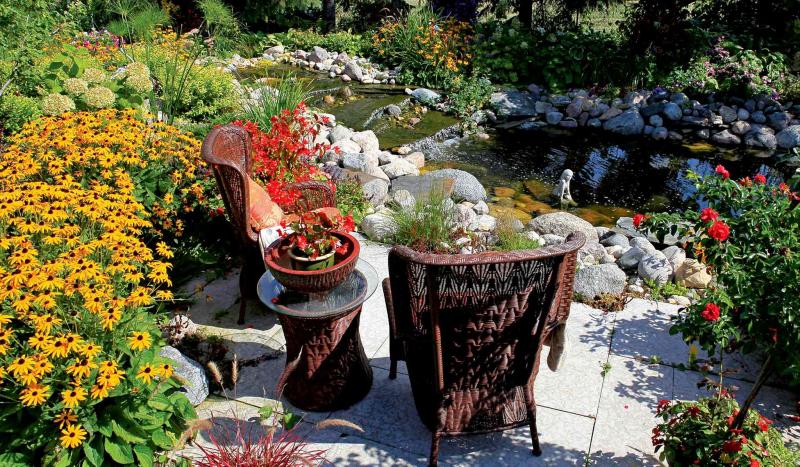
Will 2015 be the year that your landscape undergoes a makeover or facelift?
If you have ever declared, "Bah, humbug," at the thought of investing in a landscape renovation, you have probably also wished at times for an attractive, functional landscape. One where you can relax in a space that works for you and your lifestyle and affords a greater, more intimate degree of privacy.
Now, if only you knew where to start. All you need is the right inspiration and expert advice for a smart design that enhances your property, gives you a view worth looking at, and provides solutions to challenges.
Waiting until spring to talk to an expert can result in the delay of another year. Winter is the perfect time to begin laying the groundwork for how your landscape will begin its transformation.
Keith Lemkey is the owner of Lemkey Landscape Design, an award winning design-build firm that was recognized this year by National Landscape magazine as one of the top four landscape design firms in Canada.
Lemkey touts the advantages of design-build, which essentially means that the designer and contractor is one and the same person, and someone who will be involved right through to the completion of the project.
Lemkey recommends that homeowners who are planning to renovate their landscape begin by interviewing two or three landscape designers.
When you are shopping for a designer, says Lemkey, it is important that there is a connection that takes place. The homeowner should feel confident they are talking to someone who can see their vision for the landscape even when the homeowner can't fully express what it is they are hoping to accomplish.
The objective of the first meeting is not to hear the designer's ideas for your landscape. Rather, a good designer will gather the information he or she needs from you in order to plan a design that reflects your personal style and realizes the goals you have for your landscape.
Harmony between your interior and exterior elements is important. "I want to see the inside of the house," says Lemkey. "The living space gives me a sense of the homeowner's style. Is it contemporary or traditional?" Lemkey says that the colours and textures used in the interior environment provide valuable insight which the landscape designer can draw outside so that the two spaces complement one another.
Interior design can be time-stamped, based on trends that were popular at the time of installation. With a landscape design, says Lemkey, you are less likely to be able to tell when it was implemented because plant material grows and changes colour with the seasons. So long as the job is done well, the overall theme maintains its relevance for years to come.
The front yard should always be complementary to the house, not competitive with its architecture or that of neighbouring homes. People judge our front yard on its curb appeal. The front door entrance should serve as an important focal point and be visually attractive and enhancing, drawing the eye.
The backyard, says Lemkey, is where you can become truly expressive, indulging in your wish list. A desolate, deserted backyard with no amenities has little allure. Once you develop a vacant landscape and interact with others in the use of it, you will wish you had done it years ago.
Proper flow of the outdoor space is also an important consideration. Just as you move with ease from one room in your house to another, so should the rooms in your garden flow with ease. How often have you visited a landscape where the front yard is ho hum, the side yard has been allocated for storage, but the backyard is lovely? The visitor experience in this case is a bit like stepping through someone's laundry room to get to the living room.
Why not capitalize on all of the spaces in your landscape? A good designer will maximize the aesthetics and functionality of even your access or transition spaces.
What about tough areas that you have ignored because no solution seems to be available? Lemkey describes a client with a problematic low-lying space along the side of her house which consisted of a narrow strip where nothing would grow because it was always wet.
"I suggested we strip out the area and install a dry creek bed," says Lemkey. With the addition of a few berms and plants such as Siberian iris, dwarf willows, and ornamental Karl Foerster grass, the area has been revitalized and is now well-utilized.
Extreme slopes and accompanying drainage issues present other challenges that must be carefully considered. Terracing a steep slope can be an innovative solution but the designer must be cognizant of how it will tie into neighbouring sites.
In many instances, clients want a low-maintenance landscape. In one award-winning design, Lemkey designed a landscape for two busy professionals who travelled frequently and who were primarily interested in being able to entertain in their backyard but had little time for maintenance.
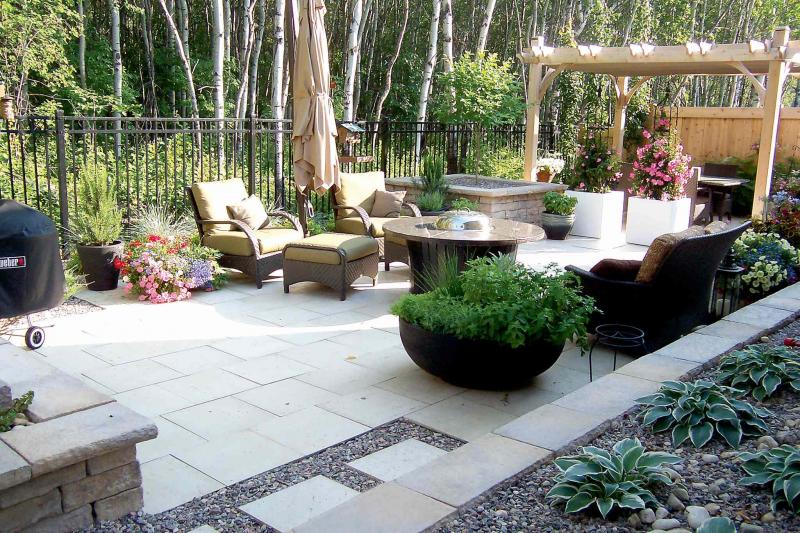
Lemkey turned the entire backyard into a patio that included containerized plants and raised beds. The existing deck has been clad in travertine stone tile to mimic the white interior tiles for a beautiful flow. Stone steps lead to a stone patio.
A water feature provides sound and motion and there is a fire table for sitting outdoors on cool evenings. A private dining area on the patio sits beneath an architectural pergola.
To make life easier for his clients, Lemkey installed an irrigation system so that water goes directly into the containers and raised beds.
Sometimes an existing landscape has simply grown old and needs a facelift. Or children have grown up and left home, opening the door to a new set of opportunities for a landscape. In one example, Lemkey revisited a landscape he designed 15 years earlier and installed an artificial putting green for a homeowner who was ready to enjoy his landscape in a new way.
What is a yard without hardscaping elements such as patios, pathways, decks, arbors? "Hardscaping is the dance floor," says Lemkey. It sets the stage and opens the door to any accessories such as irrigation, lighting, water features or other features you might wish to add.
Trusting your landscape designer to guide you through the process is important. You may be satisfied with an aspect of your landscape but being open to another perspective may help you to see your landscape in ways you never imagined.
If you have an existing flower or shrub bed in your garden that you want to keep, a good designer knows how to incorporate new elements, introducing you to plant material that will readily adapt to your landscape. By selecting plants that grow to an expected specified height you will spend less time fighting to control their growth.
Lemkey says that a good designer can assist you in establishing where your priorities lie. What do you want to do first -- the backyard followed by the front yard the following year? A piecemeal approach to a landscape design, sometimes dragged out over a period of years, can result in an overall design that lacks balance and unity. However, a good landscape design can be broken down into phases depending on your circumstances and budget and still result in a final outcome that adheres to the design principles laid out in the original plan and is aesthetically pleasing.
Typically hardscaping is installed first because it requires the most equipment work. Next, you progress into the softscaping (flower beds, trees, shrubs) and finally, installation of tangibles such as an irrigation system, sound system, landscape lighting, etc.
The last thing anyone wants is a cookie-cutter approach; for example, a couple of boulders, a stone wall, and a pair of spruce trees. It may be an improvement on what you have now but it will lack self-expression. For most of us, says Lemkey, our house represents life's largest investment. We all need our own private space to interact, to congregate with our families and friends, whether it is for a barbeque or just sitting outside and relaxing.
The thoughtful foresight and expertise that an experienced landscape designer brings to your project will result in an inspired design that, once completed, will be the gift that keeps on giving.
colleenizacharias@gmail.com
Colleen Zacharias is a Certified Prairie Horticulturalist and Master Gardener.