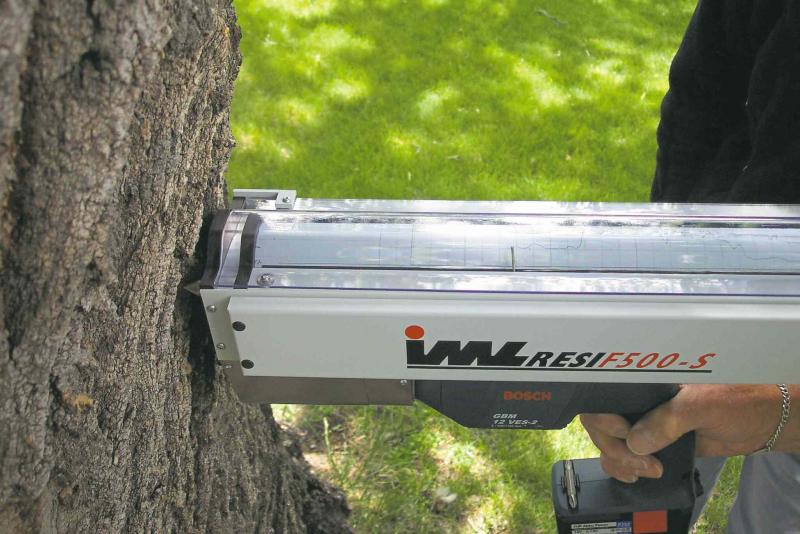
Sometimes I see trees that appear to have internal problems, usually due to significant wood decay. Now I can't see into trees, but I have a machine that can. It is called a Resistograph. It is basically a variable speed drilling device that uses a three-millimetre-diameter drill bit that is 45 centimetres long.
When the drill is engaged, a series of internal cogs and gears operate the drill bit to bore into the tree to see how dense or hollow the tree is inside. As it does, a stylus connected to the drill bit assembly moves along a linear waxed strip of stiff paper. This strip of paper is visible through a clear plastic window.
As the drill encounters wood of different densities, the stylus continuously records the density of the wood as it moves into the tree.
The resulting product is a graph etched into the wax paper strip showing the relative densities of the wood. This graph is produced as the stylus moves across the screen for the entire length from the start to the finish, which is about 18 inches into the tree. High peaks on the graph indicate sound wood.
I work with some arborists who have been shown how to use the machine. Typically, if there appears to be concerns higher up into the tree, they can employ the Resistograph and record any weakness that may be in the wood at that height.
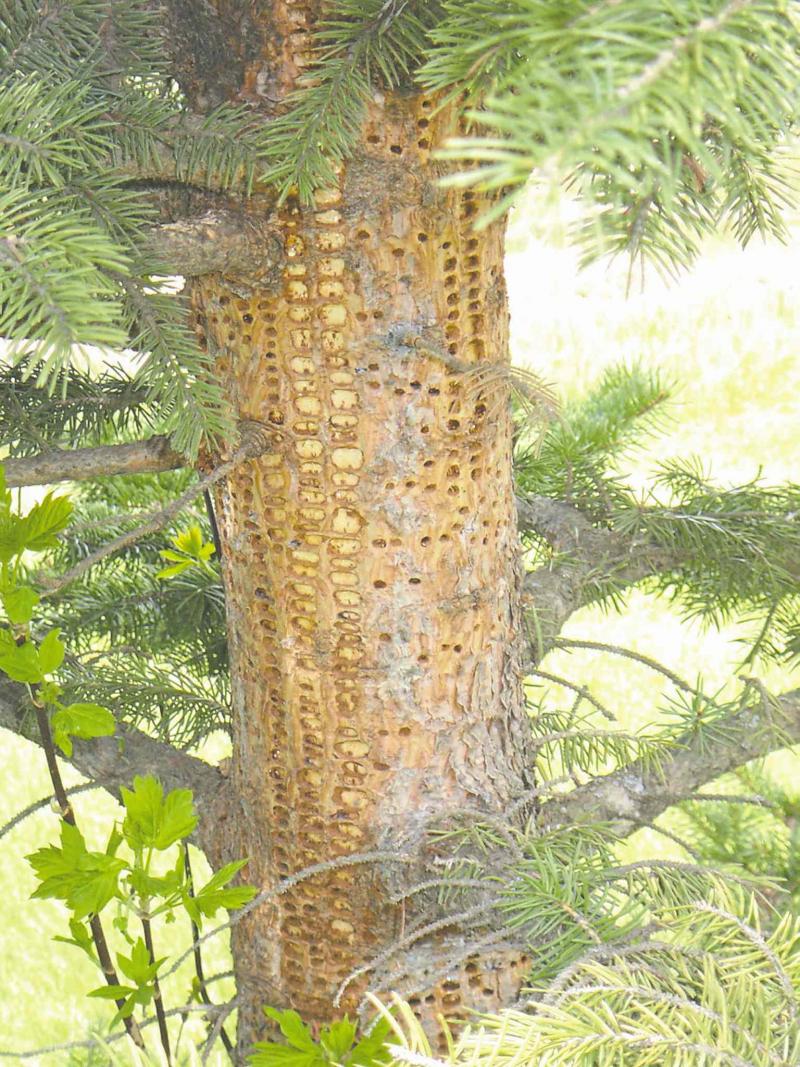
The three-mm hole produced by the Resistograph drill bit is much smaller than the holes made by woodpeckers. Many people have asked me over the years what makes the horizontal rows of holes on the tree bark. The answer is the yellow-bellied sapsucker -- a woodpecker that can be responsible for significant tree damage.
This woodpecker makes two kinds of holes when it is acquiring sap. The most common holes are completely round and quite deep. The holes the woodpecker makes appear in a row usually set out parallel to the ground. They also make shallow rectangular holes so the bird can return and lick the sap flowing out of the tree.
The woodpecker achieves two purposes in making these holes. The first is the fact it likes to lick the sap that comes out of the tree holes. The second is the opportunity for the woodpecker to return to see if there are any insects that have become stuck in the dripping sap. If there are, this becomes a feast for the bird.
Depending upon the number of holes made by this bird throughout the tree, the effect on the tree can be disastrous. The beaks of these birds can spread fungal disease from tree to tree as they peck out the holes. These birds love soft bark tree species such as lindens, basswoods, silver maples and coniferous evergreens such as spruce and pine.
If there are a few holes, they can be sealed with tree-pruning compound. Often, there may be hundreds of holes along sections of the entire tree.
The previous treatment would then be totally impractical. For shade trees, their holes do not cause too many problems; however, for coniferous evergreens, the holes can readily be infected with a non-treatable fungal disease call Cytospora canker. This disease will weaken the tree over a number of years, and severe infections can lead to the death of many branches, or even to the death of the entire tree.
Woodpeckers are a protected bird in Manitoba, and they cannot be killed. There are harmless ways to scare off the birds. Hanging many shining pieces of foil paper or old CD discs will often scare off the birds, especially if they have been a nuisance to your trees in the past.
Typically, they migrate in our area on their way north during April and May. The sapsucker woodpecker is unique among woodpeckers, so enjoy them when you can, especially in the early mornings.
Michael Allen M.Sc.F., RPF (ret'd) is a consulting urban forester, tree diagnostician and certified arborist. He owns Viburnum Tree Experts. He makes house and garden visits, diagnoses problematic and hazardous trees, and can be reached at 204-831-6503 or 204-223-7709. His new book, 'Dr. Tree's Guide to the Common Diseases of Urban Prairie Trees' provides detailed information about prairie tree problems.