Michael Allen / Winnipeg Free Press
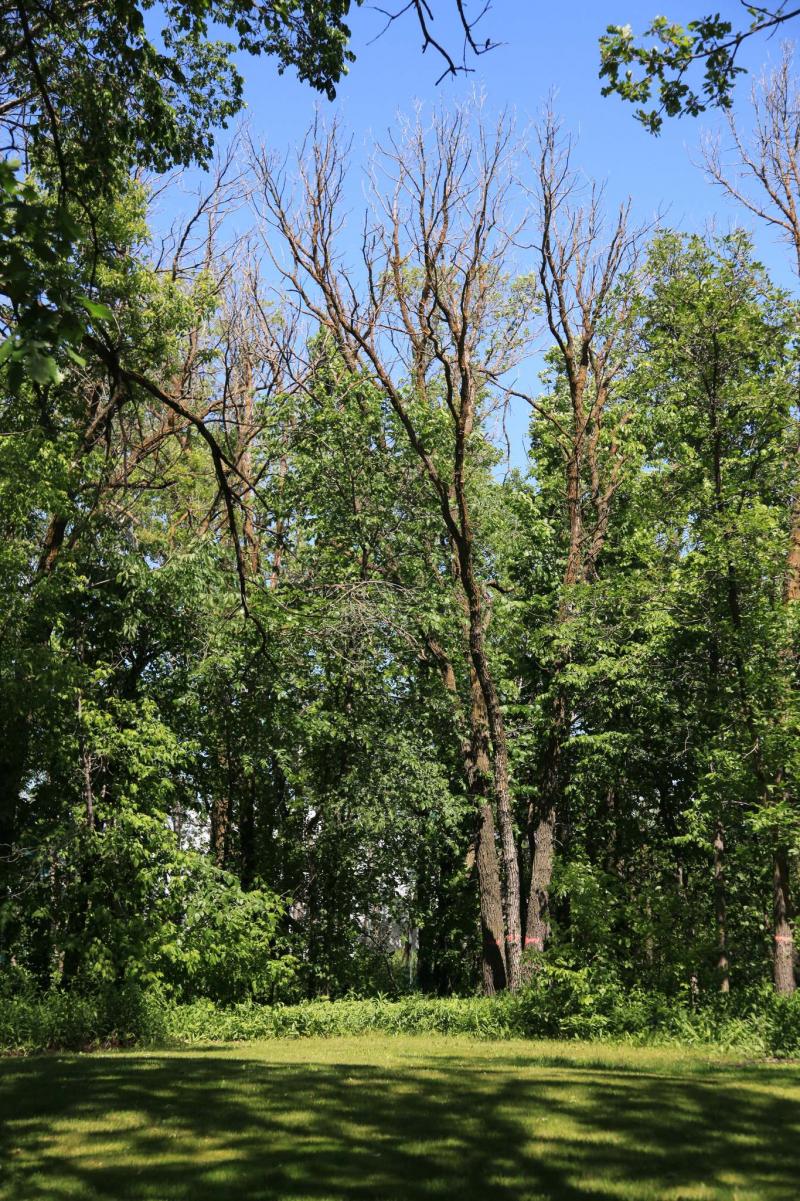
Advanced damage done by two lined chestnut-borer is evident in this oak tree.
In the past, I have written articles on the ongoing problems bur oak trees are experiencing. I am definitely seeing a worsening of the oak situation in southern Manitoba on the basis of the volume of calls and visits I have made to see stressed oak trees this year.
The activity of the two-lined chestnut borer is spreading everywhere, including the woodland adjacent to where I live.
I first discovered the feeding activity of this insect in oak trees in River Heights in 1990, when I was the city forester. Nearly 25 years later, the evidence of this insect’s feeding destruction has become very widespread. Many previously healthy oaks that are more than a hundred years old are dying.
The loss of these oaks is often exacerbated by construction near the roots, overland drainage towards the roots and road salt, especially along rural highways and secondary roads.
Because there are no chemical insecticides registered in Manitoba to stop or treat this borer’s infestation, owners of oak trees need to stop the spread of the infestation before it starts by taking the following steps.
First of all, you need to know how this insect operates. The feeding normally starts at the very top of the tree. In each subsequent year, the feeding activity progresses through the upper branches down the tree. Usually, there will be a distinct pattern of dead branches across the top of the tree, but this pattern can vary. Adult female beetles lay their eggs in late spring through early summer on the bark. The eggs hatch into thin, white, segmented larvae (they have a grub-like appearance) that bore their way into the bark to start their feeding activity in the living cambial cells.
At the first recognizable signs of this feeding cycle at the very top of the tree, the owner of the tree will want to hire a licensed Manitoba arborist and experienced tree climber who is knowledgeable about the control of this insect. The arborist must prune out the dead branches as well as infested branches below the dead branches. Those infested branches will likely be growing green leaves at first, but there will be evidence of the borer’s feeding activity to a knowledgeable arborist.
After one year in the tree, the adult borer chews a D-shaped hole to exit the tree. Skilled arborists need to find these holes to determine where the last feeding activity occurred. They can also scrape the bark off nearby small branches to see if there are any larval galleries (feeding areas) in the wood.
Advanced feeding behaviour showing extensive dead branches cannot be controlled; the insect is too entrenched in the wood.
Oak firewood piles or abandoned pieces of oak lumber are ideal attractants for the borer. They will breed in these woodpiles. Oak wood should be covered with a tarp or removed, especially if it is stacked near oak trees. The two-lined chestnut borer is a very small insect that spends most of its life inside the tree, making photographing it virtually impossible. The damage it causes is certainly visible.
This insect is a sister beetle of the emerald ash borer, which is devastating ash trees in Minneapolis and in eastern regions of Canada and the United States. Fortunately, the emerald ash borer is not known to be present in Manitoba.
There is no registered control product approved for the control of the two-lined chestnut borer beetle in Manitoba. There is a product registered in the U.S. for the control of the emerald ash borer. This product is registered in North Dakota for the two-lined chestnut borer, but it cannot legally be used in Manitoba.
Keeping oak trees healthy can be very difficult, especially in dense forest stands where adverse effects of drainage are weakening and ultimately killing the trees. The two-lined chestnut borer will simply take advantage of these stressful situations, significantly killing those stressed trees and, unfortunately, nearby healthy ones, too.
Michael Allen M.Sc.F., RPF (ret’d) is a consulting urban forester, tree diagnostician and certified arborist. He owns Viburnum Tree Experts. He can be reached at 204-831-6503 or 204-223-7709.
viburnumtrees@shaw.ca